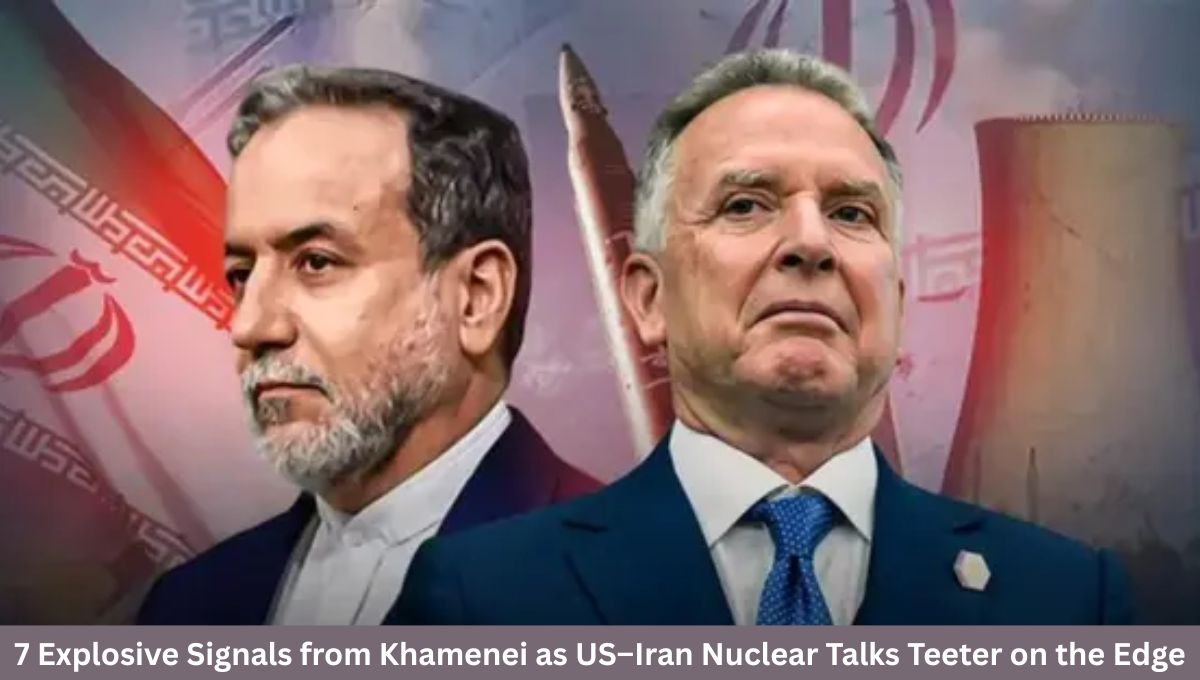
7 Explosive Signals from Khamenei as US–Iran Nuclear Talks Teeter on the Edge — The world’s most dangerous diplomatic standoff. As indirect nuclear negotiations between Iran and the United States resume in Geneva, the diplomatic choreography is unfolding against a backdrop of threats, symbolism, and military signaling.
Iran’s Supreme Leader Ayatollah Ali Khamenei has made it clear that dialogue does not mean détente. Instead, his recent speeches and social media posts reflect a deep skepticism toward Washington’s intentions, even as Iran’s diplomats cautiously signal progress on “guiding principles” for a potential agreement.
The contradiction underscores a familiar pattern in US–Iran relations:
tactical diplomacy overshadowed by strategic mistrust.
This article breaks down the seven most critical signals emerging from Khamenei’s rhetoric, Iran’s negotiating posture, and the escalating military dynamics surrounding the talks.
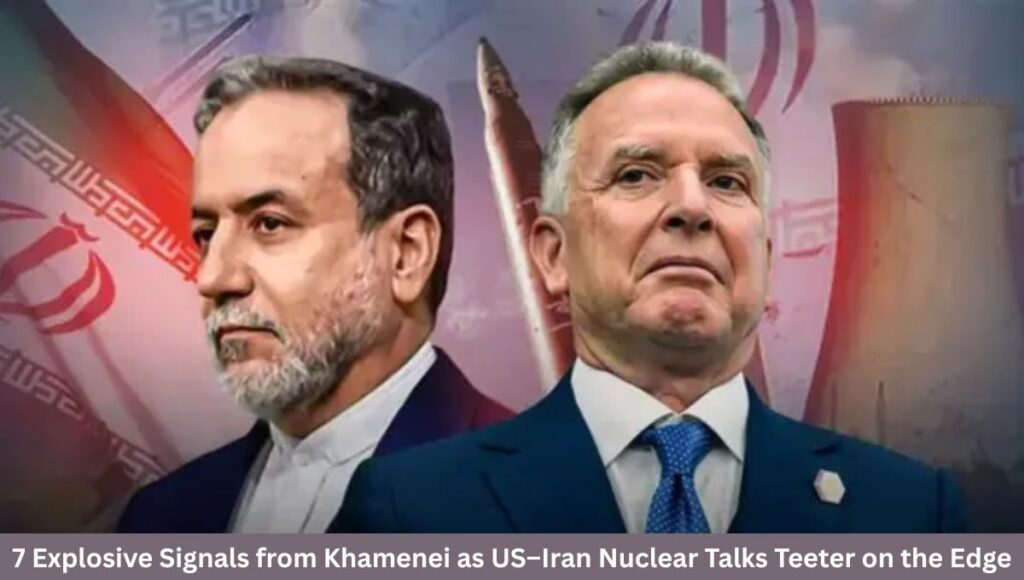
7 Explosive Signals from Khamenei as US–Iran Nuclear Talks Teeter on the Edge
1. Khamenei’s Direct Challenge to Donald Trump
Khamenei’s remarks were notable not only for their substance but for their tone. Responding to comments by Donald Trump, the Iranian leader framed decades of US pressure as a failure.
By invoking the 1979 Islamic Revolution, Khamenei positioned the current standoff as part of a historical struggle rather than a discrete policy dispute.
His message was blunt:
regime change has failed before and will fail again.
This framing matters. It signals to Iranian negotiators—and to Iran’s domestic audience—that talks are a tactical necessity, not a concession of ideological ground.
2. Zero Enrichment: The Unmovable Red Line
One of Khamenei’s clearest interventions concerned uranium enrichment. Washington’s insistence that Iran must move to zero enrichment was dismissed as “foolish” and unrealistic.
Iran maintains that uranium enrichment is a sovereign right under the Nuclear Non-Proliferation Treaty (NPT).
Any agreement that begins with a demand for total dismantlement, Khamenei suggested, is dead on arrival.
This position places Iran fundamentally at odds with the US negotiating stance and ensures that enrichment will remain the most contentious technical issue at the table.
3. Diplomacy via Geneva, Mediation via Oman
The indirect talks in Geneva are being mediated by Badr bin Hamad al-Busaidi, reflecting Oman’s long-standing role as a quiet intermediary between Tehran and Washington.
Iran’s delegation, led by Abbas Araghchi, struck a cautiously optimistic note after the latest round, emphasizing a “constructive atmosphere” and agreement on broad principles.
However, optimism remains tightly constrained. No draft text has been finalized, and no timeline has been announced—both signs that major gaps persist.
4. The IAEA Factor and Nuclear Verification
Any future deal will hinge on verification, placing the International Atomic Energy Agency at the center of the process.
IAEA Director-General Rafael Grossi has held parallel consultations, but the agency faces a credibility challenge.
Access to several Iranian sites has been restricted since recent hostilities, complicating assessments of Iran’s enriched uranium stockpile.
Without robust inspections, sanctions relief—Tehran’s primary objective—will remain politically untenable in Washington.
5. Military Signaling in the Strait of Hormuz
While diplomats met in Geneva, the Islamic Revolutionary Guard Corps conducted live-fire naval drills in the Strait of Hormuz, through which roughly 20 percent of global oil and gas supplies pass.
The symbolism was unmistakable. Iran was reminding global markets—and US military planners—that it possesses escalation tools far beyond the nuclear file.
Temporary closures of shipping lanes during the exercises sent a message that economic consequences could follow diplomatic failure.
6. US Military Buildup and Parallel Crises
The United States, meanwhile, has increased its military footprint in the region, including the deployment of the aircraft carrier USS Gerald R. Ford.
Complicating matters further, Washington’s negotiating team—led by Steve Witkoff and Jared Kushner—is simultaneously engaged in talks related to the Russia–Ukraine war.
Critics argue this dual-track diplomacy risks overstretch, reducing the bandwidth required for technically complex nuclear negotiations that historically take years, not weeks.
7. Sanctions, Economy, and the Rial’s Decline
Behind Iran’s tough rhetoric lies economic vulnerability. US sanctions continue to strangle Iran’s economy, and the rial has hovered near historic lows.
Iranian officials have floated unconventional incentives—joint energy projects, aircraft purchases, even limited US access to Iranian markets—as ways to make a deal more attractive to the Trump administration.
Yet without clarity on enrichment and inspections, such proposals remain aspirational rather than actionable.
Why Optimism Remains Elusive
Experts caution against reading too much into early diplomatic signals. Ali Vaez of the International Crisis Group has pointed out that the 2015 nuclear deal took more than two years of intensive negotiations.
By contrast, the Geneva talks concluded in just a few hours. That brevity suggests either a lack of political patience—or gaps too wide to bridge quickly.
Iran’s Strategic Messaging: Strength Without Closure
Khamenei’s repeated warnings about the ability to “sink” aircraft carriers serve a dual purpose. Internationally, they deter military escalation.
Domestically, they reinforce the narrative that Iran negotiates from a position of strength, not desperation.
Yet this posture also narrows the space for compromise. Supreme Leader approval is essential for any deal, and his rhetoric suggests limited tolerance for concessions perceived as humiliating.
The Global Stakes
For global audiences, the implications extend far beyond Iran and the United States:
- Energy markets remain vulnerable to disruptions in the Strait of Hormuz
- Regional allies fear escalation into a wider Middle East conflict
- Non-proliferation norms face erosion if diplomacy collapses
The world is watching not just what negotiators say in Geneva—but what Khamenei signals from Tehran.
Conclusion: A Path Begun, Not Cleared
The US–Iran nuclear talks have entered a familiar phase:
cautious engagement shadowed by mutual suspicion and military pressure.
While diplomats speak of “guiding principles,” Khamenei’s rhetoric underscores a deeper reality. Iran is willing to talk—but not to yield on sovereignty, enrichment, or security guarantees.
Whether this path leads to a renewed agreement or another dangerous rupture will depend less on Geneva’s conference rooms and more on decisions made at the very top of Iran’s power structure. For now, diplomacy survives—but only just.
Also Read: 7 Explosive Choices Facing Trump as Iran Standoff Nears Breaking Point
Also Read: US, Iran Praise Progress In Nuclear Talks After Trump Threats
Related Posts:
- 11 Explosive Warnings as Trump Vows to ‘Knock the…

- Trump’s 20-Point Gaza Peace Plan Gains Urgent Global…

- 7 Explosive Signals as Hegseth Warns Iran and Trump…
- 7 Dead in Explosive Iran Protests as Economic Anger…

- Afghanistan–Pakistan War 2025: Inside the 48-Hour Ceasefire

- In 8 Moves, EU Targets China-Linked Refineries and…
