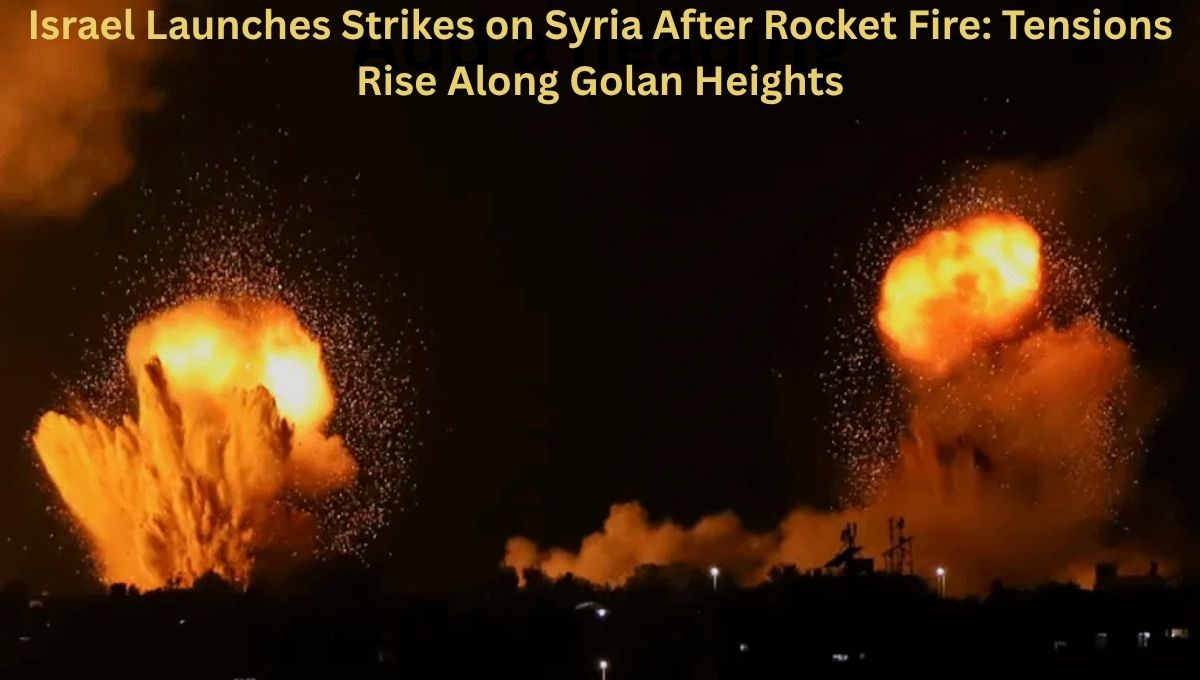
Cross-border tensions reignite as Israel Launches Strikes on Syria After Rocket Fire: Tensions Rise Along Golan Heights. Tensions flared along the Israel-Syria border this week as Israel launched its first airstrikes in nearly a month, in response to two projectiles fired from Syrian territory into open areas of the Israeli-occupied Golan Heights.
While the rockets caused no casualties or structural damage, the Israeli government wasted no time in retaliating, holding interim Syrian President Ahmed al-Sharaa “directly responsible.” The strikes mark a significant escalation and come amid a fragile political climate following the ousting of longtime Syrian leader Bashar al-Assad in late 2024.
Israel Launches Strikes on Syria After Rocket Fire: Tensions Rise Along Golan Heights
Syria Denounces “Blatant Violation of Sovereignty”
In a strongly-worded statement, the Syrian Foreign Ministry condemned the Israeli strikes, calling them a “blatant violation of Syrian sovereignty.” Foreign Minister Asaad al-Shaibani, speaking at a press conference with EU Commissioner Dubravka Šuica, accused Israel of “coordinated provocations” intended to derail Syria’s post-Assad reconstruction and stabilization efforts.
Syrian authorities denied involvement in the rocket launches and emphasized that “Syria has not and will not pose a threat to any party in the region.” Damascus added that the accusations are politically motivated and intended to justify Israeli aggression.
Militant Groups Claim Responsibility for Rocket Attack
Amid conflicting reports, two obscure militant groups have claimed responsibility for the rocket attack on the Golan Heights. A Telegram channel linked to the Martyr Muhammad Deif Brigades named after the Hamas commander killed by Israel in 2024 released a video claiming to show the rockets being launched.
Another group, calling itself the Islamic Resistance Front in Syria, also claimed involvement.
Neither claim has been independently verified by credible sources such as Reuters or AFP. Syrian officials suggested that remnants of Assad-era militias linked to Iran may be responsible, aiming to provoke Israeli retaliation and undermine the current Syrian administration.
Details of the Israeli Strikes
Following the projectile launches, Israeli forces swiftly conducted airstrikes on multiple targets in southern Syria, particularly in the Damascus countryside, Daraa, and Quneitra areas historically known for militia activity and Iranian presence.
According to Syrian state media, the strikes caused “significant human and material losses.” Residents in Wadi Yarmouk, near the Israeli-occupied Golan Heights, reported that Israeli forces also used mortar fire and entered several Syrian villages, restricting local agricultural activity.
One notable target was a former Syrian army base near Izraa, signaling Israel’s continued suspicion toward any remnants of Syria’s military infrastructure, especially under its new leadership.
Israel’s Broader Strategy: Containment and Deterrence
Since the fall of Assad in December 2024, Israel has intensified its military operations inside Syria. According to the Armed Conflict Location and Event Data (ACLED) project, over 200 Israeli air, drone, and artillery strikes have taken place between December 2024 and May 2025 averaging one attack every 3–4 days.
Key focus areas include:
- Daraa: 57 attacks on weapons convoys and suspected militia bases
- Damascus Governorate: 49 strikes, including 18 inside the capital
- Quneitra: 25 operations, primarily targeting surveillance systems
Israel has also reportedly moved ground forces into parts of the U.N.-monitored demilitarized zone, sparking international concern and debates over legal sovereignty.
President Al-Sharaa Calls for Calm Amid Rising Hostility
President Ahmed al-Sharaa, a former Islamist opposition leader, has publicly urged de-escalation. Despite Israeli accusations, Sharaa has maintained that his government seeks peace and reconstruction, not confrontation.
Last month, U.S. envoy Thomas Barrack visited Damascus and proposed a non-aggression agreement between Israel and Syria. While no formal agreement has been signed, the diplomatic dialogue marks a rare moment of engagement between the historically hostile neighbors.
Iranian Militias and Geopolitical Intrigue
Experts argue that Iran-backed militias and rogue factions some of whom operated under Assad’s rule may be exploiting the fragile security situation in southern Syria to stoke tensions.
According to regional analyst Bassam al-Suleiman, a unified Syrian government under Sharaa challenges Israel’s long-standing preference for a fragmented, weakened Syria.
Adding complexity, U.S. President Donald Trump has recently lifted some sanctions on Syria and supported re-engagement between Syria and its neighbors, including Israel.
However, Trump’s strategy remains controversial, with many analysts warning that deep mistrust and territorial disputes will continue to impede normalization.
Golan Heights: The Core of the Conflict
The Golan Heights, seized by Israel from Syria in the 1967 Six-Day War and unilaterally annexed in 1981, remains the most sensitive flashpoint in the region. The latest rocket fire was the first from Syria since Assad’s fall, and although the projectiles landed harmlessly, their political fallout has been significant.
Israel’s policy holds Damascus accountable for any cross-border fire, regardless of whether it originates from state or non-state actors. As new militant groups emerge and existing factions resurface, attributing responsibility grows increasingly complexfurther complicating prospects for long-term stability.
Missile Threat from Yemen Adds to the Pressure
Coinciding with the events in Syria, Yemen’s Iran-aligned Houthi rebels also launched a ballistic missile at Israel, claiming it targeted Tel Aviv’s Jaffa district. The Israeli military intercepted the missile, but the coordinated timing suggests a broader, regional strategy involving Iranian proxies.
The Houthis stated the strike was in solidarity with Palestinians, referencing the ongoing conflict in Gaza, thereby tying the southern front in Syria with wider Middle Eastern fault lines.
Conclusion: Fragile Peace at the Brink
As of now, Israel and Syria are locked in a familiar cycle of accusation and retaliation, with neither side showing clear intent to back down. President Sharaa’s overtures for peace face significant obstacles, from militant spoilers and entrenched suspicions to broader geopolitical interests.
Without meaningful diplomatic breakthroughs and multilateral engagement, the latest confrontation may prove to be just one more chapter in a decades-long conflict defined by mistrust, external interference, and tragic human costs.
The region remains on edge and the world is watching.
Also Read: Syria says Israeli attack on Deraa causes ‘significant’ losses
Related Posts:
- Israel Launches Strikes in Syria to Protect Druze…
- Israel-Syria Ceasefire Begins as Druze-Bedouin…

- Ceasefire in Suwayda Wobbles as Israeli Strikes Hit Syria

- Houthi Prime Minister Ahmed al-Rahawi Killed in…

- 7 Deadly Strikes: US Unleashes Massive Retaliation…
- Trump Meets Syria’s New Leader Ahmad al-Sharaa,…