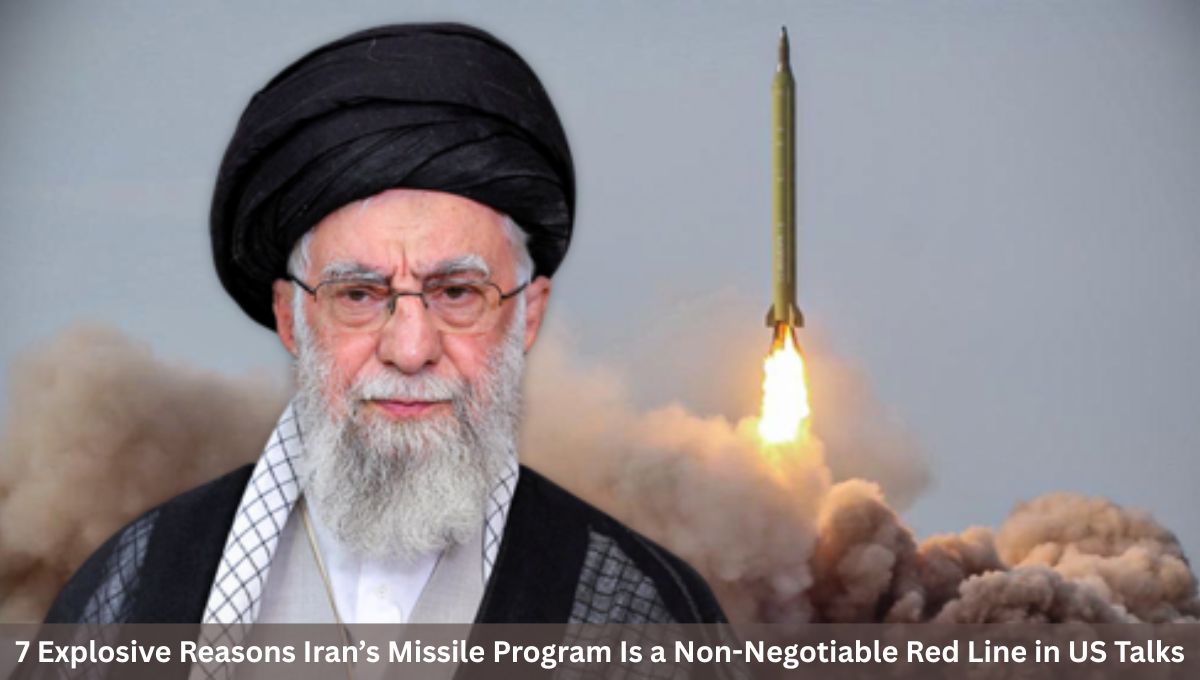
7 Explosive Reasons Iran’s Missile Program Is a Non-Negotiable Red Line in US Talks as Tehran sees its arsenal as core to national defense.
As Iran and the United States cautiously edge toward another round of indirect negotiations, a familiar and formidable obstacle has re-emerged:
Tehran’s ballistic missile program.
Iranian officials have drawn a clear line—one they say cannot be crossed, bargained over, or diluted. “The Islamic Republic’s missile capabilities are non-negotiable,” declared Ali Shamkhani, senior adviser to Iran’s Supreme Leader Ayatollah Ali Khamenei, during events marking the 47th anniversary of the Islamic Revolution.
The message was unmistakable:
while Iran is prepared to discuss nuclear constraints, its missiles remain off the table.
This hardline position comes amid heightened regional tensions, lingering trauma from last year’s brief but deadly war with Israel, and an expanding US military footprint across the Gulf. For Washington, Iran’s missile arsenal is a destabilizing threat. For Tehran, it is the backbone of survival.
Below are the seven key reasons why Iran considers its missile program a red line—and why this stance could define the future of US–Iran diplomacy.
7 Explosive Reasons Iran’s Missile Program Is a Non-Negotiable Red Line in US Talks
1. Missiles as Iran’s Core Deterrence Strategy
Iran’s military doctrine is shaped by one defining reality:
it lacks a modern conventional air force.
Years of sanctions have left Tehran without advanced fighter jets or comprehensive air-defense systems comparable to those of the US or Israel.
In this vacuum, ballistic missiles have become Iran’s primary deterrent.
As Behnam Ben Taleblu of the Foundation for Defense of Democracies put it, Iran’s missiles function like a “Swiss Army knife”—serving purposes of deterrence, coercion, retaliation, and signaling all at once.
From Tehran’s perspective, surrendering missile capabilities would be equivalent to unilateral disarmament in a hostile neighborhood.
2. Trauma of the 12-Day War With Israel
The memory of last year’s 12-day war between Iran and Israel looms large over current negotiations.
The conflict killed hundreds inside Iran and saw unprecedented Israeli and US strikes on Iranian territory, including nuclear-linked facilities.
Although Iran retaliated with missile and drone attacks, the war reinforced a deep-seated belief among Iranian leaders: only credible strike capability prevents future aggression.
Many ordinary Iranians share this fear. Reporting from Tehran, journalists note widespread anxiety that renewed talks could collapse and trigger another conflict—one potentially far deadlier than the last.
3. US Military Bases Within Missile Range
Iran’s insistence on preserving its missile arsenal is not abstract—it is geographically grounded.
Iran possesses an estimated 2,000 ballistic missiles, many capable of striking US military bases across the Middle East.
These include:
Major US Bases Within Range
- Al Udeid Air Base (Qatar) – US Central Command headquarters
- NSA Bahrain – Home to the US Fifth Fleet
- Ain al-Asad Air Base (Iraq)
- Camp Arifjan & Ali Al Salem (Kuwait)
- Al Dhafra Air Base (UAE)
- Prince Sultan Air Base (Saudi Arabia)
With over 50,000 US troops stationed in the region, Iran views its missile reach as a counterbalance to overwhelming American conventional power.
4. Missiles Are Separate From Nuclear Talks—By Design
Iranian officials repeatedly emphasize that missiles were never part of the nuclear negotiations—including the original 2015 nuclear deal (JCPOA).
Foreign Minister Abbas Araghchi has stated unequivocally:
“Iran’s missile program has never been on the agenda.”
From Tehran’s perspective, Washington’s attempt to expand talks to include missiles represents goalpost shifting—and undermines trust already damaged by the US withdrawal from the nuclear deal in 2018.
Iran insists on a single-issue framework:
nuclear limits in exchange for sanctions relief. Anything beyond that, officials argue, is unacceptable.
5. Solid-Fuel Missiles Like Sejjil Change the Equation
Among Iran’s arsenal, the Sejjil missile stands out as a strategic gamechanger.
Why Sejjil Matters
- Range: ~2,000 km
- Fuel: Solid-fuel (quick launch, high survivability)
- Targets: Israel, Gulf bases, regional command centers
- Launch Time: Minutes, not hours
Unlike liquid-fuel missiles, Sejjil can be stored, transported, and launched with minimal warning—making preemptive strikes far less effective.
Iranian officials claim such missiles could reach targets like Tel Aviv within minutes, underscoring their value as a rapid retaliation tool rather than an offensive weapon.
6. Post-War Shift Toward “Offensive Deterrence”
Following last year’s conflict, Iran’s military leadership signaled a doctrinal shift.
Chief of Staff Abdolrahim Mousavi stated that Iran has moved from a purely defensive posture to one emphasizing “crushing responses” and asymmetric warfare.
This does not mean Iran seeks war—but it does mean Tehran wants adversaries to believe that any attack will carry immediate, painful costs.
Ballistic missiles, particularly mobile and solid-fuel systems, are central to this posture.
7. Domestic Politics and Revolutionary Identity
Missiles are not just military assets in Iran—they are symbols of sovereignty and resistance.
During anniversary celebrations in Tehran, Iran showcased ballistic and cruise missiles alongside captured Israeli drones. Protesters waved flags and chanted slogans rejecting US pressure.
For Iran’s leadership, conceding on missiles would be seen domestically as capitulation, undermining revolutionary legitimacy at a time when the country is already grappling with internal unrest and economic strain.
The US Position: Why Washington Keeps Pushing
From Washington’s standpoint, Iran’s missile arsenal threatens:
- US forces in the Gulf
- Israel’s security
- Regional stability
- Global energy routes
President Donald Trump has sent mixed signals—praising early talks while simultaneously threatening military action and deploying additional naval assets.
Israel, meanwhile, continues to lobby aggressively for any deal to include missile limits and curbs on Iran’s regional alliances.
Can Talks Succeed Without Missile Concessions?
This is the central question looming over diplomacy.
Iran believes missiles are defensive, non-negotiable, and essential. The US sees them as offensive, destabilizing, and inseparable from the nuclear issue.
With Qatar and Oman mediating, and regional actors urging restraint, diplomacy remains possible—but fragile.
As one Iranian academic put it:
“It’s absurd to attack a country and then expect it to hand over its main means of defense.”
Conclusion: A Red Line That Defines the Future
Iran’s missile program is more than hardware—it is strategy, psychology, history, and identity rolled into one.
As Tehran and Washington weigh another round of talks, this red line may determine whether diplomacy advances, stalls, or collapses entirely.
One reality is clear:
any deal that ignores Iran’s perception of its own security is unlikely to survive.
Also Read: US B-2 Bombers Strike Iran’s Nuclear Sites: Why Fordow, Natanz, and Esfahan Were Targeted
Also Read: Explainer: What are Iran’s ballistic missile capabilities?
Related Posts:
- 5 Shocking Revelations from Iran’s $1bn Hijab-Free Wedding

- 11 Explosive Warnings as Trump Vows to ‘Knock the…

- 11 Explosive Developments as Iran Warns US Over…
- 7 Dead in Explosive Iran Protests as Economic Anger…

- Trump’s 20-Point Gaza Peace Plan Gains Urgent Global…

- 7 Explosive Signals in a Brutal Showdown: Trump…
