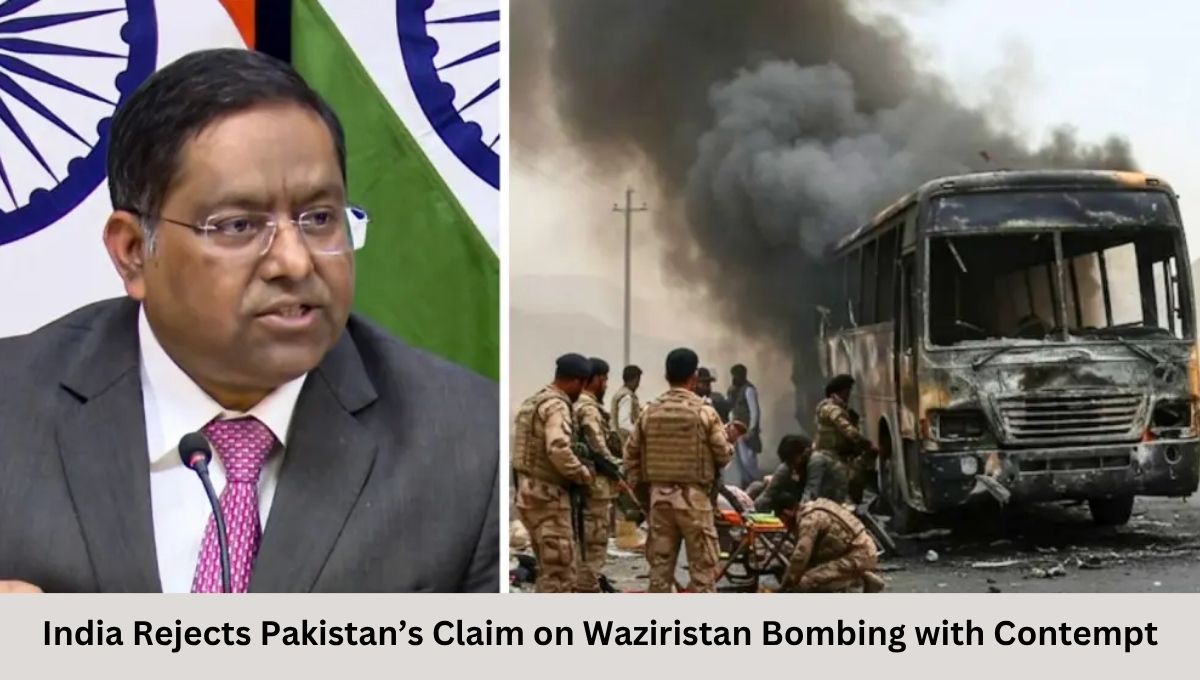
In a deadly suicide bombing attack, India Rejects Pakistan’s Claim on Waziristan Bombing with Contempt. At least 13 Pakistani soldiers lost their lives and nearly 30 others were wounded, including civilians and children, after a suicide bomber rammed an explosives-laden vehicle into a military convoy in the North Waziristan district of Khyber Pakhtunkhwa on Saturday, June 28.
The attack occurred in Mir Ali’s Khadi village, a high-conflict region near the Afghanistan-Pakistan border, and has since been claimed by the Hafiz Gul Bahadur group, a faction affiliated with the Tehrik-i-Taliban Pakistan (TTP)
India Rejects Pakistan’s Claim on Waziristan Bombing with Contempt
Massive Blast with 800 kg of Explosives
Security sources revealed that an estimated 800 kilograms of explosives were used in the suicide bombing, making it one of the deadliest attacks on Pakistan’s security forces in recent months.
The explosion was so intense that it caused the roofs of at least two nearby houses to collapse, injuring six children, according to a police officer cited by AFP.
Wounded Include Soldiers, Women, and Children
Initial local reports state that 13 soldiers were killed, while another 10 soldiers and 19 civilians were injured. Some reports suggest the death toll could be as high as 16.
Among the civilians injured were two children and a woman, highlighting the tragic collateral impact on non-combatants.
Pakistan Blames India Without Evidence
Despite the claim of responsibility by the Hafiz Gul Bahadur group, the Pakistan Army issued an official statement blaming India for orchestrating the suicide attack through proxies.
The accusation was made without presenting any concrete evidence, leading to a swift and strong denial by India.
India Responds: “We Reject the Statement with the Contempt It Deserves”
India’s Ministry of External Affairs (MEA) issued a sharply worded rebuttal on Sunday, stating:
“We have seen an official statement by the Pakistan Army seeking to blame India for the attack in Waziristan on June 28. We reject this statement with the contempt it deserves.”
India emphasized that Pakistan’s habitual blame-shifting diverts attention from its internal security failures and the growing threat posed by militant groups operating freely in its territory.
Violence Surges in Khyber Pakhtunkhwa and Balochistan
This suicide bombing is the latest in a wave of militant attacks that have gripped Pakistan’s tribal regions, particularly Khyber Pakhtunkhwa and Balochistan.
According to AFP, around 290 people, most of them security personnel, have been killed in militant attacks in these provinces since the beginning of 2025.
Pakistan’s Blame Game and Afghan-Taliban Tensions
Islamabad has routinely blamed the Taliban-led government in Afghanistan for harboring terrorist groups like the TTP and its splinter factions.
In response, the Taliban has denied such claims, instead accusing Pakistan of facilitating terrorist safe havens on its own soil.
The rise in violence is seen as a direct consequence of the Taliban’s return to power in Afghanistan in 2021, which led to a resurgence of Pakistani Taliban factions, including the Hafiz Gul Bahadur group.
Hafiz Gul Bahadur Group: A Dangerous TTP Faction
The Hafiz Gul Bahadur group, operating from the rugged tribal regions near the Afghan border, is known for its lethal ambushes and suicide missions.
Security analysts consider it one of the most dangerous splinters of the TTP, with increasing territorial and ideological ambitions.
In March, the group had announced a “spring campaign” against security forces, threatening suicide attacks, ambushes, and targeted strikes. Since then, over 100 attacks have been reported in the region, many attributed to the group.
PM Shehbaz Sharif and General Munir Condemn Attack
Pakistani Prime Minister Shehbaz Sharif condemned the Waziristan bombing as a “cowardly act,” vowing to bring the perpetrators to justice.
Meanwhile, Army Chief Asim Munir warned that any effort to destabilize Pakistan’s internal security would face swift retribution.
In its official narrative, however, the Pakistan Army reiterated its claim of Indian involvement, again without sharing corroborative details.
International Reaction and U.S. Concern
International observers have expressed concern about the deteriorating security environment in the region. U.S. Congressman Bill Huizenga recently noted that Afghanistan has once again become a safe haven for terrorist groups, a trend exacerbated by the 2021 U.S. withdrawal from the region.
In a congressional hearing, Huizenga referenced the rise of ISIS-K and the TTP, labeling them as threats not only to South and Central Asia but to global security as well.
Mortar Shell Attack Adds to Civilian Casualties
In a separate but equally tragic incident, a mortar shell hit a house in Kurram district, another area of Khyber Pakhtunkhwa, injuring 14 people, including five children.
The origin of the mortar shell remains unclear, and an investigation is underway.
The Geopolitical Fallout: Accusations, Denials, and Proxy Warfare
The fallout from the Waziristan suicide attack underscores the fragile and hostile relationship between India and Pakistan, where proxy warfare and cross-border allegations often take precedence over diplomatic engagement.
While Pakistan continues to accuse India of sponsoring terrorism on its soil, India maintains that Pakistan should focus on eliminating militant sanctuaries within its own borders rather than deflecting blame.
Conclusion: Dangerous Escalation in a Volatile Region
The Waziristan suicide bombing is a grim reminder of the volatile state of Pakistan’s western frontier and the dangerous gamesmanship unfolding between India and Pakistan. The use of such attacks as political leverage only deepens mistrust, making peace and security a distant prospect in South Asia.
Until Pakistan addresses its internal security breakdowns and reins in militant factions, and until both nations commit to transparent dialogue over inflammatory accusations, the cycle of violence is likely to persist.
Also Read: Taliban Claims Waziristan Suicide Bombing As Pakistan Blames India
Also Read: Rajnath Singh Slams Pakistan at SCO Meet, Calls for United Stand Against Terror
Related Posts:
- Pakistan–Afghanistan Conflict: 10 Civilians Killed…

- Pakistan–Afghanistan Border Conflict 2025: Ceasefire…

- 7 Alarming Signs of Escalation as Pak-Afghan…

- Afghanistan–Pakistan Border Clashes 2025: Key Facts…

- 12 Killed in Powerful Islamabad Court Blast Amid…

- Afghanistan–Pakistan War 2025: Inside the 48-Hour Ceasefire
