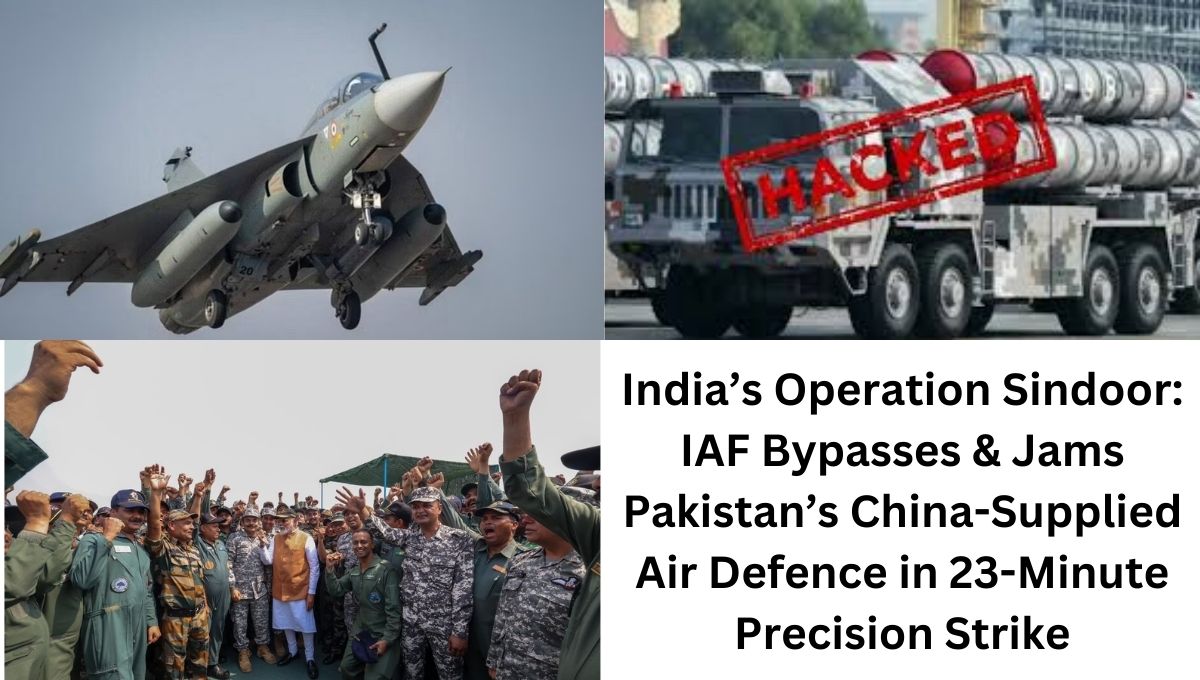
In a major development that has sent ripples across global defence circles is India’s Operation Sindoor: IAF Bypasses & Jams Pakistan’s China-Supplied Air Defence in 23-Minute Precision Strike. India’s Operation Sindoor marks a strategic military success, with the Indian Air Force bypassing and jamming Pakistan’s Chinese-made air defence systems in under 23 minutes. Here’s how India executed the precision strike using indigenous technology.
India’s Operation Sindoor: IAF Bypasses & Jams Pakistan’s China-Supplied Air Defence in 23-Minute Precision Strike
India’s Rapid and Tactical Strike: The Success of Operation Sindoor
India revealed the successful execution of Operation Sindoor, a highly strategic military response targeting Pakistan’s terror infrastructure.
What makes this operation a historic milestone is the fact that the Indian Air Force (IAF) jammed and bypassed Pakistan’s Chinese-supplied air defence systems, including the HQ-9, and completed its mission in just 23 minutes.
India’s Retaliation to the Pahalgam Terror Attack
The operation came in response to the April 22 terrorist attack in Pahalgam, Jammu and Kashmir, where 26 civilians, including tourists, were killed.
India’s response, according to the government statement, was “deliberate, precise, and strategic,” and it notably did not cross the Line of Control (LoC) or international boundary.
IAF Jammed Chinese HQ-9 Systems with Precision
The government’s statement underlined that the IAF’s loitering munitions and long-range drones played a key role in the strike, neutralizing high-value military targets including enemy radar, missile systems, and airbases at Noor Khan and Rahimyar Khan.
These “kamikaze drones” hovered over designated targets and delivered surgical blows with devastating accuracy.
Crucially, the statement emphasized that India’s indigenous electronic warfare and drone systems jammed Pakistan’s China-made HQ-9 defence systems, rendering them ineffective.
All Indian Assets Safe: A Sign of Strategic Superiority
Despite the complexity and speed of the operation, India confirmed “no loss of Indian assets,” a testament to superior surveillance, planning, and execution.
The operation showcased India’s ability to combine advanced surveillance systems, real-time targeting, and indigenous weaponry in a coordinated, high-precision attack.
India’s Indigenous Defence Technology Takes Centre Stage
One of the most significant takeaways from Operation Sindoor is the prominent role of Indian-made defence systems. Battle-tested platforms like the Pechora, OSA-AK, and LLAD guns, along with the indigenous Akash missile system, performed admirably.
In addition, India’s Integrated Counter-UAS Grid and layered air defence network effectively intercepted and destroyed incoming Pakistani drones and missiles, including PL-15 missiles of Chinese origin and Turkish UAVs named ‘Yiha’ or ‘Yeehaw’.
Concrete Evidence of Destroyed Foreign-Supplied Weaponry
India has recovered and forensically verified fragments of these foreign-made systems, underlining the success of Indian countermeasures.
The Press Information Bureau (PIB) reported that remnants of PL-15 missiles, quadcopters, and commercial drones used by Pakistan were recovered and analyzed.
This highlights how Pakistan’s reliance on imported weaponry fell short against India’s domestically-developed defence ecosystem.
ISRO’s Crucial Role in Supporting Operation Sindoor
India’s space agency, ISRO, also played a critical role in Operation Sindoor. According to ISRO Chairman V. Narayanan, at least 10 satellites were dedicated to support national security, providing real-time intelligence and surveillance data that enabled India’s rapid military precision.
Global Ripple Effect: Chinese Defence Stocks Fall
India’s successful military response had financial ramifications beyond the battlefield. The shares of Avic Chengdu Aircraft, the Chinese manufacturer of the J-10 fighter jets used by Pakistan, plunged over 11.5% in three trading sessions following PM Narendra Modi’s strong message against terrorism.
The Prime Minister declared that “terror and trade, terror and talks cannot go together,” asserting India’s tough stance. In stark contrast, Indian defence stocks surged, signaling growing investor confidence in India’s indigenous defence sector.
PM Modi Declares “New Normal” in Anti-Terror Strategy
Speaking to the nation, Prime Minister Narendra Modi described Operation Sindoor as a “new normal” in India’s response to terrorism. “We will not succumb to nuclear blackmail. Our operations are only in abeyance; their future depends on Pakistan’s behaviour,” he warned.
PM Modi further stated, “The world saw how Pakistan’s drones and missiles fell like straws in front of India. India’s strong air defence system destroyed them in the sky itself.”
Conclusion: Operation Sindoor Signals a Strategic Shift
Operation Sindoor is not just a military victory—it’s a strategic declaration of India’s technological and tactical edge in regional defence.
From jamming enemy radars to deploying homegrown missiles, drones, and AI-backed warfare systems, India has asserted its position as a high-tech military power.
This operation will likely influence future policy, defence partnerships, and India’s standing on the global stage.
As terrorism and foreign interference continue to threaten regional stability, India’s swift and calibrated response has set a new benchmark for precision warfare without escalation.
For more such in-depth stories, visit [The News] – your trusted source for critical national and global developments.
Also Read: Operation Sindoor: India Strikes 9 Terror Bases in Historic Tri-Services Offensive
Also Read: Jammed air defence, mission over in 23 minutes: How India struck Pak bases
Related Posts:
- 7 Powerful Signals as India Joins G7 Critical…

- 5 Key Signals from PM Modi’s Virtual ASEAN Summit Appearance

- US Revokes Sanctions Waiver for Iran’s Chabahar…

- India-EFTA Free Trade Agreement Comes Into Force:…

- 7 Shocking Details: 13-Year-Old Executes Man Before…

- 7 Powerful Reasons Russia Is Backing India’s BRICS…