Celebrating quirky Science: From Zebra-Striped Cows to Pizza-Loving Lizards: Inside the 2025 Ig Nobel Prizes. Every year, the Ig Nobel Prizes shine a spotlight on research that is both bizarre and brilliant — the kind of science that makes you laugh first, then think deeply afterward. The 35th annual Ig Nobel Prize awards, held at Boston University and webcast globally, once again delivered an evening of humor, science, and inspiration.
This year’s theme was “digestion”, and the ceremony lived up to its reputation with quirky research, mini-operas, and even paper airplane salutes from the audience. The winners ranged from scientists who painted cows to look like zebras, to biologists studying pizza-loving lizards, to researchers experimenting with whether eating Teflon could bulk up food without adding calories. Let’s take a closer look at the funniest, oddest, and most thought-provoking Ig Nobel Prize 2025 winners.
From Zebra-Striped Cows to Pizza-Loving Lizards: Inside the 2025 Ig Nobel Prizes
What Are the Ig Nobel Prizes?
The Ig Nobel Prizes, presented by the Annals of Improbable Research, are a parody of the prestigious Nobel Prizes. They honor genuine scientific studies that seem silly at first but carry important insights beneath the humor.
The awards celebrate research across disciplines including physics, chemistry, biology, psychology, literature, and even engineering. The goal, as founder Marc Abrahams explains, is simple:
“Every Ig Nobel prize winner has done something that first makes people laugh, and then makes them think.”
This year’s winners once again proved that science can be curious, fun, and deeply impactful.
Zebra-Striped Cows: A Buzz-Free Breakthrough
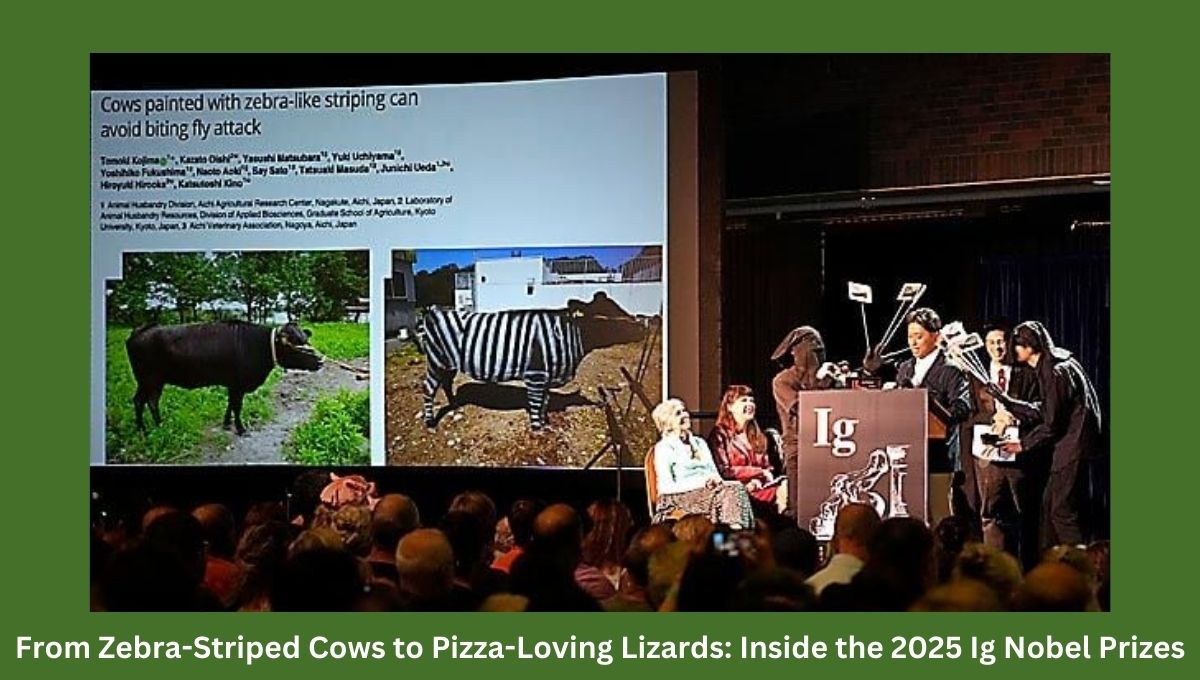
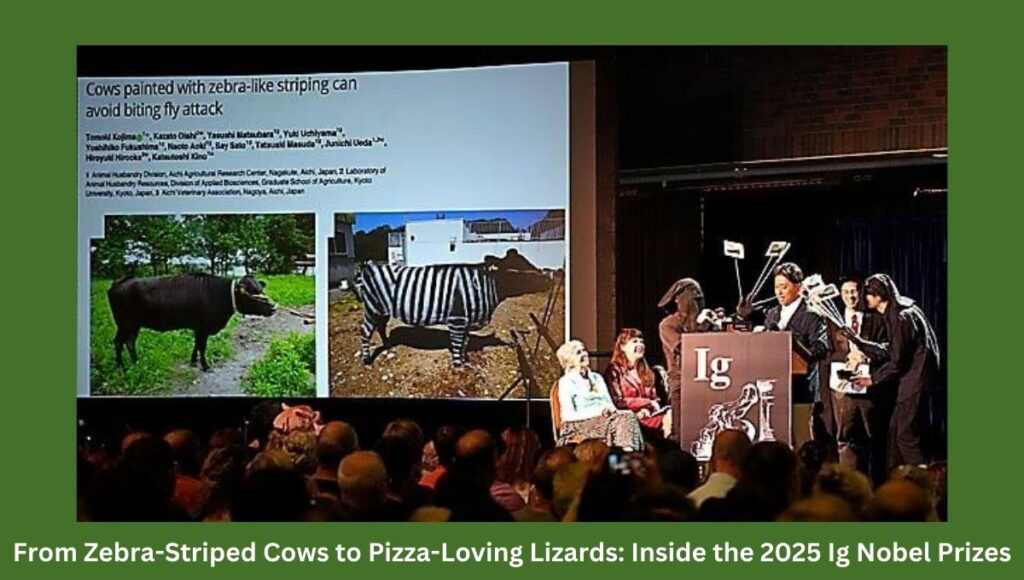
One of the most talked-about awards went to Japanese researchers who discovered that painting cows with zebra-like stripes dramatically reduced the number of insect bites they suffered.
- How it worked: White stripes were painted on black cows using water-based paint.
- The result: The zebra-painted cows endured 50% fewer horsefly bites compared to unpainted cows.
- The theory: Stripes may disrupt how flies perceive polarized light, confusing their ability to target the animals.
Lead researcher Tomoki Kojima, who attended the ceremony in a zebra-print shirt, said the recognition was both surprising and gratifying. His team’s work could help reduce pesticide use and improve livestock welfare.
Given that blood-sucking insects cost the cattle industry billions annually, this lighthearted experiment could have serious economic and environmental benefits.
Pizza-Loving Lizards: A Taste for Four-Cheese
Another prize-winning study came from researchers in Togo, who asked an unusual but surprisingly insightful question: What kind of pizza do rainbow lizards prefer?
- The team discovered that four-cheese pizza was their top choice.
- The findings highlighted how human activity and discarded foods can influence the behavior of local wildlife.
By studying how animals adapt to urban and tourist environments, the researchers shed light on ecological interactions — all while giving us one of the funniest headlines of the year: Pizza-loving lizards take Ig Nobel Prize.
The Curious Case of Teflon Food
In the chemistry category, researchers Rotem Naftalovich, Daniel Naftalovich, and Frank Greenway explored whether eating Teflon, the non-stick material found on cookware, could be used to bulk up food volume without adding calories.
- The idea: Teflon would pass through the digestive system without breaking down, theoretically making people feel fuller without consuming extra energy.
- The result: While fascinating in theory, the U.S. Food and Drug Administration was not impressed by the “wonky” concept.
The project may sound absurd, but it underscores the lengths scientists go to in exploring nutrition, satiety, and public health challenges like obesity.
Pasta Sauce Physics: Avoiding the Clump
Italian researchers scooped up the physics prize for studying the tricky behavior of cacio e pepe pasta sauce.
- The problem: Cheese and pepper sauce tends to clump and separate at certain points during cooking.
- The solution: By analyzing the sauce’s physical properties, the team figured out when and how clumping occurs, offering tips for smoother, creamier pasta dishes.
Beyond the humor, this research touches on food science, molecular interactions, and the physics of emulsions — useful knowledge for chefs and food technologists alike.
Garlic-Flavored Milk: Babies Don’t Mind
The pediatrics prize went to Julie Mennella and Gary Beauchamp, who studied how maternal diet affects the flavor of breast milk.
Their research showed that when mothers ate garlic, their breast milk developed a garlic aroma. Surprisingly, babies seemed to enjoy nursing more when the flavor was present.
The study provides insight into how early flavor experiences may shape taste preferences later in life.
Fingernail Growth: A 35-Year Study
The literature prize was awarded posthumously to William B. Bean, who meticulously recorded and analyzed the growth of one of his fingernails for 35 years.
Though seemingly eccentric, the data helped scientists better understand long-term biological processes and human physiology.
Narcissists and Intelligence Compliments
In the psychology category, Marcin Zajenkowski and Gilles Gignac examined what happens when you tell narcissists — or anyone, really — that they’re intelligent.
Their findings added to the body of knowledge on self-perception, personality, and the psychology of flattery.
Alcohol, Language, and Drunken Bats
Two different prizes connected alcohol to unusual effects:
- Peace Prize: Awarded to researchers who tested whether drinking alcohol improves foreign language ability. The results showed a mild boost in confidence and fluency — at least in Dutch.
- Aviation Prize: A team studying fruit bats discovered that alcohol consumption impaired both their ability to fly and to use echolocation. In short, bats can get tipsy just like humans, with similar side effects.
Stinky Shoes and Engineering
From India, Vikash Kumar and Sarthak Mittal won an engineering design award for investigating how foul-smelling shoes affect the usability of a shoe rack.
Though comical, the study highlights everyday ergonomic and design challenges that impact consumer experiences.
Quirky Ceremony Traditions
As always, the Ig Nobel ceremony was filled with lighthearted traditions and theatrical flair:
- Paper airplanes rained down from the audience.
- A mini-opera titled “The Plight of the Gastroenterologist” was performed.
- Researchers gave 24-second lectures about their work, some with props like ice cream cones.
- If a winner’s speech dragged on, a man in a dress interrupted with the cry: “Please stop. I’m bored.”
This year, instead of the classic Zimbabwean trillion-dollar bill, winners received a wet wipe — a nod to inflation and perhaps the digestion theme.
Why Silly Science Matters
While many of the winning studies sound eccentric, experts argue that such curiosity-driven research is vital.
Biologist Carly York emphasized that:
- Nearly half of U.S. economic growth stems from curiosity-driven science.
- Breakthroughs like DNA sequencing technology originated from basic research that once seemed obscure.
- Budget cuts to organizations like the National Science Foundation risk sidelining this kind of exploration.
In short, the Ig Nobels remind us that playful science often lays the groundwork for serious discoveries.
A Tradition of Laughter and Thought
Since their founding, the Ig Nobel Prizes have balanced humor with insight. As Marc Abrahams puts it:
“Every great discovery ever, at first glance seemed screwy and laughable. The same is true of every worthless discovery. At the very first glance, who really knows?”
The 2025 ceremony once again highlighted how absurd-sounding experiments can lead to real-world benefits, whether in animal welfare, food science, or human health.
Final Thoughts
From zebra-striped cows that dodge flies to rainbow lizards with a taste for pizza, the Ig Nobel Prize 2025 winners prove that science can be strange, funny, and profoundly meaningful all at once.
These quirky projects are more than just jokes — they challenge assumptions, spark curiosity, and remind us that the pursuit of knowledge often begins with a laugh. Whether it’s Teflon food, garlic milk, or drunken bats, the Ig Nobels show us that no idea is too odd to explore. And in that playful spirit lies the very essence of scientific discovery.
Also Read: Nobel Peace Prize 2025 awarded to Venezuela’s María Corina Machado
Also Read: Chemistry Nobel Prize 2025: Groundbreaking Discoveries