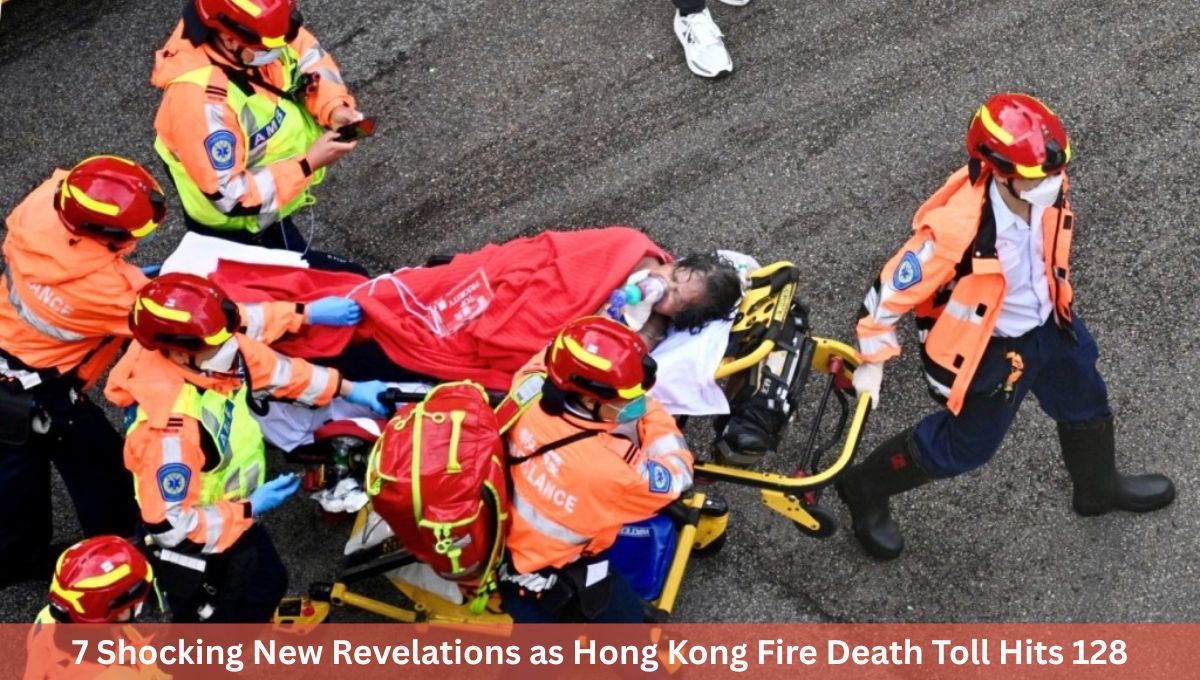
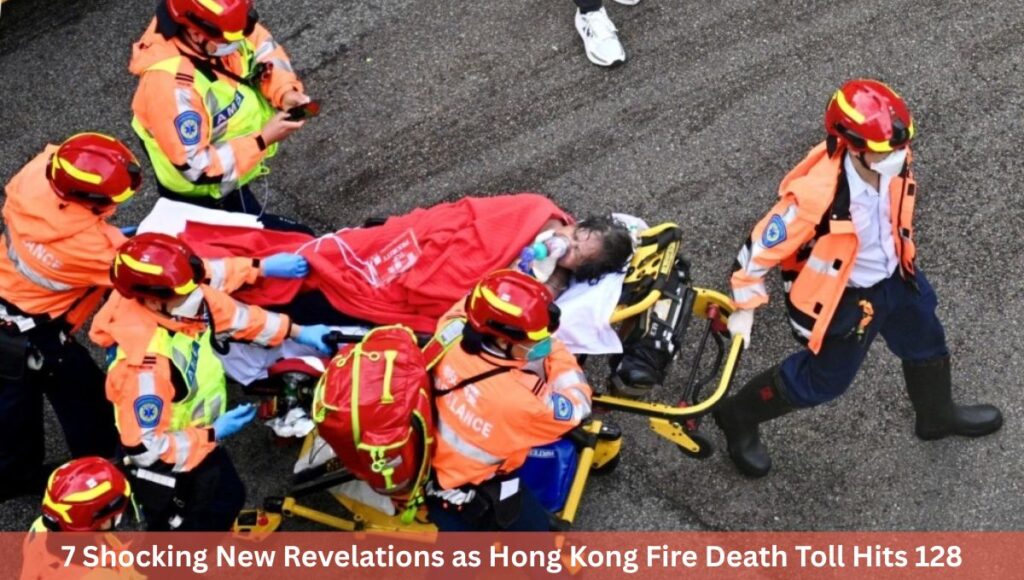
7 Shocking New Revelations as Hong Kong Fire Death Toll Hits 128 with over 200 missing.Hong Kong has entered three days of official mourning as the death toll from the city’s deadliest fire in nearly eight decades rose to 128, with more than 200 people still unaccounted for after an inferno tore through the Wang Fuk Court public housing estate in Tai Po.
The disaster, which spread across seven of the estate’s eight 32-storey towers, has triggered intense scrutiny of Hong Kong’s construction and fire safety standards, the city’s reliance on bamboo scaffolding, and apparent negligence in renovation works. Authorities have launched sweeping criminal investigations, with 11 arrests made so far—including directors, engineering consultants, and subcontractors involved in the renovation project.
Flammable styrofoam, non-compliant scaffolding nets, and exposed bamboo structures have emerged as critical factors in the rapid spread of the blaze. As rescue operations conclude and the city mourns the victims, Hong Kong faces mounting questions about accountability, safety oversight, and systemic weaknesses that allowed such a catastrophe to unfold.
7 Shocking New Revelations as Hong Kong Fire Death Toll Hits 128
A City in Mourning After Its Worst Fire Since 1948
The devastating blaze, first reported at 2:51 p.m. on Wednesday, escalated into a towering inferno within minutes, engulfing seven blocks and trapping thousands of residents inside flats, corridors, lifts, and stairwells.
The government confirmed:
- 128 dead, including a firefighter
- 79 injured, among them 12 firefighters
- Around 200 residents unaccounted for
- 56 people still hospitalised
- 391 fire engine sorties and 185 ambulance deployments
Hong Kong Chief Executive John Lee Ka-chiu ordered city-wide inspections of public housing estates undergoing major renovations, saying the disaster revealed “deep concerns” about material safety and renovation oversight.
President Xi Jinping also expressed condolences, urging “all-out efforts” to minimise further casualties.
Timeline of the Inferno — How the Blaze Spread in Minutes
Fire ignites on bamboo scaffolding
According to preliminary findings, the fire began on the lower-level perimeter nets outside Wang Cheong House, one of the eight blocks undergoing extensive renovation since July 2024. The scaffolding wrapped the entire building in bamboo poles and green protective mesh—a combination firefighters now describe as “highly combustible under intense heat.”
Styrofoam boards fuel the disaster
Officers discovered flammable styrofoam boards sealing lift windows and other exterior openings on every floor. These boards, allegedly installed by renovation contractors, acted like “vertical fuel channels,” allowing flames to leap rapidly up the building façade and burst into flats.
Officials said both the foam and the netting failed fire safety standards.
Winds, mesh, and bamboo create a ‘perfect storm’
As flames climbed the outer scaffolding, burning sections of bamboo poles fell to lower floors and neighboring blocks, setting off fresh fires. Within minutes, seven towering structures were engulfed, creating one of the most frightening urban firestorms in Hong Kong’s history.
Eleven Arrests and Widening Criminal Probe
Hong Kong’s Independent Commission Against Corruption (ICAC) confirmed the arrest of 11 individuals linked to the renovation project, including:
- Two directors of Will Power Architects
- Directors and senior staff of Prestige Construction & Engineering Co.
- Engineering consultants
- Scaffolding subcontractors
- Project managers
Three senior staff members of Prestige Construction, including two directors, were arrested on suspicion of manslaughter.
Police said the suspects may have shown “gross negligence” by using prohibited materials and unsafe design methods such as:
- Installing styrofoam window seals
- Using non-compliant scaffolding nets
- Allowing bamboo poles without fire barriers
- Failing to ensure emergency exits and alarms remained operational
Documents, computers, and phones were seized from company offices in a broadening investigation expected to take three to four weeks.
Fire Alarms Failed—Residents Received No Warning
Survivors described scenes of chaos as thick smoke filled corridors, lights failed, and alarms did not sound. Many residents said they received no early warning, a problem officials attribute to renovation-related tampering with fire safety systems.
One survivor who lived on the 19th floor said:
“There was no alarm, no announcement. Just black smoke suddenly filling the corridor. We ran.”
As firefighters forced their way into apartments, they found multiple families who had died in groups—parents shielding children, elderly residents trapped near windows, and domestic workers unable to escape from locked employer homes.
Domestic Workers Among the Casualties
The blaze struck a community home to hundreds of foreign domestic workers from the Philippines, Indonesia, Nepal, and Sri Lanka.
A Philippine support organisation reported that 19 Filipino workers remain unaccounted for, while Indonesia confirmed at least two deaths among its nationals.
Because domestic helpers often live in employer flats, many were trapped behind locked gates and window grilles.
Pets and Animals—92 Recovered, Many Still Missing
The Society for the Prevention of Cruelty to Animals (SPCA) confirmed that of 243 pets believed to be inside the estate during the fire:
- 92 animals have been recovered
- Many others remain missing
- Survivors include dogs, cats, rabbits, and tortoises
Heartwarming moments surfaced as pets were reunited with their owners. One viral moment showed a couple embracing their rescued dog outside the charred estate.
However, rescuers also discovered numerous deceased animals as they searched burnt-out flats.
Viral Video Suggests Cigarette Sparked Blaze—Authorities Cautious
A video posted by RT India, showing workers smoking near the building’s exterior moments before the fire, has ignited controversy.
The clip alleges a cigarette may have caused the blaze. Authorities have neither confirmed nor dismissed the claim.
Security chief Chris Tang stressed:
“The official cause has not been determined. We are reviewing all evidence.”
But multiple experts say the highly flammable materials used in the renovation—not merely the ignition source—turned a spark into a deadly firestorm.
Bamboo Scaffolding Under National Scrutiny
Hong Kong is one of the few modern cities still using bamboo scaffolding, a centuries-old method valued for its flexibility and cost-effectiveness. However, the fire has intensified debate over its safety in densely populated high-rise environments.
Why bamboo scaffolding is risky
- Bamboo is combustible
- Strong winds can fan flames through scaffolding
- Protective mesh can trap heat
- Foam insulation or cladding can ignite easily
Since 2018, scaffolding-related incidents have caused 23 deaths.
The Development Bureau previously suggested transitioning to metal scaffolding, but adoption has been slow due to higher costs. Officials now say a large-scale policy shift is “imperative.”
Survivors Take Refuge in Shopping Malls
Hundreds of evacuated residents chose to sleep in the nearby Plaza Tai Po shopping mall, turning the premises into a temporary shelter. Families camped on mattresses and inside tents as volunteers distributed food, blankets, masks, and hygiene supplies.
Residents said they avoided government shelters because:
- They wanted to stay close to the estate
- They preferred to leave shelters for those most in need
- They feared losing contact with missing family search teams
The tragedy has stirred unease in one of the world’s most crowded cities, where aging buildings, renovation delays, and cramped living conditions amplify public frustration.
Government Response: Relief Funds and Emergency Assistance
The Hong Kong Special Administrative Region (HKSAR) government has announced multiple relief measures:
- HK$200,000 condolence payment per victim
- HK$50,000 living allowance per affected household
- HK$10,000 emergency cash grant
- A new HK$300 million relief fund for survivors and families
Beijing has also made significant offers of support, highlighting the national-level attention the disaster has drawn.
International Condolences — Pope Leo XVI Prays for Victims
The Vatican issued a message of condolence, with Pope Leo XVI expressing deep sadness at the loss of life.
In a telegram to Cardinal Stephen Chow, the Pope wrote that he was praying for:
- The injured
- Families of the deceased
- Emergency workers
- Survivors still searching for loved ones
He invoked blessings of “strength, consolation, and peace” at a moment of profound grief for the city.
Rescue Operations End, But Search for Bodies Continues
Firefighting, rescue, and search operations formally ended at 10 a.m. Friday, almost 43 hours after the blaze began.
But police warn that:
- More bodies may be recovered
- Some units remain unsafe to enter
- Investigations into collapsed structures may reveal additional casualties
Officials are now moving into the forensic phase, examining apartments, lifts, ventilation shafts, and utility rooms for remains.
Families Face Agonising Wait
In heartbreaking scenes outside a community centre, authorities showed families photographs taken inside burnt apartments in an effort to identify victims.
People waited in silence, some clutching identification documents or holding each other’s hands.
One resident searching for her father said:
“Rationally, there’s no hope left. But we still need to find him.”
How the Disaster Exposed Systemic Safety Failures
As details emerge, the Hong Kong fire highlights several larger issues:
1. Reliance on bamboo scaffolding in high-rise estates
The fire’s rapid vertical spread exposed the vulnerability of bamboo structures wrapped around large residential towers.
2. Lack of fire-resistant renovation materials
The use of styrofoam near windows and non-compliant mesh contributed significantly to the disaster.
3. Inadequate monitoring of contractors
Investigators allege that safety compliance oversight was lax.
4. Failed alarms and emergency systems
Residents were given no early warning—one of the most preventable aspects of the tragedy.
5. Aging public housing stock
The estate housed nearly 4,600 residents in old units undergoing heavy renovation. Experts say the tragedy may finally force reforms Hong Kong has postponed for years.
Hotlines and Support Services
Authorities issued the following hotlines:
- Police casualty inquiry hotline: 1878 999
- Mental Health Support Hotline (Health Bureau): 18111
- Tai Po District Office Help Desk (Alice Ho Miu Ling Nethersole Hospital): 2658 4040
- Hong Kong Sheng Kung Hui (donations): 8209 8122
- Hong Kong Family Welfare Society (donations): 2772 2322
Looking Ahead — A Turning Point for Hong Kong
The Wang Fuk Court fire has become a defining moment for Hong Kong—one that exposed long-standing safety blind spots in public housing maintenance, renovation oversight, and construction practices.
Public pressure is mounting for:
- A full transition to metal scaffolding
- Strict bans on flammable renovation materials
- Tougher inspections of public housing estates
- Better emergency warning systems
- Transparent reporting of missing residents
Fire safety experts argue that the tragedy will likely reshape Hong Kong’s construction regulations for decades to come. As the city mourns, searches continue, and the painful process of rebuilding begins, the 128 lives lost—and the hundreds still missing—hang heavily over a city now forced to confront the shortcomings that made this catastrophe possible.
Also Read: 7 Shocking Findings Behind Hong Kong’s Deadliest Blaze in 77 Years
Also Read: What is bamboo scaffolding and how did it worsen the Hong Kong fire?
Related Posts:
- 7 Shocking Truths Behind Hong Kong’s Deadliest…
- 7 Shocking Findings Behind Hong Kong’s Deadliest…
- Indonesia School Collapse 2025: 54 Dead in Deadliest…

- Saudi Arabia to Open Property Market to Foreign…

- 5 Key Takeaways as Zohran Mamdani Wins Historic New…

- Camp Mystic TikTok Turns Tragic: Texas Flash Flood…
