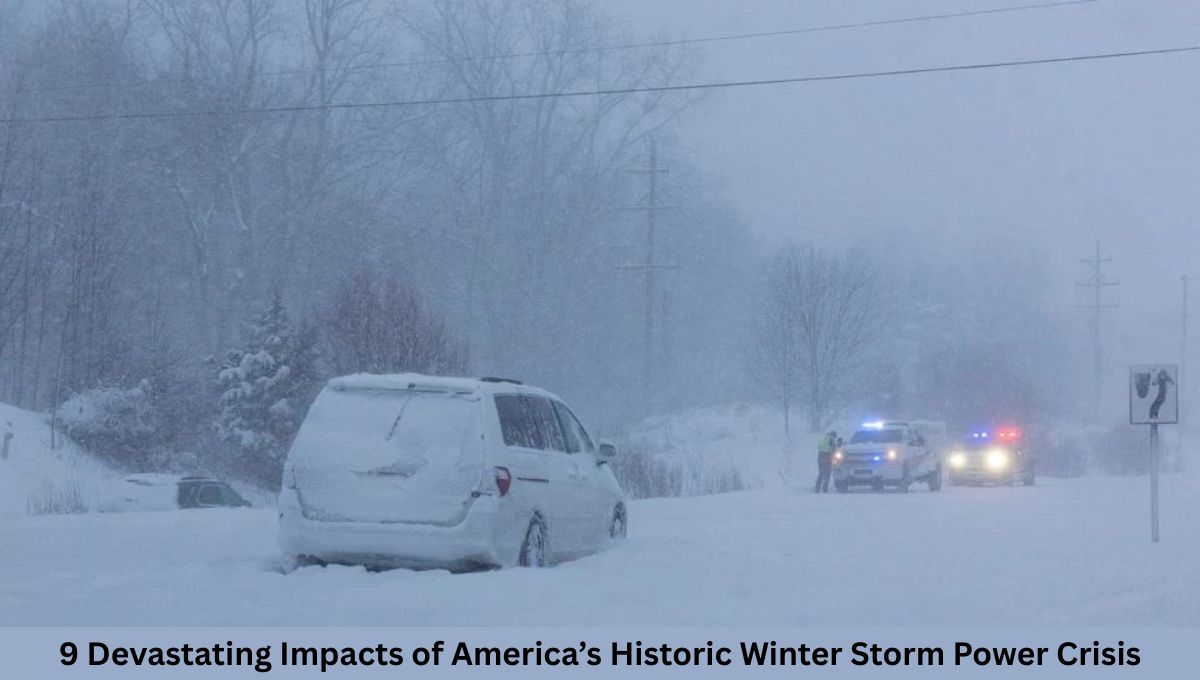
9 Devastating Impacts of America’s Historic Winter Storm Power Crisis, leaving over one million without power. A historic and unusually expansive winter storm has brought widespread disruption across the United States, leaving more than one million homes and businesses without electricity, canceling over 10,000 flights, and plunging temperatures to dangerous and potentially life-threatening levels.
Stretching nearly 2,000 miles from the Southwest to New England, the massive storm system has unleashed a destructive mix of heavy snow, sleet, freezing rain, and Arctic cold across much of the eastern two-thirds of the country.
Federal and state authorities have declared emergencies across dozens of states as infrastructure strains, travel collapses, and prolonged power outages raise growing concerns for public safety.
Forecasters warn that the worst impacts may linger for days, even after snowfall subsides, as extreme cold locks in ice damage and slows recovery efforts.
9 Devastating Impacts of America’s Historic Winter Storm Power Crisis
A Monster Storm With a Continental Reach
The National Weather Service (NWS) described the system as both historic and unique due to its extraordinary size, duration, and intensity.
“This is a very widespread storm,” said NWS meteorologist Allison Santorelli. “It’s affecting areas from New Mexico and Texas all the way into New England — roughly a 2,000-mile spread.”
As of Sunday afternoon, winter weather alerts covered approximately 213 million people, with either snow, sleet, freezing rain, or dangerously low temperatures threatening communities unaccustomed to such extremes.
Heavy snow blanketed the Ohio Valley, Midwest, and Northeast, while “catastrophic ice accumulation” impacted the South, Mid-Atlantic, and Southeast — regions where ice storms often cause more damage than snow due to falling trees and downed power lines.
More Than One Million Without Power
Power outages surged as freezing rain coated trees, transformers, and transmission lines with thick layers of ice.
According to PowerOutage.us, more than 1,005,000 customers were without electricity at the height of the storm on Sunday afternoon. The hardest-hit states included:
- Tennessee, which accounted for roughly one-third of all outages
- Mississippi
- Texas
- Louisiana
- Georgia
- Kentucky
- Virginia
- Alabama
In some counties, outage rates exceeded 10 percent, with Middle Tennessee particularly devastated. In Davidson County, home to Nashville, nearly 92 percent of customers lost power overnight as ice accumulation reached between 0.5 and 0.75 inches.
Utility crews worked around the clock, but officials warned that restoration could take days due to continuing cold and ice-weighted power lines.
Flights Canceled, Airports Paralyzed
Air travel was among the sectors most severely affected.
According to FlightAware, more than 10,000 U.S. flights were canceled on Sunday, with an additional 8,000 delayed.
By some estimates, total cancellations across Saturday and Sunday exceeded 14,800 flights, making it one of the worst weather-related aviation disruptions since the COVID-19 pandemic.
Several major airports were effectively shut down:
- Ronald Reagan National Airport near Washington, D.C. canceled nearly all flights
- Airports serving New York City, Philadelphia, Boston, Charlotte, Atlanta, Chicago, and Nashville reported cancellation rates exceeding 80 percent
- Dallas–Fort Worth International Airport saw over 700 outbound flights canceled in a single day
Major airlines including Delta Air Lines and American Airlines warned passengers to expect abrupt schedule changes as conditions evolved.
Heavy Snow Totals Across Dozens of States
Snowfall totals climbed rapidly as the storm progressed:
- Colorado, Illinois, Indiana, Missouri, New Jersey, New Mexico, New York, Ohio, Pennsylvania, and West Virginia reported over a foot of snow in at least one location
- New England braced for up to 18 to 24 inches in some areas
- Snow totals exceeded 15 inches in parts of Pennsylvania and 13 inches in Indiana
Roads became impassable in many areas, prompting authorities to issue urgent warnings for residents to avoid travel.
Catastrophic Ice in the South and Southeast
While snow dominated northern regions, freezing rain proved more destructive across the South.
More than half an inch of ice accumulated in parts of Alabama, Georgia, Louisiana, Mississippi, Oklahoma, South Carolina, Tennessee, and Texas.
In several locations, ice thickness approached or exceeded one inch — enough to snap trees, collapse power lines, and cause damage comparable to a hurricane.
“Ice is a whole different ballgame than snow,” said Georgia meteorologist Will Lanxton. “You can’t drive on it. It’s much more likely to bring down power lines and trees.”
Life-Threatening Arctic Cold Follows the Storm
Compounding the damage is an intense Arctic air mass sweeping in behind the storm.
Forecasters warned that temperatures would remain below freezing for days across much of the storm-affected region.
In the Northern Plains and Upper Midwest, wind chills were forecast to plunge as low as minus 50 degrees Fahrenheit, cold enough to cause frostbite within minutes.
Even southern states braced for record lows, with temperatures running 10 to 40 degrees below average.
Homeland Security Secretary Kristi Noem warned that the cold would prolong power outages by keeping ice frozen on lines and slowing repair efforts.
“This ice that has fallen will keep those power lines heavy, even if they haven’t gone down immediately,” she said.
Federal and State Emergency Declarations
Calling the storm “historic,” President Donald Trump approved federal emergency disaster declarations for nearly 20 states, including:
- Tennessee
- Georgia
- North Carolina
- South Carolina
- Virginia
- Maryland
- Arkansas
- Kentucky
- Louisiana
- Mississippi
- Indiana
- West Virginia
Seventeen states and the District of Columbia declared weather emergencies as governors mobilized National Guard units, emergency responders, and public works crews.
“We will continue to monitor and stay in touch with all states in the path of this storm,” Trump wrote on Truth Social. “Stay safe, and stay warm.”
FEMA and DHS Mobilize Resources
The Federal Emergency Management Agency (FEMA) pre-positioned supplies, fuel, generators, food, water, and search-and-rescue teams across multiple states ahead of the storm.
Secretary Noem urged Americans to prepare for prolonged disruptions.
“It’s going to be very, very cold,” she said. “We would encourage everybody to stock up on fuel, stock up on food, and we will get through this together.”
Energy Grid Under Emergency Orders
As energy demand surged and infrastructure strained, the Department of Energy issued emergency orders to prevent grid failures.
- The Electric Reliability Council of Texas (ERCOT) was authorized to deploy backup generation resources at data centers and major facilities
- Grid operator PJM Interconnection, which serves the Mid-Atlantic, was permitted to run “specified resources” regardless of state laws or environmental permit limits
Officials said the measures were necessary to prevent rolling blackouts during peak cold.
Dominion Energy warned that if ice forecasts held, the storm could be among the largest events to ever affect its Virginia operations, which include the world’s largest concentration of data centers.
Severe Weather and Tornado Threats
Adding to the chaos, the storm produced sharp temperature contrasts across the South.
While Arctic air pressed southward east of the Appalachians, warm Gulf air surged northward through the Deep South, creating conditions ripe for severe weather.
Officials investigated multiple possible tornado touchdowns in southeast Alabama and the Florida panhandle.
In Montgomery, Alabama, winds gusted up to 66 mph, damaging roofs, toppling trees, and knocking out power.
Human Toll and Reported Deaths
As the storm intensified, reports of storm-related deaths began to emerge.
In New York City, officials said at least five people died outdoors, believed to be homeless individuals exposed to extreme cold. Louisiana health officials reported two deaths from hypothermia.
Authorities across multiple states warned that the greatest danger could come after snowfall ends, as those without power struggle to stay warm for days.
Panic Buying and Daily Life Disruptions
As warnings intensified, panic buying spread across several major cities.
Residents reported empty grocery shelves, especially in produce and frozen food sections. Schools canceled classes across multiple states, while offices and government buildings closed.
Public transit systems struggled with snow and ice infiltration, even as cities deployed snow-melting agents and plows around the clock.
What Caused the Storm: The Polar Vortex Effect
Meteorologists traced the storm’s origins to a disrupted polar vortex — a large region of low-pressure Arctic air that normally remains compact near the North Pole.
In this case, the vortex stretched into an elongated shape, allowing cold air to spill south across much of North America.
The system also tapped deep subtropical moisture from the Pacific and Gulf of Mexico, intensifying snowfall and ice.
Scientists say such disruptions may be occurring more frequently, potentially linked to climate change altering atmospheric patterns.
When Will Conditions Improve?
Forecasters expect snow and ice to gradually move off the East Coast by Monday, but recovery will be slow.
Daytime highs may remain below freezing across large portions of the South and Mid-Atlantic until mid-week. Overnight lows are expected to plunge into the single digits, teens, and 20s.
Even as sunshine returns, refreezing at night could keep roads dangerously slick for several days.
A Long Recovery Ahead
With power restoration ongoing, travel severely disrupted, and extreme cold lingering, officials warned that the full impact of the storm is far from over.
“This is a situation that’s going to stay dangerous for a period of time,” the National Weather Service cautioned.
For millions of Americans, the coming days will be defined not just by snow and ice, but by endurance — waiting for lights to turn back on, roads to reopen, and temperatures to finally rise above freezing.
Also Read: 9 Alarming Impacts of a Massive U.S. Winter Storm
Also Read: Winter storm leaves over a million people without power across US
Related Posts:
- 9 Alarming Impacts of a Massive U.S. Winter Storm
- 7 Stunning Reasons Saudi Arabia’s Desert Saw Snow…

- 30 Dead in Japan’s Brutal Snow Disaster as Record…
- 11 Powerful Impacts as Winter Storm Cripples US…
- 7 Critical Signals Behind Trump’s Claim of a Ukraine…

- 9 Stark Signals as US Deploys Aircraft to Greenland Base