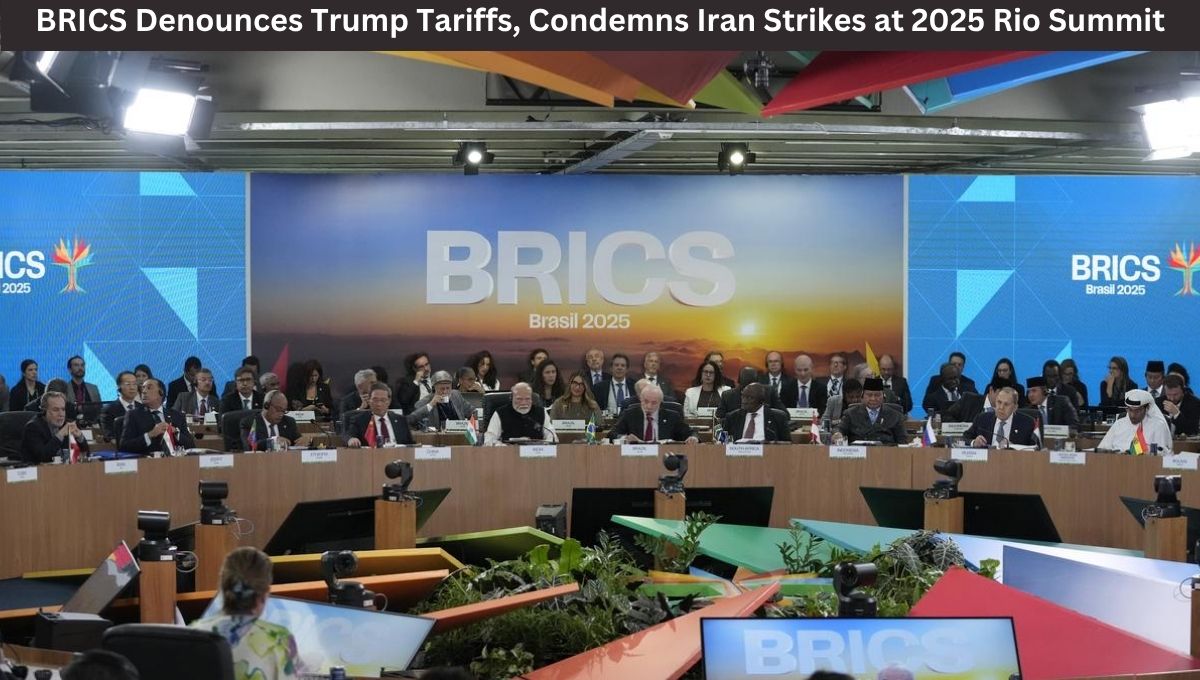
In a bold show of unity, BRICS Denounces Trump Tariffs, Condemns Iran Strikes at 2025 Rio Summit. The BRICS nations concluded their 2025 summit in Brazil by strongly condemning President Donald Trump’s unilateral tariff regime and the recent military strikes on Iran, calling them violations of international law and threats to global stability.
Though the summit was overshadowed by the absence of key figures like China’s Xi Jinping and Russia’s Vladimir Putin, the gathering still sent a powerful message: the expanded BRICS bloc is ready to assert itself as a counterweight to Western economic and military dominance.
The Rio de Janeiro Declaration, adopted on Sunday, marked a turning point for BRICS as it expands its vision for a multipolar world, rooted in fairness, sovereignty, and inclusive global governance.
BRICS Denounces Trump Tariffs, Condemns Iran Strikes at 2025 Rio Summit
Trump’s Tariff Blitz Under Fire: BRICS Labels Measures “Unilateral and Illegal”
The primary flashpoint at the summit was the Trump administration’s latest tariff announcement, which threatens to impose duties as high as 70% on imports from dozens of countries many of which are aligned with or part of BRICS.
“We voice serious concerns about the rise of unilateral tariff and non-tariff measures which distort trade and are inconsistent with WTO rules,” the BRICS draft declaration read.
Though the United States and President Trump were not named directly, the criticism was unmistakable.
Trump’s aggressive trade strategy now including punitive tariffs on major BRICS economies like India, China, and Brazil has triggered alarm over a possible global trade war.
The declaration warned that these protectionist actions would “further reduce global trade”, hurt developing economies, and destabilize fragile global supply chains.
Xi Jinping’s Absence Raises Eyebrows as Modi Takes Center Stage
The political dynamics at the summit shifted dramatically due to the absence of Chinese President Xi Jinping, who for the first time in 12 years sent Premier Li Qiang in his place.
Xi’s decision sparked widespread speculation, particularly as Indian Prime Minister Narendra Modi received prominent attention and a state lunch.
“Xi does not want to appear upstaged by Modi,” noted Ryan Hass, a former China director at the U.S. National Security Council.
Putin, facing an arrest warrant from the International Criminal Court, also stayed away but participated via video link.
Despite the two absences, BRICS leaders including Brazil’s President Luiz Inácio Lula da Silva, India’s Modi, and new members like Iran and Indonesia carried forward key policy discussions and symbolic commitments to Global South solidarity.
BRICS Condemns Military Strikes on Iran
Another cornerstone of the summit was the unanimous condemnation of military strikes on Iran, following a devastating 12-day conflict in June involving Israeli and U.S. forces.
“We condemn the military strikes against the Islamic Republic of Iran since 13 June 2025,” read the final declaration.
The strikes targeted nuclear and military sites in Natanz, Fordow, and Isfahan, leading to international outcry. Though the declaration avoided naming Israel or the United States, the timing and tone made the reference clear.
Iran, now a full BRICS member, was represented by Foreign Minister Abbas Araghchi, as President Masoud Pezeshkian remained in Tehran to manage post-conflict recovery.
Sources say Iran pushed for stronger language but accepted a consensus-driven statement.
Focus on Terrorism: BRICS Unites Against Extremism
The declaration also took a firm stance against global terrorism. BRICS members condemned the April 22 terrorist attack in Jammu and Kashmir, where 26 people were killed.
“We reaffirm our commitment to combating terrorism in all its forms and manifestations, including cross-border terrorism, financing, and safe havens,” the leaders stated.
The group reiterated its call for adopting the long-pending Comprehensive Convention on International Terrorism (CCIT) and warned against double standards in global counterterrorism frameworks.
BRICS also addressed emerging threats from the misuse of cryptocurrencies, AI, and digital tools to fund and spread extremist ideologies.
Lula Positions Brazil as a Voice of the Global South
As host of the summit, President Lula da Silva used the platform to project Brazil as a key voice in reforming the global financial and trade systems. Speaking at the pre-summit business forum, Lula emphasized:
“Faced with the resurgence of protectionism, it is up to emerging countries to defend the multilateral trade regime and reform the international financial architecture.”
This summit marks a landmark year for Brazil, which will also host COP30 and has already hosted the G20 Summit, all leading up to its 2026 presidential elections where Lula is widely expected to run again.
De-Dollarization, BRICS Currency Still a Distant Goal
Although not officially on the agenda, the theme of de-dollarization loomed large over the summit. With increasing frustration over U.S.-led sanctions, members like Russia, Iran, and China are eager to move away from the U.S. dollar in global transactions.
China’s delegation, led by Premier Li, is pushing for:
- Expansion of digital yuan
- Increased use of offshore RMB
- Support for regional alternative payment systems
While Brazil’s Lula once floated the idea of a BRICS common currency, there was no mention of it in this year’s final declaration a sign that consensus remains elusive.
Trump has already threatened 100% tariffs on countries supporting any move toward BRICS-backed currency systems, intensifying the risks of economic retaliation.
Expansion and UN Reform: BRICS Struggles with Diversity
With 11 full members and 10 strategic partners, BRICS now includes a diverse array of nations: from Saudi Arabia and Egypt to Indonesia and Ethiopia. This diversity is both a strength and a challenge.
During the Rio talks, United Nations Security Council reform became a sticking point. While BRICS agreed to support permanent seats for Brazil and India, internal disagreement prevented consensus on Africa’s representative.
However, unlike the April ministerial meeting that failed to yield a joint statement, the Rio summit did result in a united declaration a sign of growing diplomatic maturity.
Trade, AI, and Climate: Expanding BRICS’ 2025 Vision
Beyond immediate geopolitical crises, BRICS committed to advancing cooperation in several long-term areas:
- Artificial Intelligence and digital governance
- Climate change and sustainable development
- Global health systems, including pandemic preparedness
These initiatives reflect the bloc’s ambitions to shape the future of global governance, especially as emerging technologies and climate change reshape the world’s priorities.
Can BRICS Remain Unified Amid Geopolitical Shifts?
While the 2025 Rio Summit projected unity and strength, questions remain about BRICS’ internal cohesion. Key divisions include:
- Differing positions on the Ukraine war
- Varied responses to Israel-Palestine tensions
- Divergent economic models and governance styles
Yet, the group continues to evolve driven by shared discontent with the current international order and the desire for Global South representation in key global institutions.
What’s Next for BRICS?
Looking ahead, the 2026 BRICS Summit will be hosted by India, where key items on the agenda are expected to include:
- Institutional reforms for member integration
- Advancing alternative financial systems
- Building consensus on climate and health cooperation
The coming months will be crucial, particularly as Trump’s August 1 tariff hikes loom and as tensions in the Middle East remain high.
Conclusion: BRICS Pushes Back as Trump Reshapes Global Trade
The 2025 BRICS Summit in Rio de Janeiro made clear that emerging nations are no longer willing to accept a world order dominated by unilateral decisions and Western power centers. With condemnations of Trump’s tariff policy, military interventions, and imbalances in global governance, BRICS is asserting itself as the collective voice of a more inclusive, multipolar world.
The bloc’s success, however, will depend on its ability to maintain cohesion, expand economic alternatives, and deliver on its promises for the Global South. As global tensions mount, BRICS is no longer just a forum for emerging economies it is fast becoming a political force with the potential to reshape the international system.
Also Read: Trump Targets BRICS With 10% Tariffs: A Dollar Defense or Global Disruption?