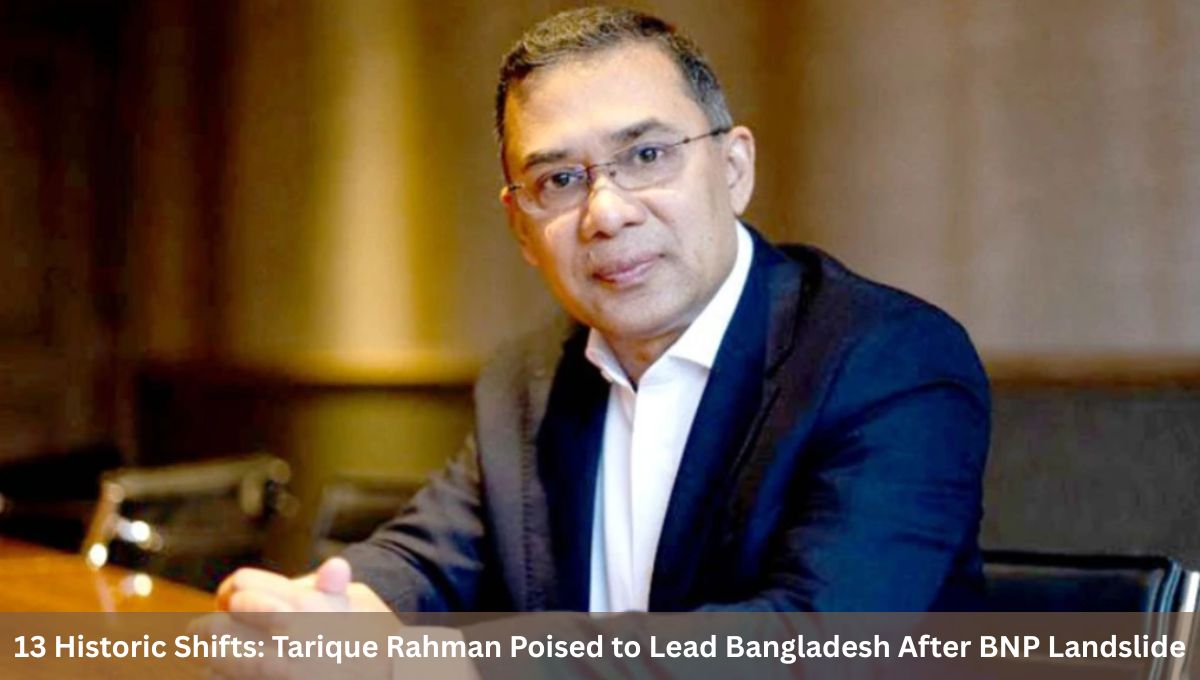
13 Historic Shifts: Tarique Rahman Poised to Lead Bangladesh After BNP Landslide, clearing the path for the political heir. Bangladesh has entered a decisive new chapter after the Bangladesh Nationalist Party (BNP) claimed a sweeping victory in parliamentary elections, positioning Tarique Rahman to become the country’s next prime minister.
At 60, Rahman’s rise represents both political continuity and rupture: continuity as the heir to one of Bangladesh’s most powerful dynasties, and rupture after nearly two decades of exile, legal battles, and the collapse of a long-entrenched rival regime.
Though official results are still being finalised, unofficial tallies show the BNP and its allies securing a commanding two-thirds majority in parliament—an outcome widely anticipated but no less historic in its consequences.
13 Historic Shifts: Tarique Rahman Poised to Lead Bangladesh After BNP Landslide
From Exile to the Centre of Power
Rahman’s ascent would have seemed improbable just a year ago. After spending 17 years in self-imposed exile in the United Kingdom, he returned to Dhaka only in December, re-entering a political landscape transformed by the 2024 mass uprising that toppled Sheikh Hasina.
His return was both triumphant and tragic. Days after coming home, his mother—former prime minister Khaleda Zia—died at the age of 80, depriving him of the reunion he had long imagined.
“I came home to my country,” Rahman told AFP in an interview before the election. “But instead of embracing my mother, I had to say goodbye.”
Within days, he assumed leadership of the BNP and launched its election campaign, addressing massive rallies while still in mourning.
A Dynasty That Shaped Bangladesh
Tarique Rahman’s political inheritance is inseparable from Bangladesh’s modern history.
He is the eldest son of Ziaur Rahman, a former army chief who rose to prominence after the assassination of independence leader Sheikh Mujibur Rahman in 1975.
Ziaur Rahman later founded the BNP and served as president until his own assassination in 1981, when Tarique was just 15 years old.
His mother, Khaleda Zia, entered politics after her husband’s death and went on to become Bangladesh’s first female prime minister, alternating power with Sheikh Hasina in a rivalry that dominated national politics for more than three decades.
That rivalry—between the Zia and Sheikh families—defined Bangladesh’s political culture, often at the expense of institutional stability.
A Childhood Shaped by Conflict
Born when Bangladesh was still East Pakistan, Rahman’s early life unfolded against the backdrop of war and upheaval.
He was briefly detained as a child during the 1971 independence struggle, a detail the BNP often highlights to underscore his lifelong proximity to the nation’s turbulent history.
Growing up inside his mother’s political orbit, Rahman learned politics not in classrooms but on campaign trails.
“I used to go to her constituencies and campaign,” he recalled. “That’s how I slowly became involved.”
A Career Shadowed by Controversy
Rahman’s political journey has never been straightforward. His rise within the BNP coincided with allegations of corruption, abuse of power, and political violence during the party’s time in government in the early 2000s.
A leaked US diplomatic cable once described him as a leader who “inspires few but unnerves many,” while others branded him a symbol of kleptocracy.
Rahman has consistently denied these accusations, calling them politically motivated.
In 2007, he was arrested on corruption charges during a military-backed caretaker government. He claims he was tortured in custody.
The following year, he left for London for medical treatment and did not return—eventually facing multiple convictions in absentia.
Legal Barriers Fall After Hasina’s Ouster
The legal roadblocks that kept Rahman abroad collapsed after Sheikh Hasina’s removal from power in 2024.
Courts overturned the most serious verdicts against him, including a life sentence related to a 2004 grenade attack on a Hasina rally—charges he had always denied.
These decisions cleared the way for his return and restored his eligibility to contest national leadership.
Rahman has acknowledged past controversies with rare candour. “If there were mistakes that were unwanted, we are sorry for that,” he said, while stopping short of admitting wrongdoing.
Election Results: Numbers That Reshape Power
Unofficial results from the 13th parliamentary election show the BNP-led alliance winning approximately 208 of 300 directly elected seats, comfortably surpassing the threshold needed to form government.
Bangladesh’s parliament includes an additional 50 reserved seats for women, typically allocated proportionally—further strengthening the BNP’s hold.
The main rival, the Jamaat-e-Islami alliance, is projected to secure around 70 seats, emerging as the principal opposition in the absence of the now-disbanded Awami League.
Notably, the BNP announced there would be no victory rallies, urging supporters instead to offer prayers for the nation—an unusual move aimed at signalling restraint after years of unrest.
First Male Prime Minister in 35 Years
If sworn in, Tarique Rahman will become Bangladesh’s first male prime minister since 1990, ending a 35-year era dominated by Khaleda Zia and Sheikh Hasina.
The symbolism is profound:
a generational shift within dynastic politics, even as dynastic rule itself continues.
For supporters, Rahman represents renewal within tradition. For critics, he is the latest iteration of elite politics in a country still searching for deeper democratic consolidation.
“Not Revenge, But Stability”
Rahman has repeatedly emphasised reconciliation over retribution. In an interview with Reuters, he said: “I’m not interested in revenge. What we need now is peace and stability.”
The message is directed both domestically—toward supporters eager for accountability—and internationally, as Bangladesh seeks to reassure investors and partners after years of turmoil.
Interim leader Muhammad Yunus described the election as the end of a “nightmare” and the beginning of “a new dream,” capturing the broader public mood of cautious optimism.
BNP’s Reform-Heavy Manifesto
The BNP’s election manifesto, titled “Bangladesh First”, lays out an ambitious reform agenda aimed at rebuilding institutions weakened by years of political confrontation.
Constitutional and Political Reforms
- Introduction of new constitutional bodies
- Proposal for a bicameral parliament
- A 10-year term limit for any individual serving as prime minister
- Keeping the armed forces strictly out of politics
Economy and Trade
- Reviving closed industries
- Diversifying exports beyond garments
- Allowing foreign investors to repatriate profits within 30 days
- Raising the tax-to-GDP ratio to 15 percent without increasing tax burdens
Employment and Youth
- Creation of nearly one million ICT jobs
- Inflation-linked wage reviews every two years
- Merit-based government recruitment
- Skills and language training for young workers
Social and Human Development Priorities
The BNP manifesto places unusual emphasis on social policy, reflecting lessons from the 2024 Gen-Z-led uprising.
Health and Education
- Increasing public health spending to 5 percent of GDP
- Recruiting 100,000 health workers
- Expanding preventive healthcare
- Introducing a mid-day meal programme for students
Welfare and Inclusion
- “Family card” programme for low-income households
- Increased funding for religious minority welfare trusts
- Training-based welfare programmes for religious leaders of all faiths
Rahman has repeatedly stressed inter-faith harmony, declaring:
“Religion is individual, the state is for all.”
Foreign Policy: Neighbours and the Indo-Pacific
On foreign policy, the BNP has signalled a pragmatic, interest-based approach. Its manifesto calls for relations with neighbours based on “equality, cooperation and mutual respect.”
Without naming India directly, it pledged to:
- Ensure fair water sharing of trans-boundary rivers such as the Ganges and Teesta
- Prevent border killings and forced push-ins
- Play a stronger role in maintaining Indo-Pacific peace and security
For global audiences, this suggests a recalibration rather than a rupture in Bangladesh’s regional diplomacy.
Rebuilding a Country After Upheaval
Rahman has described the task ahead as “immense,” arguing that years of authoritarian governance hollowed out institutions and damaged public trust.
The BNP’s long-term goal is ambitious:
transforming Bangladesh into a modern, democratic, upper-middle-income country with a trillion-dollar GDP by 2034.
Whether that vision can be realised will depend on implementation, coalition management, and the ability to move beyond the cycle of vengeance that has long plagued Bangladeshi politics.
Conclusion: A Moment of Reckoning and Opportunity
The Bangladesh elections represent more than a change of government—they mark a generational and psychological reset after decades of rivalry, repression, and revolt.
Tarique Rahman’s journey from exile to the threshold of power encapsulates the contradictions of Bangladeshi politics:
dynastic yet dynamic, polarised yet hopeful.
As the world watches Dhaka, the central question remains whether this historic mandate will be used to entrench old patterns—or finally to break them.
Also Read: 9 Defining Moments as Tarique Rahman Returns to Bangladesh After 17 Years
Also Read: Tarique Rahman finally steps into the spotlight, set to be Bangladesh PM
Related Posts:
- 11 Powerful Moments as Tarique Rahman Returns to…

- 9 Defining Moments as Tarique Rahman Returns to…

- 7 Critical Updates on Khaleda Zia’s Health and…
- Bangladesh Election Shock: 9 Explosive Takeaways…
- 15 Defining Moments of Khaleda Zia’s Powerful Political Life
- Macron Reappoints Lecornu as PM 2025 – Triggers…
