Bangladesh Election Shock: 9 Explosive Takeaways from BNP’s Landslide Comeback for Bangladesh’s political future. Bangladesh has entered a decisive new political chapter after the Bangladesh Nationalist Party (BNP) secured a commanding victory in the country’s first parliamentary election since the dramatic 2024 uprising that toppled former prime minister Sheikh Hasina.
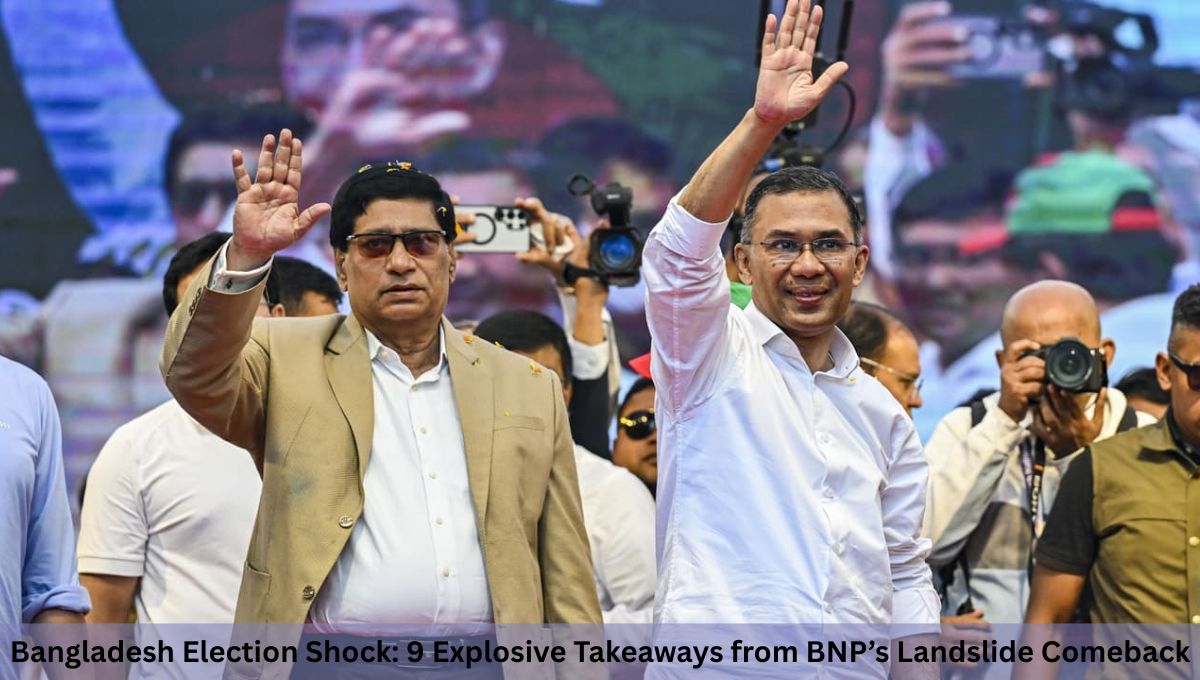
As ballots were counted late into Friday night, local television networks projected that the BNP had crossed the majority threshold in the 300-member Jatiya Sangsad, clearing the path for party chairman Tarique Rahman to become Bangladesh’s next prime minister.
The election result is being widely viewed as a turning point after nearly two years of political uncertainty, interim governance, street unrest, and institutional upheaval.
It also raises critical questions about Bangladesh’s democratic direction, civil-military balance, relations with India, and the fate of sweeping reforms proposed by interim leader Muhammad Yunus.
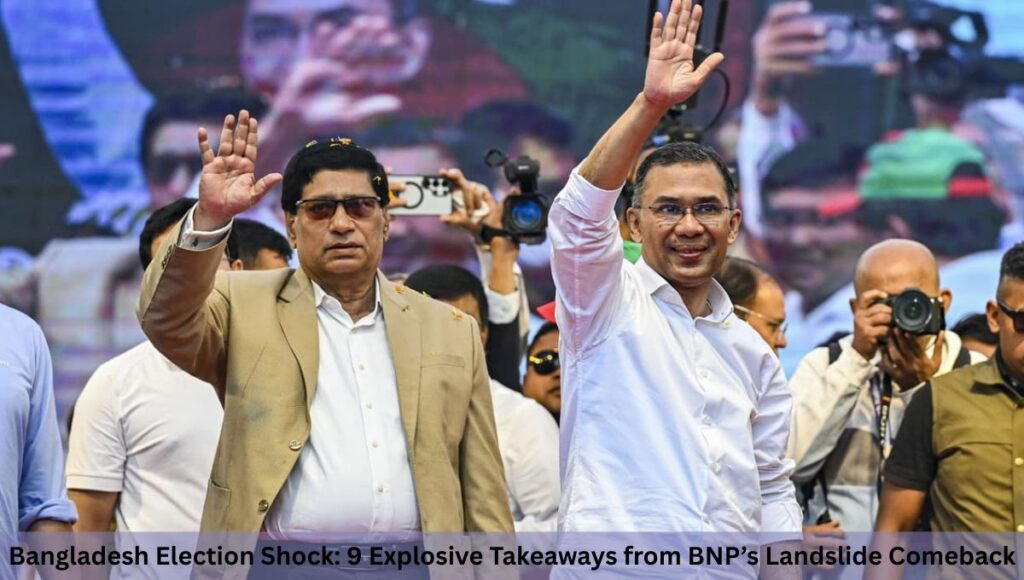
Bangladesh Election Shock: 9 Explosive Takeaways from BNP’s Landslide Comeback
BNP Crosses Majority Mark as Results Roll In
According to early projections by Ekattor TV, the BNP won 151 seats, enough to secure a simple majority in parliament even before the Election Commission’s formal declaration.
Later tallies from local media suggested an even larger mandate. The BNP and its allies — including Gono Odhikar Porishad and Gono Songhoti Andolon — were reported to have secured 211 seats, giving the bloc a two-thirds majority, while the Jamaat-e-Islami alliance lagged far behind with about 70 seats.
Results were declared in 287 of the 299 constituencies, with voting postponed in one seat due to a candidate’s death.
For the BNP, the scale of victory marks a stunning comeback after years of exile, boycotts, and repression under Hasina’s long rule.
Tarique Rahman’s Long Road Back to Power
At the centre of the BNP revival is Tarique Rahman, a figure who has loomed over Bangladeshi politics for more than two decades.
The 60-year-old son of former prime minister Khaleda Zia, Rahman spent 17 years in self-imposed exile in London, returning to Dhaka only in December 2025 after Hasina fled the country.
Often described as the BNP’s behind-the-scenes strategist during his mother’s tenure, Rahman was once labelled the “shadow prime minister.”
His political career was derailed after the BNP’s defeat in 2008, followed by arrests, convictions, and exile.
His return — just days before Khaleda Zia’s death — transformed the election into a referendum on leadership, legacy, and national direction.
Rahman contested and won from Dhaka-17 and Bogura-6, defeating Jamaat-e-Islami candidates with strong margins and cementing his claim as the country’s next leader.
First National Vote Since the July Uprising
The 2026 election was Bangladesh’s first national poll since the Gen-Z-driven July Uprising of 2024, a movement that began as student protests against quota systems and escalated into a nationwide revolt after a violent state crackdown.
The uprising ultimately led to the collapse of the Awami League government on August 5, 2024, ending Sheikh Hasina’s long and controversial rule.
Since then, Bangladesh has been governed by an interim administration led by Nobel laureate Muhammad Yunus, tasked with stabilising the country and overseeing democratic restoration.
For many voters, this election represented not just a change of government, but a chance to reset Bangladesh’s political system after years of authoritarian drift.
Low Turnout Raises Questions of Legitimacy
Despite the historic stakes, voter turnout remained subdued.
Local media estimates suggested turnout ranged between 47% and 60%, significantly lower than previous competitive elections.
Analysts attributed the drop to political fatigue, security concerns, and the absence of the Awami League — which was banned from contesting and saw its iconic “boat” symbol missing from ballots for the first time in three decades.
Minority participation was reported to be particularly low, especially among Hindu voters, following a series of attacks since the fall of Hasina’s government.
While polling was largely peaceful, the muted turnout underscores the challenges facing the next government in claiming a fully inclusive mandate.
BNP vs Jamaat: Former Allies Turned Rivals
One of the most striking features of the 2026 election was the direct contest between the BNP and its former ally, Jamaat-e-Islami.
For decades, Jamaat had been a key partner in BNP-led coalitions. That relationship has now fractured, with Jamaat emerging as the BNP’s principal rival in the absence of the Awami League.
Jamaat chief Shafiqur Rahman conceded defeat as counting progressed, signalling a shift towards what he termed “positive politics” rather than confrontational opposition.
The BNP’s distancing from Jamaat is widely seen as an attempt to project itself as a centrist, secular-leaning force, capable of governing a diverse and globally connected Bangladesh.
The Yunus Referendum Controversy
Alongside the general election, voters were asked to weigh in on a national referendum endorsing Yunus’s proposed reform package, known as the “July National Charter-2025.”
The charter outlines 84 reform points aimed at overhauling governance, strengthening institutions, and preventing the return of authoritarian rule.
Yunus openly urged voters to support a “Yes” vote, arguing that the reforms would secure Bangladesh’s future.
However, legal experts questioned both the government’s neutrality and the referendum’s constitutionality, noting that Bangladesh’s constitution does not explicitly provide for such a mechanism.
The outcome of the referendum — and whether the incoming BNP government chooses to honour or revise it — could shape Bangladesh’s institutional framework for years to come.
BNP’s Manifesto: Welfare, Youth, and Stability
The BNP campaigned on a platform branded “Bangladesh Before All,” promising economic relief, political reform, and social unity.
Key pledges include:
- A “Family Card” welfare programme offering monthly financial support or essential goods to low-income households
- Expanded youth employment through digital innovation, entrepreneurship, and startup support
- A 10-year cap on the prime minister’s tenure
- Creation of a vice-president post
- Protection of religious freedoms and minority rights
Analysts, however, warn that funding these initiatives will be challenging in a country where millions still live in extreme poverty and public finances remain under strain.
India Factor: Friendship or Friction?
Perhaps the most closely watched aspect of a BNP-led government will be its relationship with India.
The BNP manifesto speaks of improving ties with neighbours for “growing together,” yet simultaneously accuses India of border killings and push-ins, promising “strong measures” to stop them.
This dual messaging has left geopolitical observers divided over whether the BNP is extending a hand of cooperation or signalling a tougher stance toward New Delhi.
Rahman’s past attacks on Sheikh Hasina — who remains in exile in India — further complicate the equation.
However, recent outreach, including India’s diplomatic engagement with BNP leaders, suggests both sides may be preparing for pragmatic coexistence.
Foreign Policy and the Rohingya Challenge
On the global stage, the BNP has pledged a more assertive and balanced foreign policy.
Key commitments include:
- Proactive global engagement
- Signing the UN Water Convention
- Renewed push for a fair resolution of the Teesta River dispute with India
- Accelerated efforts to secure the repatriation of Rohingya refugees to Myanmar
Managing these priorities while maintaining regional stability will test the diplomatic skills of the next government.
A Turning Point for Bangladesh
The BNP’s sweeping victory marks the end of one of the most turbulent periods in Bangladesh’s modern history.
For supporters, it represents a mandate for stability, reform, and national reconciliation. For critics, questions remain over voter turnout, minority participation, and the durability of democratic norms.
As Tarique Rahman prepares to take the reins of power, Bangladesh stands at a crossroads — between past authoritarianism and the promise of a more inclusive future.
What happens next will not only define Bangladesh’s political trajectory, but also reshape South Asia’s strategic landscape for years to come.
Also Read: 15 Defining Moments of Khaleda Zia’s Powerful Political Life
Also Read: Bangladesh Elections 2026: Why Jamaat failed as BNP surged ahead