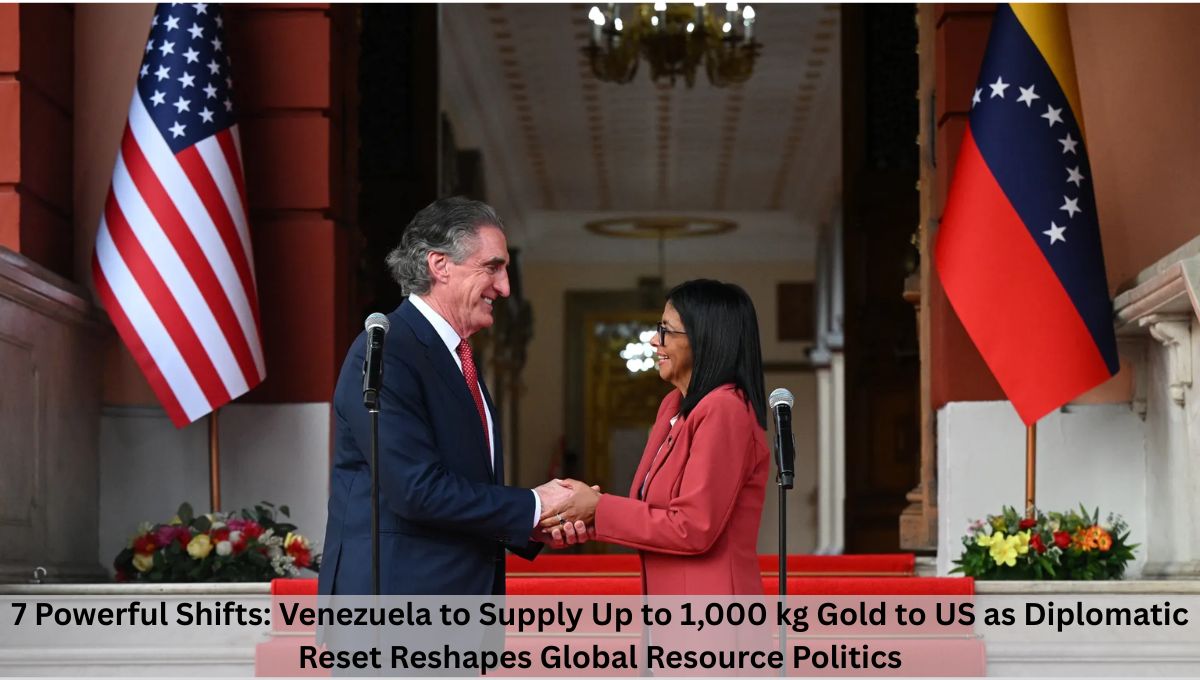
7 Powerful Shifts: Venezuela to Supply Up to 1,000 kg Gold to US as Diplomatic Reset Reshapes Global Resource Politics — A deal that could blur the line between cooperation and exploitation. A major new agreement between Venezuela and the United States could reshape global resource politics and revive economic ties between two nations whose relationship has been strained for years.
Under the agreement, Venezuela’s state-owned mining company will supply between 650 and 1,000 kilograms of gold destined for the U.S. market, marking one of the most significant resource deals between the countries in recent history.
The arrangement reflects rapidly changing geopolitical dynamics following the removal of Venezuela’s long-time leader and the installation of an interim administration seeking closer ties with Washington.
While supporters say the deal will help stabilize Venezuela’s economy and bring transparency to its mining sector, critics argue it raises serious questions about sovereignty, resource control, and geopolitical influence in Latin America.
7 Powerful Shifts: Venezuela to Supply Up to 1,000 kg Gold to US as Diplomatic Reset Reshapes Global Resource Politics
A Major Gold Supply Deal
The agreement involves Venezuela’s state mining company Minerven, which will supply gold doré bars to the commodities trading giant Trafigura.
Doré bars are semi-pure gold products produced directly from mines. They typically contain a mix of gold and other metals before being refined to reach near-pure levels.
According to sources familiar with the contract, the deal includes several key provisions:
- Venezuela will supply 650 to 1,000 kilograms of gold
- The gold will contain 98% final gold content
- Trafigura will arrange transportation to U.S. refineries
- Refining will occur under a separate arrangement with the U.S. government
At current market prices, the value of this shipment is substantial.
A kilogram of gold currently costs roughly $166,000, meaning the full deal could exceed $166 million depending on final delivery volumes and market fluctuations.
Although relatively small compared with the global gold trade, the deal carries symbolic and geopolitical significance, representing a new phase in U.S.–Venezuela economic relations.
Gold Prices Rising Amid Global Uncertainty
The timing of the deal coincides with a surge in global gold prices.
Gold has traditionally served as a safe-haven asset, attracting investors during periods of economic or geopolitical instability.
Recent tensions across several regions have pushed investors toward precious metals.
Gold prices have climbed sharply this year due to:
- Ongoing geopolitical conflicts
- Trade tensions between major economies
- Uncertainty around global interest rates
- A weakening U.S. dollar
Spot gold recently traded above $5,177 per ounce, with futures contracts approaching $5,185 per ounce.
Earlier this year, gold briefly hit an all-time high above $5,595 per ounce, reflecting the growing demand for safe-haven assets amid global uncertainty.
For Venezuela, which possesses substantial untapped gold reserves, rising prices create a strong incentive to expand exports.
Expanding U.S.–Venezuela Economic Cooperation
The gold agreement is only one part of a broader effort by Washington and Caracas to rebuild economic cooperation.
After years of sanctions, diplomatic tensions, and political instability, the two countries are now gradually restoring bilateral ties.
Officials say the gold deal is the third resource extraction agreement signed since Washington increased its involvement in Venezuela’s energy and mining sectors.
In addition to gold, negotiations are underway in several other sectors, including:
- Oil production
- Natural gas exploration
- Strategic minerals
- Mining infrastructure development
American companies are reportedly eager to return to Venezuela, which possesses some of the largest oil reserves in the world along with extensive mineral deposits.
Venezuela’s Vast Natural Resource Wealth
Venezuela is widely known for its massive oil reserves, but the country also possesses enormous mineral wealth.
Among its most valuable resources are:
Gold
Large deposits exist across southern Venezuela, particularly in the Orinoco Mining Arc.
Copper
An essential metal for global energy infrastructure and renewable technologies.
Diamonds
Venezuela hosts several diamond-bearing regions that remain underdeveloped.
Coltan
An ore used to produce tantalum and niobium, both critical for electronics and electric vehicle batteries.
Bauxite
The primary source of aluminum, another key industrial metal.
These resources are increasingly valuable in the modern economy, particularly as demand grows for materials used in technology, renewable energy, and defense systems.
Washington’s Strategic Interest in Minerals
U.S. officials have emphasized that expanding access to Venezuelan resources could strengthen American supply chains.
In recent years, Washington has become increasingly concerned about global dependence on China for critical minerals.
China currently dominates the production and processing of many essential materials used in:
- Electric vehicles
- Smartphones
- Renewable energy systems
- Military technologies
By expanding cooperation with Venezuela, U.S. policymakers hope to reduce reliance on foreign competitors and secure access to key resources.
Officials have also argued that investment could help rebuild Venezuela’s struggling economy.
Mining Reform Plans in Venezuela
Venezuela’s interim leadership has pledged to introduce major reforms to the country’s mining sector.
The current mining legislation dates back to 1999, and officials believe it requires modernization to attract international investment.
The proposed reforms aim to:
- Allow greater foreign participation in mining projects
- Improve regulatory oversight
- Increase transparency in resource extraction
- Encourage legal mining operations
Officials say new regulations will mirror recent reforms in Venezuela’s oil sector that opened the door to private investment.
If implemented successfully, the changes could reshape the country’s resource industries and attract billions of dollars in foreign capital.
Illegal Mining and Security Concerns
Despite its resource wealth, Venezuela’s mining sector faces serious challenges.
Large portions of the country’s mineral-rich regions are located in remote jungle territories with limited infrastructure.
These areas are often controlled by:
- Criminal gangs
- Guerrilla groups
- Illegal mining networks
Wildcat mining operations are widespread, often operating without safety regulations or environmental protections.
In many cases, armed groups collect fees or taxes from miners in exchange for allowing operations to continue. Tragic accidents are not uncommon.
In October of last year, heavy rains caused a gold mine collapse that killed 14 workers, highlighting the dangers faced by miners in unregulated environments.
Security Assurances for Foreign Investors
To address these challenges, Venezuelan officials have reportedly offered security assurances to international companies interested in investing in the mining sector.
Authorities say they will work to provide protection for companies conducting exploration or reopening old mines.
Officials argue that legal mining projects could help reduce the influence of criminal networks by bringing formal employment and infrastructure to remote regions.
Some analysts agree that economic investment could stabilize parts of the country where illegal mining has become entrenched.
However, others warn that dismantling criminal networks could prove extremely difficult.
A Diplomatic Reset Between Washington and Caracas
The economic deals follow a dramatic political shift earlier this year.
After months of escalating tensions, Venezuelan leader Nicolás Maduro was captured in a controversial operation that sparked widespread international debate.
The event led to the installation of an interim government led by Delcy Rodríguez, who has signaled a willingness to rebuild relations with Washington.
Since then, the United States and Venezuela have begun restoring diplomatic and consular ties.
Officials from both countries say the goal is to support:
- Political reconciliation
- Economic recovery
- A peaceful democratic transition
The restoration of diplomatic relations marks a dramatic shift after years of hostility and sanctions.
Critics Raise Concerns About Sovereignty
Despite the renewed cooperation, the new relationship has sparked criticism from political analysts, activists, and some lawmakers.
Critics argue that Washington’s increasing involvement in Venezuela’s energy and mining sectors risks undermining the country’s sovereignty.
International law recognizes that countries have permanent sovereignty over their natural resources.
Some legal experts warn that external control over these resources could violate fundamental principles of self-determination.
Opponents also fear the deals may prioritize foreign commercial interests over the needs of Venezuelan citizens.
Supporters Say the Deal Benefits Venezuela
Supporters of the agreement argue the new arrangements could bring greater transparency and economic stability. For years, Venezuela’s gold trade has been plagued by corruption and smuggling.
Large quantities of gold have reportedly been exported through black-market channels to countries such as Turkey and Iran.
Advocates of the new agreement say the deal could:
- Redirect revenue into official government channels
- Reduce illegal mining activities
- Increase tax revenues
- Strengthen economic ties with international markets
Some insiders claim the new system ensures profits from natural resources benefit the Venezuelan people rather than criminal networks.
The Role of Trafigura
The commodities trading firm Trafigura plays a central role in the gold deal.
The company is one of the world’s largest independent commodity traders, handling billions of dollars in energy and metals each year.
In addition to the gold contract, Trafigura is reportedly involved in oil agreements in Venezuela worth more than $1 billion.
Commodity traders like Trafigura often act as intermediaries between resource-rich nations and global markets.
They provide logistical services such as:
- Shipping and transport
- Refining arrangements
- Market access
- Financial structuring of resource deals
Global Implications for the Gold Market
Although the amount of gold involved in the agreement is relatively small compared with global production, the deal signals a potentially larger shift.
If Venezuela successfully reforms its mining industry and expands exports, it could become a more significant player in the global gold market.
The country’s gold reserves are believed to be among the largest in Latin America. However, decades of political instability, economic crisis, and underinvestment have limited production.
Foreign investment and improved regulations could unlock vast reserves that remain largely untapped.
Competition for Critical Minerals
The renewed U.S. interest in Venezuelan minerals is part of a broader global race for critical resources. Modern economies depend heavily on minerals used in advanced technologies.
These include materials needed for:
- Electric vehicles
- Renewable energy systems
- Semiconductor manufacturing
- Aerospace and defense technologies
Governments around the world are increasingly seeking to secure reliable supplies of these resources. For the United States, Latin America represents a crucial region in that strategy.
The Future of U.S.–Venezuela Relations
The gold agreement and mining reforms suggest the relationship between Washington and Caracas may be entering a new phase.
If diplomatic cooperation continues, the two countries could expand collaboration in multiple areas, including:
- Energy production
- Infrastructure development
- Mineral extraction
- Environmental management
However, the future of the partnership remains uncertain.
Political tensions, domestic opposition, and security challenges could still complicate efforts to rebuild Venezuela’s economy.
Much will depend on how the country navigates its political transition and whether reforms succeed in attracting long-term investment.
A Defining Moment for Venezuela’s Resource Economy
For Venezuela, the gold deal represents more than a simple commercial transaction. It reflects a broader effort to reshape the country’s economic model after years of crisis.
The nation’s future may increasingly depend on how effectively it manages its vast natural resources.
If reforms succeed, Venezuela could once again become a major supplier of energy and minerals to global markets.
If they fail, the country risks remaining trapped in cycles of instability and underdevelopment.
Conclusion
The agreement to supply up to 1,000 kilograms of gold to U.S. markets marks a significant development in the evolving relationship between Venezuela and the United States.
It comes amid a dramatic political transition, renewed diplomatic engagement, and growing global competition for natural resources.
For supporters, the deal represents a chance to rebuild Venezuela’s economy, formalize its mining sector, and deepen cooperation with international markets.
For critics, it raises serious questions about sovereignty, geopolitical influence, and the future control of Venezuela’s vast resource wealth.
As mining reforms move forward and new investment opportunities emerge, the world will be watching closely to see whether this new partnership becomes a model for economic recovery—or a new chapter in the long debate over resource politics in Latin America.
Also Read: 9 Powerful Shifts as Venezuela Opens Its Oil Industry to the World
Related Posts:
- 7 Big Takeaways: Macron’s High-Stakes China Visit…

- Pakistan Opens Mining to US, China & Russia Amid…

- 7 Powerful Measures: Trump Sanctions Russian Oil…

- 5 Key Shifts in Bangladesh–Pakistan Relations as…

- Afghanistan–Pakistan War 2025: Inside the 48-Hour Ceasefire

- Trump’s 20-Point Gaza Peace Plan Gains Urgent Global…
