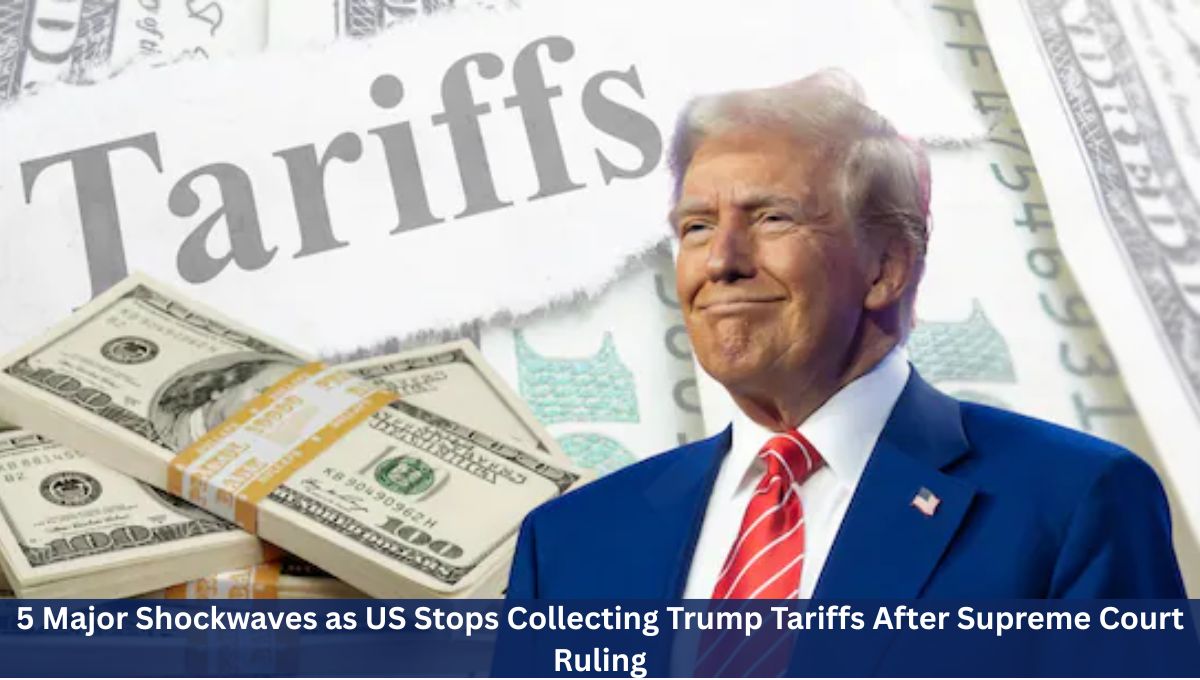
5 Major Shockwaves as US Stops Collecting Trump Tariffs After Supreme Court Ruling, rattling global diplomacy.The United States will stop collecting a tranche of global import tariffs beginning Tuesday, days after the Supreme Court of the United States ruled that President Donald Trump had exceeded his constitutional authority by imposing the levies under emergency powers.
The decision marks a dramatic reversal in U.S. trade policy and injects fresh uncertainty into global markets, ongoing trade negotiations, and recently signed bilateral deals — particularly with India and the European Union.
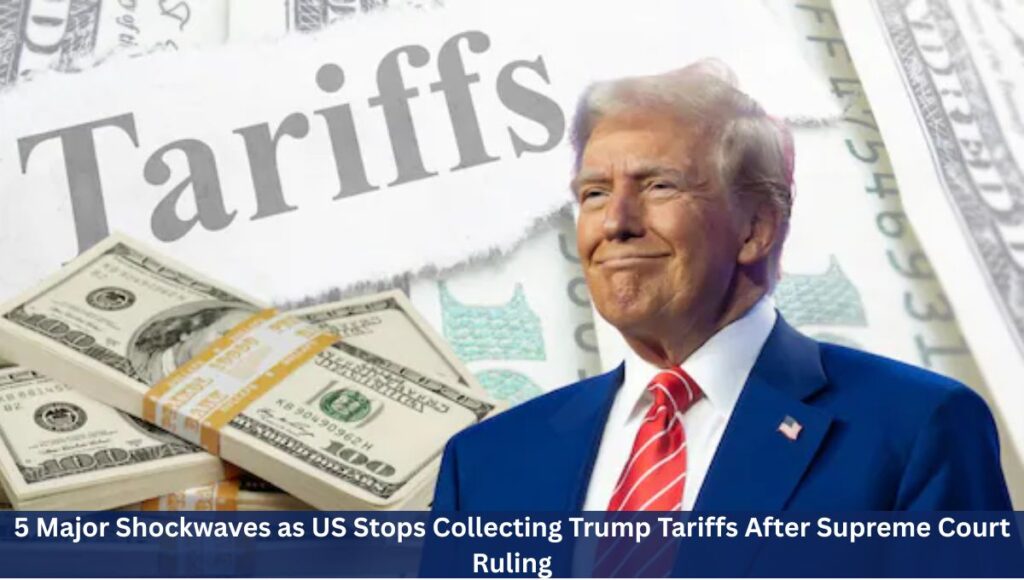
5 Major Shockwaves as US Stops Collecting Trump Tariffs After Supreme Court Ruling
Customs Agency Halts Collection of Illegal Tariffs
In a formal notice circulated through its Cargo Systems Messaging Service, US Customs and Border Protection (CBP) said all tariff codes linked to duties imposed under the International Emergency Economic Powers Act (IEEPA) would be deactivated at 12:01 a.m. Eastern Time on February 24.
The agency confirmed that:
- Tariffs struck down by the Supreme Court will no longer be collected
- Importers were required to continue paying duties until the systems were updated
- No clarity has been provided on whether refunds will be issued for duties already paid
The suspension applies only to IEEPA-based tariffs and does not affect other Trump-era trade measures imposed under separate laws.
The Supreme Court’s 6–3 Ruling Explained
In a 6–3 verdict, the Supreme Court ruled that the 1977 International Emergency Economic Powers Act does not grant the president unilateral authority to impose sweeping global tariffs.
The court reaffirmed a core constitutional principle:
the power to tax and impose tariffs primarily rests with Congress, not the executive branch.
Notably, two justices appointed by Trump joined the majority, marking the first major judicial setback for a second-term Trump policy to reach the top court.
Why Tariffs Continued After the Ruling
Despite the court’s decision on Friday, importers continued paying duties for several days, triggering confusion and criticism from the trade community.
CBP offered no explanation for the delay and has not yet addressed whether the government will refund billions of dollars collected during the interim period.
According to estimates cited by Reuters, the invalidated tariffs had been generating more than $500 million per day, putting over $175 billion in potential refunds at stake.
Trump’s Rapid Pivot: From Court Loss to New Tariffs
Within hours of the Supreme Court ruling, Trump announced a new blanket tariff on all imports:
- 10% global tariff announced Friday
- Raised to 15% on Saturday
- To remain in effect for up to 150 days
Unlike the struck-down tariffs, the new levies are being imposed under Section 122 of the Trade Act of 1974, a rarely used and legally untested provision.
What Is Section 122 — And Why It Matters
Section 122 allows the president to impose tariffs of up to 15% to address balance-of-payments emergencies, but only temporarily.
Congressional approval is required if the measure is extended beyond 150 days.
No previous U.S. president has used Section 122 in this manner, making the new tariffs highly vulnerable to legal challenges.
Legal Criticism Mounts: Neal Katyal Speaks Out
Indian-origin constitutional lawyer Neal Katyal, who recently argued a successful case against Trump’s earlier trade measures, sharply questioned the legality of the new 15% tariff.
Katyal pointed out that the Trump administration’s own Justice Department had previously argued that Section 122 does not apply to trade deficits — the very justification Trump is now using.
“If the President believes tariffs are such a good idea, he should do the American thing and go to Congress,” Katyal said.
Former IMF First Deputy Managing Director Gita Gopinath echoed the concern, noting that trade deficits and balance-of-payments deficits are not the same.
Impact on India: Relief, But Not Clarity
The developments have direct implications for India, which has been negotiating an interim trade framework with Washington.
What Changes — And What Doesn’t
- Tariffs imposed under IEEPA, including punitive duties linked to Russian oil purchases, will cease
- Trump has said “nothing changes” regarding India-specific levies
- India remains covered under the new 15% global tariff until a different authority is invoked
Earlier, U.S. tariffs on Indian goods were expected to fall to 18% from a combined 50%, which included a 25% punitive surcharge imposed in August.
India’s commerce ministry said it is studying the Supreme Court ruling and its implications.
EU Pushes Back: ‘A Deal Is a Deal’
The European Commission issued a strongly worded statement insisting that Washington honor last year’s EU–US trade agreement.
Under that deal:
- US tariffs on most EU goods were capped at 15%
- Some products, such as aircraft parts, enjoyed zero tariffs
- The EU withdrew planned retaliatory measures
Brussels warned that unpredictable tariff changes undermine confidence and destabilize global markets.
Will the New 15% Tariff Override Existing Trade Deals?
That remains unclear.
Trade analysts say Trump’s new across-the-board tariff could:
- Eliminate EU zero-tariff exemptions
- Be stacked on top of existing “most-favoured-nation” duties
- Erase the EU’s comparative advantage over non-deal countries
According to Global Trade Alert, the EU could be 0.8 percentage points worse off, with Italy facing the steepest hit.
Which Tariffs Are Being Halted
CBP listed multiple executive orders whose duties will no longer be collected, including tariffs imposed on:
- China (synthetic opioid supply chain)
- Countries importing Venezuelan oil
- Nations targeted under “reciprocal tariff” measures
- Russia and Brazil under national threat designations
However, tariffs imposed under Section 232 (national security) and Section 301 (unfair trade practices) remain untouched.
Refunds: The Billion-Dollar Question
CBP has declined to say whether importers will be refunded for tariffs paid after the court ruling or earlier under now-invalid orders.
If refunds are mandated, the financial exposure for the US Treasury could run into hundreds of billions of dollars, creating a fresh fiscal and political battle.
Global Markets Watch Closely
The Supreme Court ruling and Trump’s rapid tariff pivot have:
- Jolted global supply chains
- Raised compliance risks for exporters
- Increased volatility in currency and equity markets
Major manufacturing hubs in Asia — including China, Japan, South Korea, and Taiwan — were directly affected by the invalidated tariffs.
What Comes Next
Several outcomes now loom:
- Legal challenges to the new 15% tariff under Section 122
- Congressional scrutiny if the levies extend beyond 150 days
- Renegotiation pressure from trade partners like India and the EU
For now, businesses face a familiar but destabilizing reality:
policy uncertainty at the heart of global trade.
Conclusion: A Watershed Moment for US Trade Policy
The decision to stop collecting Trump-era tariffs marks a historic rebuke from the judiciary and a reaffirmation of constitutional limits on executive power.
Yet Trump’s swift move to reimpose tariffs under a different law ensures that the global trade landscape remains unsettled — with courts, Congress, and trading partners all preparing for the next round of confrontation.
For the world economy, the message is clear:
the tariff wars are far from over.
Also Read: 5 Powerful Options for Trump If the Supreme Court Strikes Down His Tariffs