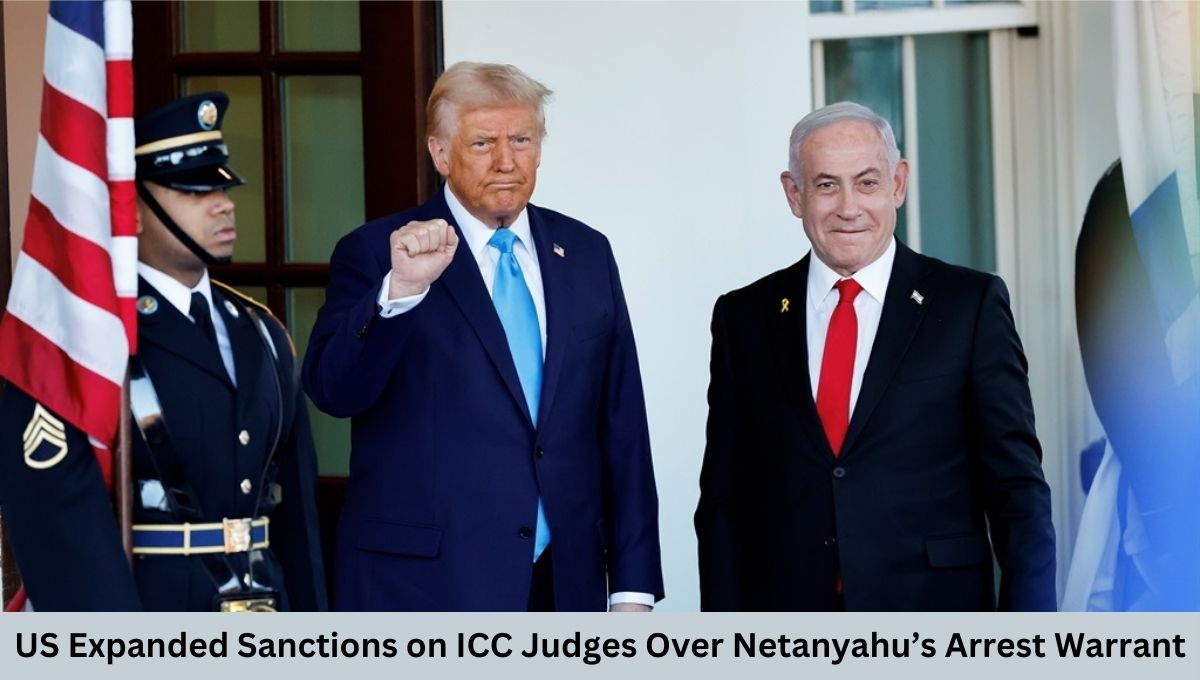
The move sparked global outcry as the US Expanded Sanctions on ICC Judges Over Netanyahu’s Arrest Warrant. The United States has escalated its confrontation with the International Criminal Court (ICC) by sanctioning four of its senior judges and prosecutors over investigations into alleged Israeli war crimes in Gaza and earlier probes involving US forces in Afghanistan.
The decision, announced by US Secretary of State Marco Rubio, has triggered sharp criticism from France, the United Nations, and the ICC itself, which called the move a “flagrant attack” on judicial independence.
This latest development highlights Washington’s determination to shield itself and its close ally Israel from international accountability, while fueling debates over global justice and the integrity of international institutions.
US Expanded Sanctions on ICC Judges Over Netanyahu’s Arrest Warrant
ICC Condemns “Flagrant Attack” on Judicial Independence
The International Criminal Court strongly denounced the sanctions, saying they undermine the rule of law and the rights of victims of war crimes worldwide.
In its statement, the ICC described the measures as “a flagrant attack against the independence of an impartial judicial institution” and warned that they are also “an affront against the rules-based international order.”
The penalties bar the four targeted officials from entering the US or accessing any assets or property under US jurisdiction.
The sanctions mark one of the most severe diplomatic escalations against the ICC since its creation in 2002.
Who Was Targeted by the US Sanctions?
The new sanctions targeted four high-ranking ICC officials directly involved in sensitive investigations:
- Judge Nicolas Guillou (France) – presided over the pre-trial chamber that issued an arrest warrant for Israeli Prime Minister Benjamin Netanyahu.
- Judge Kimberly Prost (Canada) – sanctioned for her role in authorizing an ICC investigation into alleged war crimes committed by US forces in Afghanistan.
- Deputy Prosecutor Nazhat Shameem Khan (Fiji) – accused by Washington of pursuing “illegitimate actions” against Israel.
- Deputy Prosecutor Mame Mandiaye Niang (Senegal) – also penalized for supporting arrest warrants against Netanyahu and former Israeli Defence Minister Yoav Gallant.
The US State Department justified the move by claiming these officials engaged in “politicisation, abuse of power, and illegitimate judicial overreach.”
Netanyahu Thanks Washington for “Decisive Action”
Israeli Prime Minister Benjamin Netanyahu welcomed the sanctions, describing them as a “firm measure against the mendacious smear campaign” directed at Israel.
He praised Rubio’s decision as an act of solidarity that countered what he called “lies” about Israel’s military campaign in Gaza.
The ICC alleges that Netanyahu bears responsibility for war crimes and crimes against humanity, including deliberately targeting civilians and using starvation as a method of warfare during Israel’s military offensive.
The court has also issued arrest warrants against former Israeli Defence Minister Yoav Gallant and Hamas commander Mohammed Deif.
France and UN Slam US Measures
The US action has not gone unchallenged by its allies and international organizations. France, whose judge Nicolas Guillou was personally sanctioned, expressed “dismay” and criticized Washington’s decision as being “in contradiction to the principle of an independent judiciary.”
France’s foreign ministry underscored that the ICC plays a vital role in fighting impunity and upholding international justice.
President Emmanuel Macron, who visited Washington just two days before the sanctions were announced, is now under pressure to defend France’s judicial representative.
At the United Nations, spokesperson Stephane Dujarric warned that the sanctions risk “severely impeding” the work of the ICC prosecutor’s office, undermining accountability for war crimes and genocide worldwide.
US Justification: ICC as a “National Security Threat”
In his announcement, Secretary of State Marco Rubio described the ICC as a “national security threat” and accused it of being “an instrument of lawfare” targeting the United States and Israel.
He condemned the court for investigating American and Israeli citizens without the consent of their governments.
Rubio argued that the ICC had exceeded its mandate and become politicized, citing ongoing probes into alleged US war crimes in Afghanistan as well as its high-profile arrest warrants against Israeli leaders.
A History of US Opposition to the ICC
The United States has long resisted the authority of the ICC. Neither the US, Israel, nor Russia are members of the court.
Washington has often rejected any suggestion that its military or political leaders could face prosecution by an international tribunal.
- Under Donald Trump’s administration, the US imposed sanctions on ICC officials in 2020, although these were lifted by President Joe Biden in 2021.
- Earlier this year, the Trump administration reimposed sanctions on five ICC officials, including chief prosecutor Karim Khan KC, over their investigations into Israeli actions in Gaza.
- The latest measures under Rubio’s leadership represent the most aggressive US stance against the ICC in years.
Critics say the US wants accountability for adversaries such as Russia but shields its own personnel and allies like Israel from similar scrutiny.
ICC’s Focus on Gaza and Afghanistan
The ICC has been pursuing two major investigations that directly involve US and Israeli officials:
- Gaza War Crimes Allegations – The court accuses Netanyahu and Gallant of authorizing attacks that deliberately targeted civilians and used starvation as a weapon. These charges relate to Israel’s ongoing military offensive in Gaza, launched after Hamas’ October attack.
- Afghanistan War Crimes Probe – The ICC has also been investigating alleged abuses by US military and CIA personnel in Afghanistan, alongside atrocities committed by the Taliban and ISIS.
These cases have made the ICC a direct target of Washington’s diplomatic and legal pushback.
Global Concerns Over Rule of Law
Human rights groups, legal experts, and international observers warn that Washington’s sanctions threaten to erode the global justice system.
By targeting judges and prosecutors, critics argue the US is undermining judicial independence and setting a dangerous precedent for powerful nations to evade accountability.
The UN’s Human Rights Chief previously demanded that the US withdraw its sanctions, warning that they directly contradict respect for the rule of law.
Legal experts caution that these moves could embolden other states to dismiss ICC rulings and weaken international accountability mechanisms.
What Happens Next?
The sanctions are likely to strain Washington’s relations with allies, particularly France, Canada, and other European nations that are strong supporters of the ICC.
They also put the United States on a collision course with international organizations, risking further isolation in global discussions on justice and accountability.
The ICC has vowed to continue its work despite mounting pressure, insisting it will pursue justice for victims of genocide, war crimes, and crimes against humanity.
Whether Washington’s punitive measures will deter the court remains to be seen but the move has already deepened divisions over the role of international law in an increasingly polarized world.
Conclusion
The US sanctions against ICC judges and prosecutors mark a turning point in its battle with the global court. While the White House frames the move as defending national sovereignty and protecting Israel, critics argue it undermines the very foundations of international justice.
With Netanyahu welcoming the decision and France, the UN, and the ICC condemning it, the episode underscores the deepening fractures in how powerful nations engage with the rules-based global order.
Also Read: US ramps up attack on international court over Israel
Related Posts:
- ICC Issues Arrest Warrants for Taliban Leaders Over…
- Afghanistan–Pakistan War 2025: Inside the 48-Hour Ceasefire

- 3 Afghan Cricketers Killed in Pakistan Airstrikes:…

- Trump’s 20-Point Gaza Peace Plan Gains Urgent Global…

- In 8 Moves, EU Targets China-Linked Refineries and…

- 6.3-Magnitude Earthquake Devastates Northern Afghanistan