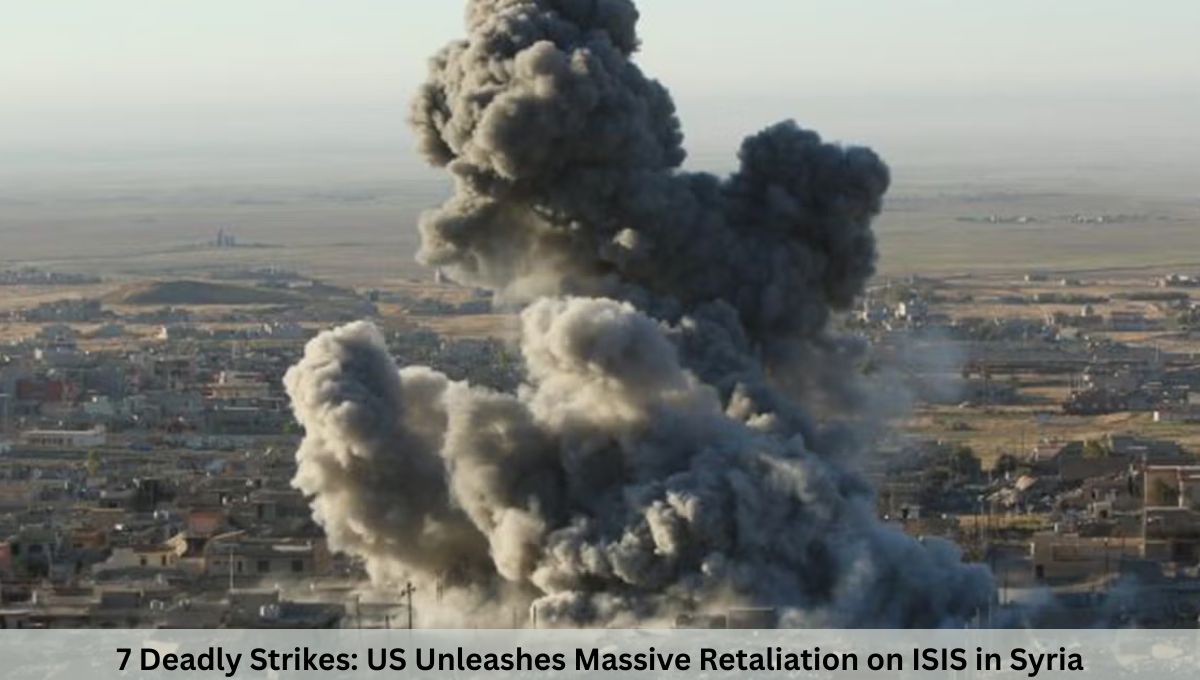
7 Deadly Strikes: US Unleashes Massive Retaliation on ISIS in Syria After Palmyra Attack Killed American Troops.The United States has carried out what it describes as a “massive” military strike against Islamic State (ISIS) targets in Syria, marking a significant escalation in its counterterrorism campaign following the killing of American personnel earlier this month.
The operation, named Operation Hawkeye Strike, was launched in direct response to a deadly ambush in the historic Syrian city of Palmyra on December 13, where two US soldiers and a civilian interpreter were killed. American officials have attributed the attack to ISIS, vowing swift and forceful retaliation.
According to the US military’s Central Command (CENTCOM), the strikes targeted more than 70 ISIS-linked locations across central Syria, employing over 100 precision-guided munitions and involving fighter jets, attack helicopters, artillery units, and coalition support aircraft from Jordan.
7 Deadly Strikes: US Unleashes Massive Retaliation on ISIS in Syria
What Is Operation Hawkeye Strike?
Operation Hawkeye Strike represents one of the most extensive US military responses to ISIS activity in Syria in recent years. CENTCOM confirmed that the operation began at 4:00 pm Eastern Time (21:00 GMT) and focused on degrading ISIS’s remaining operational capabilities.
Key Objectives of the Operation
- Destroy ISIS infrastructure and weapons storage sites
- Eliminate senior and mid-level ISIS leadership
- Prevent future attacks on US and coalition forces
- Signal deterrence against threats to American personnel
US officials stated that intelligence gathered from previous counterterrorism missions helped identify the targets struck during the operation.
Scale and Firepower of the US Strikes
CENTCOM said the operation involved:
- F-15 Eagle fighter jets
- A-10 Thunderbolt ground-attack aircraft
- AH-64 Apache helicopters
- Artillery and rocket systems
- Coalition aircraft support from Jordan
The strikes hit ISIS facilities spread across central Syria, including areas near Raqqa and Deir ez Zor, regions historically used by the group as operational hubs.
A senior US official described the action as a “large-scale strike” and warned that additional attacks could follow if ISIS continues to pose a threat.
Trump: ‘We Are Striking Very Strongly’
President Donald Trump confirmed the strikes in a series of posts on Truth Social, describing the operation as promised retaliation for the killing of American personnel.
“We are striking very strongly against ISIS strongholds in Syria,” Trump wrote. “The United States is inflicting very serious retaliation, just as I promised, on the murderous terrorists responsible.”
Trump also said that Syria’s current government fully supported the operation, a notable statement given the complex history between Washington and Damascus.
Defense Secretary Calls It a ‘Declaration of Vengeance’
US Defense Secretary Pete Hegseth issued some of the strongest language yet from the Pentagon regarding counterterrorism operations.
“This is not the beginning of a war — it is a declaration of vengeance,” Hegseth said. “If you target Americans anywhere in the world, you will spend the rest of your brief, anxious life knowing the United States will hunt you down.”
He added that US forces had already killed multiple ISIS fighters during the opening phase of the operation and would continue targeting the group relentlessly.
The Palmyra Attack That Triggered the Strikes
The airstrikes follow a December 13 ambush in Palmyra, where a convoy of US and Syrian forces was attacked.
Casualties
- Two US Army soldiers (Iowa National Guard)
- One civilian interpreter
- Three additional US soldiers wounded
The US military said the attacker was an ISIS gunman who was later killed. However, Syrian officials claimed the attacker may have been a member of Syrian security forces with suspected ISIS sympathies, highlighting ongoing uncertainties about ISIS infiltration.
No group has officially claimed responsibility for the attack.
Who Were the Fallen US Soldiers?
The US Army identified the slain soldiers as:
- Sgt. Edgar Brian Torres-Tovar, 25, of Des Moines, Iowa
- Sgt. William Nathaniel Howard, 29, of Marshalltown, Iowa
Both were members of the Iowa National Guard’s 1st Squadron, 113th Cavalry Regiment. Three additional Iowa Guard members were wounded and evacuated for treatment.
Syria’s Role and Support
In a notable development, Syria’s post-Assad government publicly expressed support for the US operation.
The Syrian Ministry of Foreign Affairs stated that it:
- Reiterates its commitment to fighting ISIS
- Invites the US and coalition partners to assist in eliminating ISIS safe havens
- Will intensify its own military operations against the group
President Ahmed al-Sharaa, who came to power after the fall of Bashar al-Assad in late 2024, has sought closer cooperation with Washington as part of Syria’s rebuilding efforts.
International Coalition Involvement
CENTCOM confirmed that the Jordanian Armed Forces provided air support during Operation Hawkeye Strike.
The US-led coalition has conducted numerous joint operations in Syria in recent months, combining airstrikes, intelligence-sharing, and ground missions.
US officials emphasized that the coalition’s involvement underscores continued international commitment to preventing ISIS’s resurgence.
Is ISIS Still a Threat in Syria?
Although ISIS lost its last territorial stronghold in Syria in 2019, the group remains active through:
- Sleeper cells
- Small-scale ambushes
- Targeted attacks on military convoys
The United Nations estimates that ISIS still has 5,000 to 7,000 fighters operating across Syria and Iraq.
US officials warn that instability and post-war reconstruction challenges create opportunities for ISIS to regroup if not aggressively countered.
US Military Presence in Syria
Approximately 1,000 US troops remain stationed in Syria as part of the long-running campaign against ISIS.
Their mission includes:
- Training local partner forces
- Conducting counterterrorism raids
- Providing intelligence and air support
The US presence dates back to 2015, when ISIS controlled large swathes of Syria and Iraq.
A Message of Deterrence
US officials say Operation Hawkeye Strike was designed not only to punish ISIS but to send a broader message.
“The goal is to deliver a decisive blow to ISIS remnants and their ability to threaten US forces,” a senior official said.
Trump echoed this sentiment, stating that Syria could have a “bright future” if ISIS is fully eradicated.
What Happens Next?
While casualty figures from the strikes have not been independently verified, monitoring groups report that a senior ISIS leader and multiple fighters were killed.
US officials caution that the campaign is not over and that further strikes are likely if intelligence points to ongoing threats.
As Syria marks one year since the fall of Assad’s regime, the country continues to grapple with security risks, economic hardship, and the challenge of rebuilding after more than a decade of war.
Conclusion
Operation Hawkeye Strike marks a significant escalation in US military action against ISIS in Syria, underscoring Washington’s commitment to protecting its forces and preventing a resurgence of the extremist group.
With Syria’s new government backing the operation and coalition partners involved, the strikes signal a rare alignment of interests in a region long marked by conflict and division.
For now, US leaders have made one thing clear:
attacks on American personnel will be met with overwhelming force.
Also Read: Trump Meets Syria’s New Leader Ahmad al-Sharaa, Signals Historic Shift in U.S. Foreign Policy
Also Read: Deadly ISIS attack tests Trump’s Syria policy, ability to retaliate
Related Posts:
- Israel-Syria Ceasefire Begins as Druze-Bedouin…

- Israel Launches Strikes in Syria to Protect Druze…
- Israel Launches Strikes on Syria After Rocket Fire:…
- Ceasefire in Suwayda Wobbles as Israeli Strikes Hit Syria
- 7 Powerful New Developments in the White House Shooting Case

- Afghanistan–Pakistan War 2025: Inside the 48-Hour Ceasefire
