

4th US Aircraft Lost: KC-135 Crash in Iraq Sparks Major Rescue Operation during Operation Epic Fury. The ongoing conflict between the United States, Israel, and Iran has taken another dramatic turn after a US military refueling aircraft crashed in western Iraq, prompting an urgent rescue operation by American forces. The aircraft, identified as a KC-135 Stratotanker, went down during a mission linked to the US military campaign against Iran, known as Operation Epic Fury.
US Central Command confirmed the incident and said rescue operations were underway, but officials did not immediately confirm whether there were casualties among the crew members on board.
The crash marks the fourth American aircraft lost since the war began, raising questions about operational risks as the conflict expands across the Middle East.
While Iran-aligned militias in Iraq have claimed responsibility for shooting down the aircraft, the US military has stated that the crash was not caused by hostile or friendly fire, leaving the exact cause under investigation.
The incident adds another layer of tension to a conflict that has already spread across several countries and disrupted global energy markets.
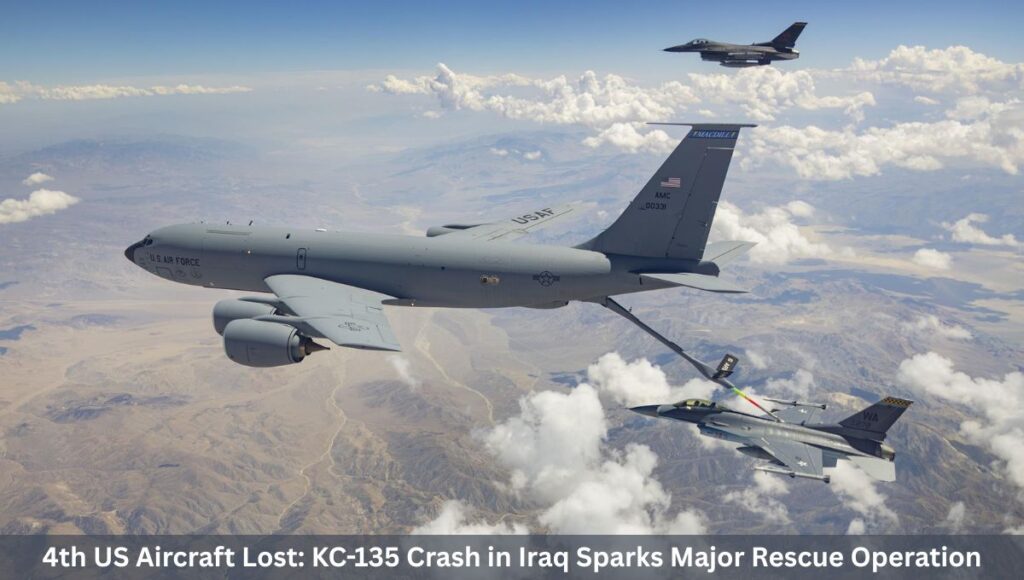
4th US Aircraft Lost: KC-135 Crash in Iraq Sparks Major Rescue Operation
What Happened: US KC-135 Aircraft Crash in Western Iraq
The United States military confirmed that the aircraft involved in the crash was a KC-135 aerial refueling tanker, a critical component of the US Air Force’s long-range combat operations.
According to a statement from US Central Command (CENTCOM), the crash occurred in friendly airspace during operations connected to the war against Iran.
Officials revealed that two aircraft were involved in the incident. One of the planes crashed in western Iraq, while the second aircraft landed safely.
The Pentagon clarified that the crash was not the result of enemy fire or friendly fire, suggesting that the incident may have been caused by technical issues or operational complications.
Rescue teams were immediately deployed to locate the crew and secure the crash site.
At least five crew members were reportedly on board the aircraft when it went down, though authorities have not yet confirmed whether they survived.
CENTCOM said more information would be released once the rescue operation and investigation progressed.
Rescue Efforts Underway
US military officials launched a large rescue effort shortly after the crash was reported.
Search and recovery teams were sent to the crash site in western Iraq, near the border with Jordan.
The remote desert terrain in the region can complicate rescue operations, particularly when aircraft wreckage is scattered across wide areas.
Military helicopters and ground units were reportedly involved in the search for survivors.
Officials have urged patience as they work to gather accurate information and notify the families of the service members involved.
The Pentagon said it would provide updates as soon as details become clearer.
What Is the KC-135 Stratotanker?
The aircraft involved in the crash plays a crucial role in US military operations.
Aerial Refueling Backbone
The KC-135 Stratotanker is an aerial refueling aircraft used by the US Air Force to extend the range and endurance of fighter jets and other military aircraft.
It allows combat aircraft to stay in the air longer without landing for fuel, making it essential for long-distance military missions.
The tanker transfers fuel to other aircraft through a boom system operated by a specialized crew member.
This capability is particularly important during overseas military operations such as those currently taking place in the Middle East.
Long Service History
The KC-135 is one of the oldest aircraft still used by the US military.
The aircraft was originally developed in the 1950s and early 1960s by Boeing and has remained in service for more than six decades.
Although it has undergone multiple upgrades, many KC-135 aircraft are still based on the original design derived from the Boeing 707 passenger jet.
According to US Air Force data, more than 370 KC-135 aircraft remain in the fleet, including units operated by the active Air Force, the Air National Guard, and the Air Force Reserve.
Crew and Capabilities
A typical KC-135 mission includes a crew of three or four members:
- Pilot
- Co-pilot
- Boom operator
- Navigator (in some missions)
The aircraft can also carry cargo, medical patients, and passengers when required. Its ability to support combat operations across long distances makes it a key strategic asset.
Fourth Aircraft Loss in the Iran War
The crash in Iraq represents the fourth US aircraft loss since the war with Iran began.
Earlier in the conflict, three F-15E Strike Eagle fighter jets were accidentally shot down by friendly fire.
According to US Central Command, the incident occurred during active combat operations when Kuwaiti air defenses mistakenly targeted the American aircraft.
Fortunately, all six crew members aboard the F-15 jets were able to eject safely and were rescued.
Even though there were no fatalities in that incident, the loss of multiple aircraft highlights the complexity and risks involved in large-scale military operations.
Iran-Backed Militias Claim Responsibility
Shortly after the crash, an Iran-aligned militia group in Iraq claimed responsibility for shooting down the US aircraft.
The group, known as the Islamic Resistance in Iraq, said it had targeted the tanker aircraft in defense of Iraqi sovereignty.
The organization posted a statement on social media saying it had successfully downed the plane. However, the US military has rejected that claim.
Officials insist that the crash was not caused by enemy action, though the investigation is still ongoing. Conflicting narratives about the incident have added to the confusion surrounding the crash.
US Military Losses in the Conflict
The crash also comes as the United States faces increasing casualties in the war.
According to Pentagon officials, at least seven US service members have died since the conflict began. More than 140 American troops have been wounded, including several with severe injuries.
One of the deadliest incidents occurred when an Iranian drone struck a US operations center at a civilian port in Kuwait. Six American personnel were killed in that attack.
Another US soldier later died from injuries sustained during a strike on Prince Sultan Air Base in Saudi Arabia. These casualties highlight the growing human cost of the war.
War Begins to Take a Political Toll in the United States
Beyond the battlefield, the conflict with Iran has also sparked political debate in the United States. Public opinion polls show that many Americans are skeptical about the war.
A survey conducted by Quinnipiac University found that 53 percent of US voters oppose the military offensive against Iran.
Even more striking, 74 percent of respondents rejected the idea of sending US ground troops into the conflict. Other surveys have produced similar results.
Research firm Ipsos reported that 43 percent of Americans disapprove of the US strikes, while only 29 percent expressed support.
The remainder said they were uncertain. These numbers suggest that the war may be one of the least popular US military campaigns in recent decades.
Division Within Trump’s Support Base
The conflict has even caused divisions within the political movement that supports US President Donald Trump. Several prominent conservative figures have openly criticized the war.
Media personality Tucker Carlson, for example, described the conflict as deeply troubling. In one interview, Carlson said the war was “absolutely disgusting and evil.”
He also suggested that Trump might have been misled by advisers about public support for the military campaign.
Trump responded by rejecting Carlson’s criticism and distancing himself from the commentator.
The president emphasized that his political movement is focused on putting American interests first.
Conflicting Justifications for the War
The Trump administration has provided several different explanations for why the military operation against Iran was necessary.
In some statements, officials have argued that the strikes were needed to prevent Iran from developing nuclear weapons.
At other times, the administration has suggested the operation was intended to counter Iranian influence in the region.
Trump himself has warned that failing to confront Iran could have led to a nuclear conflict in the future.
Meanwhile, US Secretary of State Marco Rubio initially said the US acted because Israel was planning its own strike on Iran.
However, he later walked back those comments. These shifting explanations have added to the debate over the war’s objectives.
Growing Regional Escalation
The conflict between the United States and Iran has rapidly expanded beyond the borders of the two countries. Fighting has spread across several parts of the Middle East.
Missile attacks, drone strikes, and naval incidents have been reported in Iraq, Kuwait, Saudi Arabia, and the Persian Gulf. Shipping routes near the Strait of Hormuz have also been disrupted.
This narrow waterway is one of the world’s most important oil transit routes, carrying roughly 20 percent of global oil supply. Any disruption in the strait could have major economic consequences worldwide.
Global Energy Markets React
Energy markets have already reacted to the instability in the region. Oil prices surged sharply after the conflict began.
At one point, global crude prices rose above $100 per barrel, sparking concerns about rising fuel costs and inflation.
Iranian officials have warned that prices could climb even higher if the conflict intensifies.
Some analysts believe oil could reach $200 per barrel if shipping routes in the Persian Gulf are severely disrupted. Such a scenario could trigger a global economic shock.
Strategic Importance of Air Refueling Aircraft
The crash of the KC-135 tanker also highlights the importance of aerial refueling in modern warfare.
Refueling aircraft allow fighter jets and bombers to remain in the air for extended periods. Without these tankers, many long-range missions would not be possible.
During Operation Epic Fury, aerial refueling aircraft have been essential in supporting strikes across the Middle East.
They allow US and allied aircraft to operate over long distances without returning to base. The loss of such an aircraft can temporarily reduce operational capacity.
Investigation Into the Crash
Military investigators are now trying to determine what caused the aircraft to crash.
Several possible factors are being considered, including:
- Mechanical failure
- Mid-air collision risk
- Technical malfunction
- Navigation issues
Because two aircraft were involved in the incident, investigators are also examining whether operational maneuvers played a role.
The Pentagon has promised a full investigation once rescue operations are completed.
Uncertainty Over the Crew’s Fate
One of the biggest unanswered questions remains the fate of the crew members on board the crashed aircraft.
Officials have not yet confirmed whether there were survivors. Military rescue teams continue to search the crash site.
The Pentagon has said it will release additional information once the situation becomes clearer.
Families of the service members involved are currently awaiting updates from the military.
War Continues Despite Losses
Despite the aircraft crash and growing casualties, the conflict between the United States, Israel, and Iran shows no sign of ending soon.
Military operations continue across multiple countries in the region. Iran has warned that it will retaliate against US forces and regional allies.
At the same time, the United States says it remains committed to achieving its objectives in the conflict.
President Trump has repeatedly stated that the military campaign is necessary for US national security.
Conclusion
The crash of a US KC-135 refueling aircraft in western Iraq marks another serious development in the escalating war involving the United States, Israel, and Iran.
With rescue operations still underway and the cause of the crash under investigation, many questions remain unanswered.
The incident also highlights the increasing risks facing military personnel as the conflict spreads across the Middle East. As global powers watch closely, the situation continues to evolve.
Whether the war will escalate further or move toward diplomacy remains uncertain, but the loss of another aircraft underscores how quickly the conflict is intensifying.
Also Read: 9 Chilling Details as Libyan Army Chief Dies in Turkey Plane Crash
Also Read: US military KC-135 goes down in Iraq: What caused the crash? CENTCOM clarifies
Related Posts:
- Southend Plane Crash: Jet to Netherlands Explodes…

- 7 Key Details About Deadly UPS Cargo Plane Crash in Kentucky

- Tragedy in Ahmedabad: Air India AI-171 Crash Claims…
- Bangladesh Jet Crash Kills 27, Including 25 Children
- Siemens Spain CEO Agustín Escobar, Wife, and Three…

- Bangladesh Fighter Jet Crashes into Dhaka School, Killing 19
