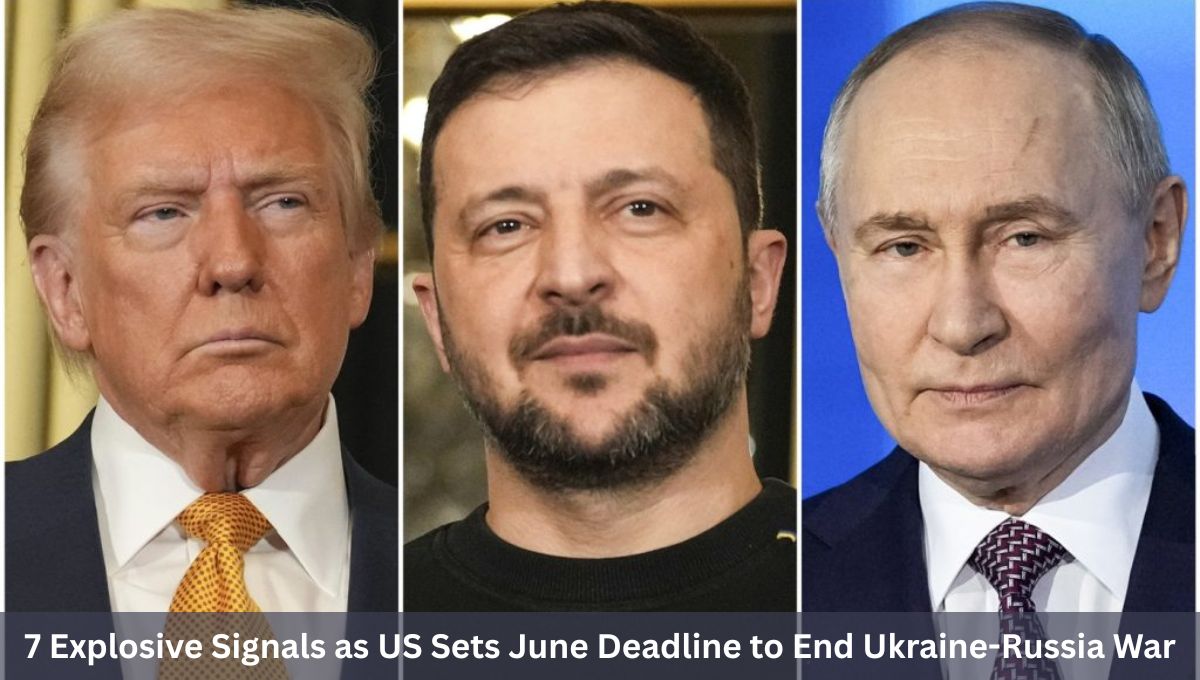
7 Explosive Signals as US Sets June Deadline to End Ukraine-Russia War, warns of pressure on both sides. The United States has proposed a June deadline for Ukraine and Russia to reach an agreement to end their nearly four-year-long war, a move that underscores Washington’s growing urgency to force momentum into stalled peace efforts.
Ukrainian President Volodymyr Zelenskyy confirmed that the Trump administration has made clear it wants the conflict resolved by early summer and is prepared to apply pressure on both sides if negotiations fail to meet that timeline.
“The Americans are proposing that the parties end the war by the beginning of this summer,” Zelenskyy told reporters. “They will probably put pressure on the parties precisely according to this schedule.”
The announcement comes as Russian strikes intensify, particularly against Ukraine’s energy and nuclear infrastructure, deepening skepticism about Moscow’s commitment to diplomacy and raising fears that battlefield realities may once again overwhelm negotiations.
7 Explosive Signals as US Sets June Deadline to End Ukraine-Russia War
Why Washington Is Pushing a June Deadline
A War Entering Its Fifth Year
Russia’s full-scale invasion of Ukraine began in February 2022, evolving into the largest European land war since World War II.
Despite massive Western military aid, Ukraine has struggled to reclaim territory seized by Moscow, which currently occupies around 20% of Ukrainian land, including Crimea and large parts of the Donbas.
With the war dragging into a fourth winter cycle, Washington appears increasingly determined to force a political outcome.
Senior US negotiators have privately acknowledged that time is not on their side.
US Political Calendar Adds Urgency
According to multiple diplomatic sources, the Trump administration is keen to secure a foreign-policy breakthrough before domestic political pressures intensify, particularly ahead of US congressional midterms.
As one official put it, “The Americans are in a hurry.”
If talks drag on into late 2026, Washington’s attention—and political capital—could shift decisively inward, reducing its leverage over both Kyiv and Moscow.
Trilateral Talks Move to the United States for the First Time
Miami Emerges as Likely Venue
Zelenskyy revealed that the US has proposed hosting the next round of trilateral talks—involving Ukraine, Russia, and the United States—on American soil for the first time, likely in Miami, Florida.
“We have confirmed our participation,” Zelenskyy said.
Until now, negotiations have been held in Abu Dhabi, chosen for its neutral diplomatic posture and established mediation channels.
A US-hosted round would signal Washington’s direct ownership of the process, increasing both visibility and political stakes.
What Has Been Achieved So Far—and What Hasn’t
Prisoner Swaps: A Rare Breakthrough
The only tangible success of recent talks has been prisoner exchanges.
In the most recent round:
- 314 prisoners of war were released
- Each side handed over 157 detainees
- Both Kyiv and Moscow confirmed the exchange
US special envoy Steve Witkoff described the swap as proof that “sustained diplomatic engagement is delivering tangible results.”
Yet beyond humanitarian gestures, core political disputes remain unresolved.
The Territorial Deadlock: Donbas at the Center
Russia’s Maximalist Demands
The biggest obstacle to peace remains territory, particularly Ukraine’s eastern Donbas region.
Russia is demanding:
- Full Ukrainian withdrawal from Donetsk and Luhansk
- Formal recognition of Russian control over occupied areas
Ukraine has rejected these demands outright.
“We stand where we stand,” Zelenskyy said, insisting the current frontline should form the basis of any ceasefire.
Kyiv argues that conceding territory is:
- Politically unacceptable
- Constitutionally prohibited
- Likely to be rejected by Ukrainian voters in any referendum
Zaporizhzhia Nuclear Power Plant: A Dangerous Sticking Point
Another flashpoint is the Zaporizhzhia nuclear power plant, Europe’s largest, located in Russian-occupied territory.
Competing Proposals
- US proposal: International or US oversight, power distributed to both sides
- Russian position: Moscow retains control, offers Ukraine discounted electricity
Ukraine has dismissed the Russian offer, warning that any arrangement leaving the plant under Kremlin control poses long-term security risks.
The International Atomic Energy Agency (IAEA) has repeatedly warned that ongoing strikes near the plant endanger nuclear safety across Europe.
Russian Strikes Undermine Peace Efforts
Massive Assault on Energy Infrastructure
Even as negotiations continue, Russia has escalated its attacks on Ukraine’s power grid.
According to Zelenskyy:
- Over 400 drones
- Around 40 missiles
were launched overnight in one of the largest energy-focused assaults this year.
Targets included:
- Power generation facilities
- High-voltage substations
- Distribution networks
- Infrastructure supporting nuclear plants
Ukraine’s grid operator Ukrenergo confirmed that all nuclear power plants in government-controlled areas were forced to reduce output.
“This is a level of attack that no terrorist in the world has ever dared,” Zelenskyy said.
Energy Warfare and Winter Leverage
Power Cuts Across the Country
The strikes triggered:
- Emergency blackouts nationwide
- Reduced nuclear output
- Severe power shortages in freezing temperatures
More than 600,000 households in western Ukraine alone lost electricity.
Ukrainian officials accuse Moscow of using cold weather as a weapon, deliberately targeting energy systems to weaken civilian morale and negotiating leverage.
US Proposal for Energy De-Escalation
Washington has proposed a renewed energy ceasefire, prohibiting attacks on power and nuclear infrastructure.
- Ukraine has agreed
- Russia has not formally committed
Despite earlier Kremlin assurances of restraint, Ukraine says Russia violated the pause within days.
Elections and Referendums: A Controversial US Push
Voting as Part of a Peace Deal
US and Ukrainian officials have discussed a framework that would:
- Submit any peace deal to a national referendum
- Hold presidential and parliamentary elections simultaneously
Some sources say May was floated as a possible voting window.
However, Ukrainian election authorities warn:
- Elections under martial law are illegal
- Organizing a vote would take at least six months
- Major legislative changes would be required
“The timeline is fanciful,” one official said.
Security Guarantees Remain Ukraine’s Red Line
Kyiv insists that no agreement is possible without iron-clad security guarantees from the US and its partners.
Ukraine fears that:
- Russia could regroup and attack again
- Past ceasefires have been routinely violated
“There can be no end to the war without security guarantees,” Zelenskyy said.
Russia’s Negotiating Posture Raises Doubts
While Ukraine has sent senior political leaders to talks, Russia’s delegation is dominated by military intelligence officials, led by GRU chief Admiral Igor Kostyukov.
The imbalance has fueled skepticism about Moscow’s seriousness.
Complicating matters further, Kostyukov’s deputy was shot in Moscow, an incident Russia blamed on Ukraine—an allegation Kyiv denies.
Public Opinion in Ukraine: A Risky Referendum
Even if negotiators strike a deal, Ukrainian voters could still reject it.
Polls show:
- A majority oppose territorial concessions
- Support for compromise has narrowed slightly, but remains fragile
Analysts warn that a rejected referendum could:
- Collapse the peace process
- Deepen political instability
- Undermine Ukraine’s wartime unity
Trump’s Promise vs Reality
Donald Trump famously claimed he would end the war “within 24 hours” of taking office.
More than a year later:
- The front lines have barely shifted
- Russia has gained about 1.3% of territory since early 2023
- Peace remains elusive
Critics accuse Trump of:
- Underestimating Russian demands
- Pressuring Ukraine disproportionately
- Prioritizing speed over sustainability
The White House has declined to comment on what actions the US would take if the June deadline is missed.
What Happens If June Passes Without a Deal?
Possible US Pressure Tools
- Reduced military aid
- Increased diplomatic pressure
- Sanctions recalibration
- Leveraging international financial support
However, applying equal pressure to both sides risks alienating Ukraine, which depends heavily on Western backing.
Global Stakes Extend Far Beyond Ukraine
The outcome of the war affects:
- European security architecture
- Global energy markets
- Nuclear safety norms
- The credibility of international law
A rushed or unstable peace could set a dangerous precedent, while prolonged war risks escalation.
Conclusion: A Deadline That Could Define the War
The US-imposed June deadline marks a pivotal moment in the Ukraine-Russia conflict.
It represents:
- Washington’s impatience with stalemate
- A gamble that pressure can force compromise
- A risk that diplomacy may outrun realities on the ground
Whether June becomes the month of peace—or merely another missed milestone—will depend not on deadlines alone, but on whether core issues of territory, security, and sovereignty can finally be bridged.
For now, Ukraine continues to fight, Russia continues to strike, and the world watches as the clock ticks toward a summer that could reshape Europe’s future.
Also Read: Trump Likens Ukraine War to ‘Fight Between Kids’, Says Let Them ‘Fight for a While’
Also Read: US sets June deadline for Ukraine-Russia peace deal, next talks likely in US, Zelensky says