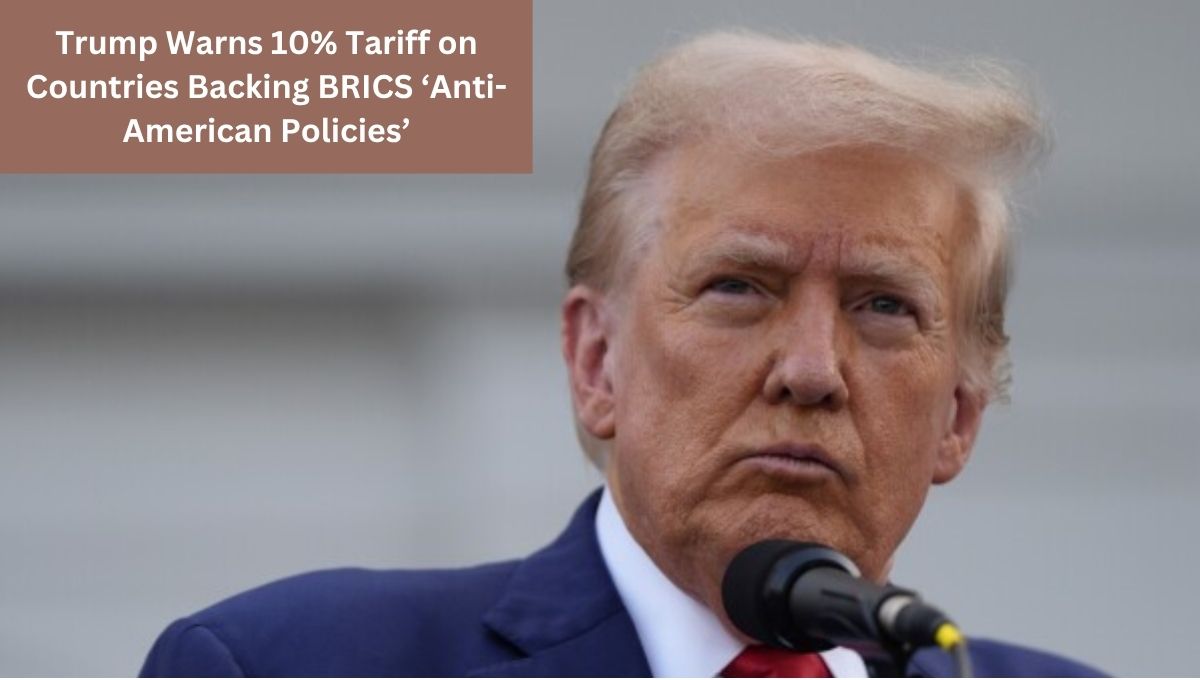
In a significant escalation of trade tensions, Trump Warns 10% Tariff on Countries Backing BRICS ‘Anti-American Policies.’ U.S. President Donald Trump has warned that any country aligning itself with the BRICS alliance and its so-called “anti-American policies” will face an additional 10% tariff on all imports entering the United States. The bold announcement came via Trump’s Truth Social platform on Sunday, just ahead of the July 9 expiration of a critical 90-day tariff pause.
This latest threat targets both official BRICS members and other nations seen as sympathetic to the bloc’s economic and geopolitical agenda. As the BRICS 2025 Summit wrapped up in Rio de Janeiro, the group issued a joint declaration criticizing U.S. trade policy, sanctions, and military actions fueling an already heated climate of global economic rivalry.
Trump Warns 10% Tariff on Countries Backing BRICS ‘Anti-American Policies’
“No Exceptions”: Trump’s Message to BRICS-Aligned Countries
Trump’s statement left no room for ambiguity:
“Any Country aligning themselves with the Anti-American policies of BRICS will be charged an ADDITIONAL 10% Tariff. There will be no exceptions to this policy.”
While the statement didn’t list specific policies deemed “anti-American,” it was clearly a reaction to BRICS nations pushing for reforms to global financial institutions, the promotion of local currencies, and vocal opposition to U.S. military actions, particularly recent airstrikes on Iran.
BRICS 2025 Summit: A Clear Challenge to U.S. Hegemony
The BRICS Summit in Brazil marked a turning point for the bloc’s political voice on the global stage.
The joint Rio Declaration took aim at:
- U.S. and Israeli airstrikes on Iran’s military and nuclear infrastructure
- Unilateral trade barriers, especially tariffs and sanctions
- Delays in IMF and WTO reforms
The declaration argued that such moves “undermine global economic stability” and urged a return to rules-based, equitable, and multilateral trading systems.
Although the U.S. was not named directly, the criticisms were unmistakable.
BRICS Bloc Expands and Gains Influence
Originally composed of Brazil, Russia, India, China, and South Africa, BRICS has grown in ambition and influence.
The group now includes Iran, Egypt, Ethiopia, Indonesia, the UAE, and Saudi Arabia countries that collectively represent over 50% of the global population.
The bloc has also extended lower-tier membership or observer status to Belarus, Nigeria, Vietnam, Thailand, and others.
This growing influence, especially in the Global South, has alarmed U.S. policymakers who see BRICS as challenging the dollar-dominated world order.
Trump’s Trade Doctrine: Tariffs as Pressure
The tariff threat forms part of Trump’s wider “America First” economic agenda, which uses trade tools to pressure nations into bilateral agreements favorable to the U.S.
The current 90-day tariff pause, initiated in April 2025, ends on July 9, after which new tariffs could reach up to 50%–70% for countries deemed to engage in unfair practices or trade deficits.
Treasury Secretary Scott Bessent explained: “If you don’t move things along, then on August 1 you will boomerang back to your April 2 tariff level.”
India’s Diplomatic Tightrope Between BRICS and the U.S.
India, a founding BRICS member and a key U.S. Indo-Pacific ally, finds itself in a particularly delicate position.
While Prime Minister Narendra Modi attended the BRICS summit that criticized U.S. foreign and trade policy, India is also in advanced trade negotiations with the U.S., hoping to secure an exemption from the looming tariffs.
Key points in the India-U.S. trade deal include:
- Support for Indian labor-intensive sectors
- Exemptions for sensitive sectors like rice, dairy, wheat, and GM crops
- Concessions on steel and auto exports
Yet, India’s active role in BRICS and its quiet backing of the group’s de-dollarization agenda could complicate the optics and outcome of its trade deal with Washington.
The De-Dollarization Push and Trump’s 100% Tariff Warning
One of BRICS’ major long-term goals is to reduce dependence on the U.S. dollar. At the summit, members endorsed progress on a cross-border payment system using local currencies an idea seen by Trump as an existential threat to American economic power.
Earlier this year, Trump warned of tariffs up to 100% on countries promoting alternatives to the dollar.
While no formal “BRICS currency” exists, the shift to local currency trade is gaining traction, especially in energy and commodities exchanges between China, India, Russia, and the Middle East.
How Other Nations Are Responding: Vietnam and Thailand React
As the U.S. ramps up tariff pressure, some countries are already scrambling to make deals.
- Vietnam has reportedly finalized a deal that maintains a 20% tariff on its exports to the U.S. but offers zero tariffs on U.S. goods something Trump called “fantastic.”
- Thailand, aiming to avoid a 36% tariff, is offering greater access for U.S. agriculture, energy products, and Boeing aircraft purchases.
Commerce Secretary Howard Lutnick confirmed that letters will be sent to over 100 countries starting Monday, July 7.
Many are expected to be given a choice: accept the baseline 10% tariff or strike a customized bilateral deal.
Defending the Tariffs: White House Pushes Back on Inflation Fears
The administration has dismissed concerns that the aggressive tariff policy could stoke inflation or hurt American consumers.
Stephen Miran, Chairman of the Council of Economic Advisers, said: “Tariff revenue is pouring in. There’s no sign of any economically significant inflation and job creation remains healthy.”
Bessent added that rising wholesale prices are unrelated to tariffs and labeled concerns as “tariff derangement syndrome.”
Yet, critics like former Treasury Secretary Larry Summers warn of long-term harm to U.S. competitiveness and risks of global economic fragmentation.
Trump’s Mixed Track Record on Trade Deals
Despite Trump’s claim of having made over 200 trade deals, only a few have been publicly confirmed:
- United Kingdom: Maintained 10% tariff rate
- China: Temporarily reduced tariffs from 145% to 30%
- Vietnam: Struck a one-sided deal in favor of U.S. exports
Bessent noted that many countries “never even contacted us” during the pause period, prompting the U.S. to apply maximum pressure starting this week.
Global Trade at a Crossroads: Choose a Side?
Trump’s threats raise difficult questions for middle-ground nations. Countries like Indonesia, Saudi Arabia, India, and South Africa must now weigh BRICS alignment against the risk of U.S. economic retaliation.
The situation puts pressure on nations that have historically tried to maintain strategic neutrality balancing relationships with both Western economies and emerging alliances like BRICS.
Conclusion: Trade War 2.0 or Tactical Victory?
As the July 9 tariff deadline approaches and the U.S. sends out letters to trading partners, the global economy stands at a crossroads.
Trump’s 10% tariff threat on BRICS-aligned countries could:
- Yield fast-tracked trade deals
- Deter further BRICS expansion
- Trigger a new phase of economic realignment
But the risks are just as high: Trump’s approach could alienate key partners, push countries further into BRICS’s orbit, and erode America’s long-standing role as leader of global trade diplomacy.
The outcome hinges not just on whether deals are signed but on whether countries believe they can afford to remain neutral in a polarized world economy.
Also Read: Lula to Trump: ‘We Don’t Want an Emperor’ as BRICS Rejects US Tariff Threat
Also Read: Why is Donald Trump so afraid of BRICS?
Related Posts:
- 5 Powerful Highlights as Trump Lands Second Nobel…

- Can the EU and NATO Impose Tariffs on India and…

- Trump’s 2025 Gaza Peace Plan Signing and Historic…

- Dramatic Moments Behind Trump’s Gaza Peace Push and…

- Trump to Host 2026 G20 Summit at His Florida Golf…

- 9 Explosive Revelations as Trump Declares His Health…