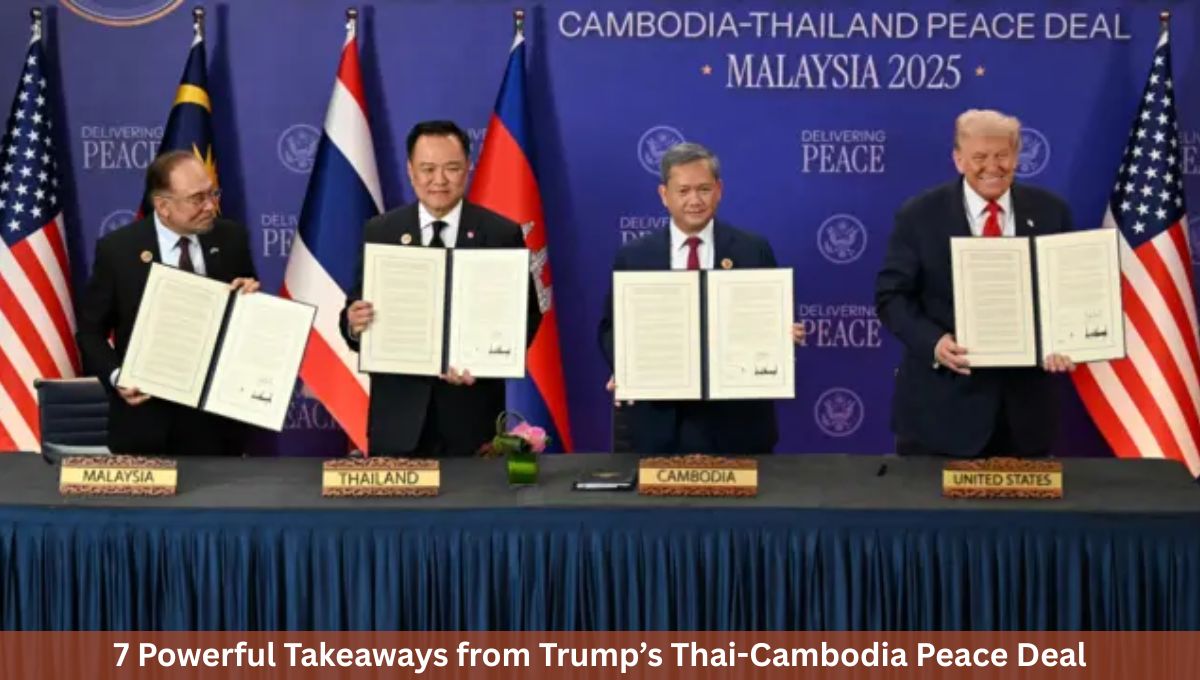
7 Powerful Takeaways from Trump’s Thai-Cambodia Peace Deal, hailed by some as historic but dismissed by others as political theatre. It was, as everyone expected, all about Donald Trump.
The American president’s arrival in Kuala Lumpur for the 47th ASEAN Summit was marked by spectacle and self-congratulation.
Cameras captured him towering over Southeast Asian leaders as he presided over what he called a “monumental” moment — the signing of the Thailand-Cambodia Kuala Lumpur Peace Accords.
Trump proclaimed:
“This is a momentous day for Southeast Asia — a monumental step.”
The ceremony, held under Malaysia’s ornate convention-hall chandeliers, saw the Thai and Cambodian prime ministers sign a ceasefire agreement that Trump said he personally brokered while “giving up a round of golf” in Scotland. Yet, behind the grandeur and glowing rhetoric lies a more complex picture.
7 Powerful Takeaways from Trump’s Thai-Cambodia Peace Deal
1. What the Kuala Lumpur Peace Accords Actually Contain
The accord formalizes a ceasefire first agreed in July 2025, following five days of deadly border clashes between Thai and Cambodian forces.
Key provisions include:
- Withdrawal of heavy weapons from the disputed frontier.
- Deployment of an interim observer team led by Malaysia.
- Joint taskforce to address border scam centres and trafficking.
- New landmine-clearing protocol along the 800 km boundary.
- Temporary replacement of missing border markers.
- Thailand’s release of 18 Cambodian soldiers captured in July.
While the framework sounds ambitious, diplomats acknowledge it’s an incremental update to the existing truce rather than a comprehensive peace treaty.
Thai Foreign Minister Sihasak Phuangketkeow told reporters the deal should be viewed as a “pathway to peace,” resisting Trump’s grander description of it as a “historic accord.”
“It’s an extremely slight agreement for the President of the United States to be presiding over,” noted Sebastian Strangio, Southeast Asia Editor of The Diplomat.
2. Trump’s Quest for Peacemaker Status
The peace ceremony fulfilled one of Trump’s personal conditions for attending the ASEAN Summit. He had pressed for a public signing ceremony that would highlight his role as a global dealmaker.
Boasting to reporters, he claimed:
“The eight wars that my administration has ended in eight months — there’s never been anything like it… I’m good at peace, and I love to do it.”
In the same session, Cambodian Prime Minister Hun Manet announced that his government had nominated Trump for the Nobel Peace Prize, citing his “decisive leadership” in ending years of Thai-Cambodian border tension.
Hun told the assembled dignitaries:
“Peace saves lives, and this is the heartfelt wish of our people.”
The nomination adds Cambodia to a growing list of Trump’s Nobel backers — from Israel and Pakistan to Armenia, Azerbaijan, Rwanda, and Malta.
3. The Border Conflict: A Century-Old Dispute
The Thai-Cambodian rivalry traces back to 1907, when a French colonial treaty ambiguously defined their frontier. At the heart of contention lie the ancient temples of Preah Vihear and Ta Muen Thom, perched on the Dangrek Mountains.
Occasional clashes have erupted for decades. The most serious since 2011 killed 16 people and drew the UN Security Council’s attention.
In July 2025, renewed fighting displaced about 300,000 civilians, prompting emergency mediation by Malaysia, which chairs ASEAN this year. Trump’s threat of additional US tariffs up to 48 percent on both economies reportedly helped push Bangkok and Phnom Penh toward a truce.
4. Malaysia’s Quiet Mediation Role
While Trump seized the spotlight, Malaysian Prime Minister Anwar Ibrahim played a pivotal behind-the-scenes role. His government coordinated ASEAN observers and hosted the technical committees that drafted the July ceasefire.
At the signing, Anwar said:
“Reconciliation is not concession — it is an act of courage.”
Analysts credit Malaysia with sustaining talks even when nationalist pressure in Thailand and domestic politics in Cambodia made compromise difficult.
However, economist Shiro Armstrong of the Australian National University warned that Trump’s parallel bilateral trade deals with Malaysia, Thailand, and Cambodia could undermine ASEAN unity:
“These deals take the shine off Malaysia’s achievements and potentially undermine the collective principles ASEAN was trying to preserve.”
5. The Economics Behind the Ceremony
Trump’s Asia tour wasn’t only about peace. Alongside the ceasefire, he unveiled major trade and investment agreements:
- Thailand will buy $2.6 billion in US farm goods, $5.4 billion in energy products, and 80 Boeing aircraft worth $18.8 billion.
- Cambodia pledged to partner with Boeing on aviation ecosystem development.
- Malaysia agreed to import $3.4 billion in US LNG annually, plus $200 million in coal and telecom products, and to purchase up to 60 US aircraft.
- Malaysia also committed to investing $70 billion in the United States and not restricting exports of critical minerals or rare-earth magnets.
The White House hailed the deals as evidence of “reciprocal trade.”
Critics, however, viewed them as transactional diplomacy — economic carrots and sticks packaged as peacemaking.
6. Asean’s Uneasy Relationship with Trump
ASEAN’s ten-member bloc has weathered a tense year under Trump’s revived tariff regime, initially set as high as 48 percent before being negotiated down to around 20 percent.
For export-dependent economies such as Vietnam, Malaysia, and Thailand, Trump’s mercurial trade policy poses existential challenges.
Regional leaders tolerated his theatrics in Kuala Lumpur partly to keep channels open. “Just having the US President here for 24 hours restores some predictability,” said a senior ASEAN diplomat.
Trump departed soon after the ceremony for Japan and South Korea, ahead of his highly anticipated meeting with Chinese President Xi Jinping at the APEC Summit.
7. Nobel Peace Prize Nominations and Global Reactions
Hun Manet’s nomination of Trump added momentum to a string of symbolic gestures:
- Israel’s Benjamin Netanyahu credited him for mediating the latest Israel-Hamas ceasefire.
- Pakistan’s government praised his “de-escalation efforts” on the India-Pakistan border — a claim New Delhi denies.
- Rwanda, Armenia, and Azerbaijan cited his interventions in their respective regional disputes.
- Malta lauded his mediation “from Gaza to the Caucasus.”
- In the US, Representatives Anna Paulina Luna, Buddy Carter, Darrell Issa, and Claudia Tenney echoed those endorsements.
Whether symbolic or strategic, the nominations reflect Trump’s success at branding himself as a global peacemaker — an image that resonates with his domestic political base.
Reactions on the Ground: Hope and Skepticism
Reporting from Sa Kaeo Province on the Thai side, Al Jazeera’s Tony Cheng described cautious optimism:
“Thais welcome any move toward peace, but they see this as the beginning of the end — not the end itself.”
Villages are still building bomb shelters, and sporadic gunfire has been reported. Malaysian troops designated as peacekeepers under the July agreement have yet to fully deploy.
“The devil will be in the details,” Cheng said.
For residents displaced by years of skirmishes, the accord represents a fragile respite.
Trump’s Political Calculus
Analysts note that the ceremony offered Trump valuable campaign imagery ahead of US elections. The sight of Southeast Asian leaders applauding his mediation reinforced his narrative of being “strong on peace and trade.”
“It was always going to be an elaborate version of the July ceasefire — a showpiece to give Trump his political theatre,” said Sebastian Strangio.
Still, some diplomats argue that Trump’s personal prestige being tied to the accord could help enforce compliance — at least temporarily. “Neither side will want to embarrass the White House by reigniting fighting,” one ASEAN official observed.
Thai Caution and Cambodian Euphoria
Thailand’s Prime Minister Anutin Charnvirakul walked a diplomatic tightrope. Facing nationalist pressure, he avoided the word “peace deal,” preferring “joint declaration.”
“This agreement creates the building blocks for lasting peace,” he said — carefully measured words aimed at domestic critics wary of ceding territory.
In contrast, Cambodia’s Hun Manet was effusive, calling the event “a historic day” and presenting Trump as a saviour. Phnom Penh’s strategy has long been to internationalize the dispute, seeking outside validation.
Inside the Technical Negotiations
Beyond the photo-ops, Thai and Cambodian delegations continue practical border-demarcation work.
At the Joint Commission meeting in Chanthaburi (Oct 21–22), both sides agreed to:
- Replace 15 boundary pillars under supervision of the Joint Technical Survey Committee.
- Expedite a Declaration of Thailand-Cambodia Relations to codify dispute-resolution mechanisms.
- Maintain cooperation through the Joint Boundary Commission (JBC).
Officials described the talks as “friendly and cordial,” a tone unseen during the summer clashes.
Regional Ripple Effects
The Thai-Cambodia accord and Trump’s accompanying trade deals may reshape ASEAN’s internal dynamics. Some members worry that bilateralism — deals struck country by country — could erode the bloc’s tradition of consensus and non-interference.
Yet, others argue that Trump’s involvement injected momentum into stalled regional dialogues. “Without the White House pressure, Thailand and Cambodia might still be fighting,” a Malaysian analyst said.
Trump’s Broader Asia Agenda
After Kuala Lumpur, Trump’s itinerary included:
- Tokyo, Japan — meeting newly sworn-in Prime Minister Sanae Takaichi to discuss defence and trade.
- Seoul, South Korea — talks on North Korean denuclearization.
- APEC Summit in South Korea — his first face-to-face meeting with Xi Jinping since 2019.
Trump hopes to leverage the peace-deal optics to project strength ahead of those meetings and at home, portraying himself as the leader who “brought calm to Asia.”
Domestic Reactions in Washington
In the United States, Trump’s Asia visit sparked mixed responses. Supporters hailed him for “restoring American leadership,” while critics accused him of politicizing diplomacy.
Opposition figures in Congress questioned the lack of State Department oversight and transparency regarding trade concessions. Economists warned that the sector-specific purchases negotiated in Kuala Lumpur resemble “managed trade” rather than free-market exchange.
Still, Trump’s team framed the trip as proof that his “America First does not mean America alone” mantra can coexist with diplomacy.
Symbolism and Substance
The Kuala Lumpur Peace Accords may not immediately transform Thai-Cambodian relations, but they signal a pause in hostilities — and a chance for diplomacy to take root.
Peacekeeping deployments, mine-clearance operations, and prisoner releases provide tangible deliverables. Whether they endure will depend less on Washington and more on local willpower.
For ASEAN, the accords showcase the bloc’s continuing relevance — if somewhat overshadowed by Trump’s theatrics.
Conclusion: A Stage-Managed Peace with Real Stakes
For one frenetic day in Kuala Lumpur, Donald Trump stood at the centre of Southeast Asia’s geopolitical stage, basking in applause as the “peace president.” Behind the slogans and self-praise, however, the Kuala Lumpur Peace Accords remain a tentative truce, not a final settlement.
Border lines remain undemarcated; minefields still scar the land; and nationalist sentiments on both sides simmer beneath the surface. Yet, even a fragile peace is better than renewed fighting. If Trump’s personal investment in the accord ensures that guns stay silent, the deal may achieve its modest goal — stability, however imperfect.
As one ASEAN official summed it up: “It may be a showpiece peace, but if it keeps the peace, it’s still worth the show.”
Also Read: Israel Awards Highest Honor to Trump in 2025 for Gaza Peace Efforts
Also Read: Trump, Modi, trade talks and peace deal: What’s on agenda at ASEAN summit
Related Posts:
- 5 Key Signals from PM Modi’s Virtual ASEAN Summit Appearance
- Trump’s 2025 Gaza Peace Plan Signing and Historic…

- 5 Powerful Highlights as Trump Lands Second Nobel…

- Thai F-16 Jet Bombs Cambodian Targets as Deadly…

- Trump’s Historic Gaza Ceasefire Deal 2025: A…

- 7 Shocking Reasons FIFA’s Peace Prize for Trump…
