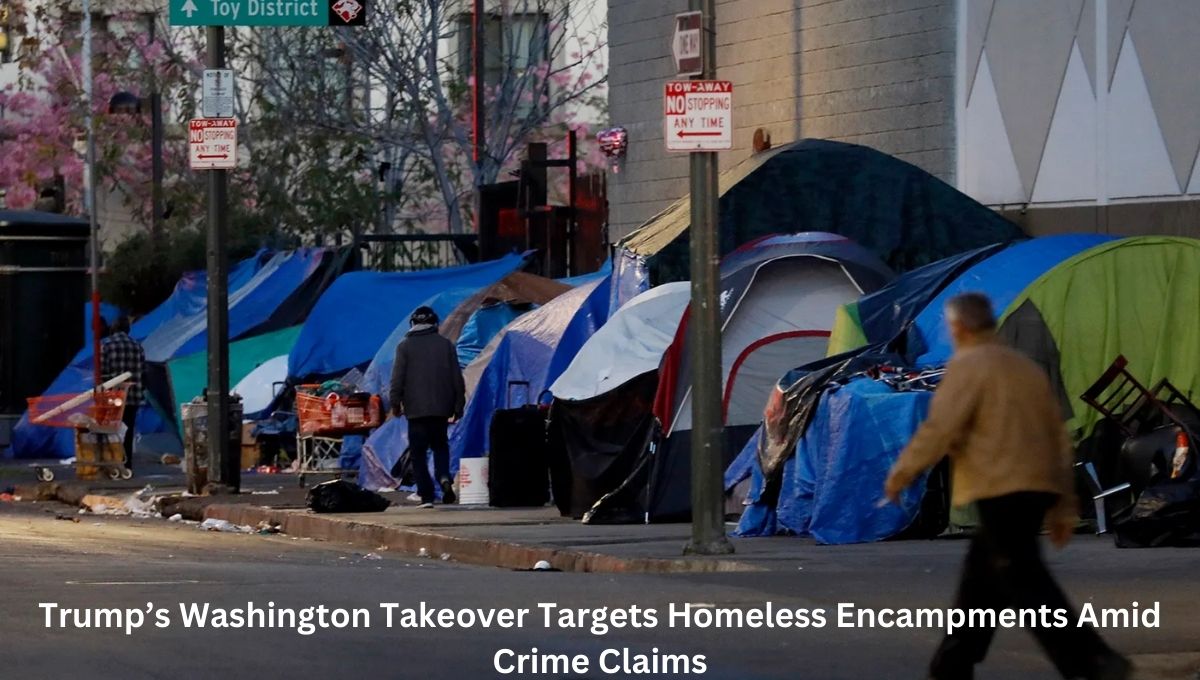
Announcing federal control and National Guard deployment, Trump’s Washington Takeover Targets Homeless Encampments Amid Crime Claims. In a sweeping and controversial move, U.S. President Donald Trump has announced a federal takeover of the Washington, D.C., police department and the deployment of 800 National Guard troops.
Framing the decision as a crackdown on crime and urban decay, Trump said the initiative would target homeless encampments in the U.S. capital, relocating unhoused individuals “far from the Capital.”
“This is about taking back our capital,” Trump declared at a press conference, flanked by senior officials including his attorney general, defense secretary, and the FBI director. “We will give you places to stay, but they will be far from the Capital.” Critics, however, argue that the move risks criminalizing poverty and sidesteps the root causes of homelessness, while further eroding the city’s autonomy.
Trump’s Washington Takeover Targets Homeless Encampments Amid Crime Claims
The Homeless Encampment Crackdown
According to the latest “point-in-time” count from January 2025, Washington, D.C. has about 5,138 unhoused adults and children a 9% decrease from the previous year, according to Mayor Muriel Bowser.
However, advocates warn that the numbers may underestimate the actual homeless population, especially as encampments shift or are dispersed.
Over the past five months, the U.S. Park Police have already removed 70 homeless encampments.
The Trump administration claims alternative shelters will be offered to those displaced, but has provided no details on the locations, living conditions, or duration of stay.
Kevin Donahue, the city administrator, confirmed that a building is available to temporarily house up to 200 people and that outreach workers are visiting encampments.
However, the scale of Trump’s relocation plan far exceeds current city capacity.
Where Will People Be Sent?
While the administration insists on providing “alternative shelter,” the lack of transparency on relocation sites has fueled uncertainty and criticism.
Federal officials have not disclosed whether the facilities will be in nearby suburbs, rural areas, or entirely different states.
Advocacy groups have raised concerns over the legality of forcibly moving people out of the city, citing potential constitutional issues.
“This is not just about homelessness it’s about displacement and erasure,” said one local housing rights advocate.
Crime Claims and the Murder Rate Debate
Trump has defended his actions by pointing to Washington’s homicide rate, claiming it is higher than that of Bogotá, Mexico City, and Lima.
Citing a 2024 figure of 27.5 homicides per 100,000 residents, Trump compared the U.S. capital to several Latin American cities: Bogotá (15), Panama City (15), San José (13), Mexico City (10), Lima (7.7), and Brasilia (6.8).
While official data confirms Washington’s murder rate did surpass several Latin American capitals in recent years, crime experts say the picture is more complex.
According to CNN fact-checker Daniel Dale, homicides in D.C. dropped by 34% in the first half of 2025 compared to 2023, when the city saw its highest murder tally in two decades.
The violent crime rate in 2024 was also the second-lowest since 1966.
Local Leaders Push Back
Washington Mayor Muriel Bowser denounced the move as “alarming and unprecedented,” warning it undermines the city’s autonomy. “I will not minimize the intrusion on the rights of D.C. residents,” Bowser said.
She emphasized that while the federal government is asserting authority over the police department, the city’s organizational chart remains unchanged.
Bowser also said the local government continues to operate “in a way that makes citizens proud” and has been working with Attorney General Pam Bondi, who was delegated authority by Trump to coordinate with the city.
Rachel Maddow’s Strong Rebuke
Television host Rachel Maddow delivered a blistering critique of Trump’s actions on her show, dismissing his crime claims and suggesting the president “enjoys” using military force against American citizens.
“Maybe it’s not about being tough on crime,” Maddow said. “Maybe it’s that he really enjoys using U.S. military force against American civilians on American soil and wants any excuse to do it anywhere he can. Watch what they do, not what they say.”
She described the National Guard deployment as an “authoritarian takeover,” warning that Trump is turning military forces toward the American public.
Maddow also noted Trump’s silence on the recent shooting at the CDC headquarters in Atlanta, implying selective use of force.
City Measures in Response
Following Trump’s announcement, D.C. officials moved to expand shelter capacity. Outreach teams are actively engaging with individuals in homeless encampments, offering them temporary accommodations.
However, city leaders maintain that crime in Washington is already trending downward without federal intervention.
A preliminary report from the Metropolitan Police Department shows overall crime decreasing in 2025, mirroring declines in other major U.S. cities such as New York, Los Angeles, and Chicago.
What We Still Don’t Know
Several critical questions remain unanswered:
- Which federal agencies will carry out the removal of homeless individuals?
- Where exactly will people be relocated?
- What will living conditions be like in the new locations?
- How long will displaced individuals remain in government-provided housing?
Without these answers, skepticism over the administration’s intentions continues to grow. Critics fear the plan could result in long-term displacement without addressing systemic issues like affordable housing, mental health services, and job access.
A Defining Moment for D.C.
The federal takeover of Washington’s police department, combined with the forced relocation of homeless residents, marks one of the most aggressive federal interventions in the city’s governance in modern history. For supporters, it’s a decisive move to tackle crime and restore order; for opponents, it’s a dangerous precedent that threatens civil liberties and the city’s right to self-governance.
As the situation develops, both the legality and morality of Trump’s plan will likely face intense scrutiny from courts, Congress, and the public.
Also Read: Trump’s DC National Guard Deployment Sparks “Authoritarian” Fears
Also Read: ‘Chaos, fear and confusion’: Trump-backed crackdown hits DC’s homeless population