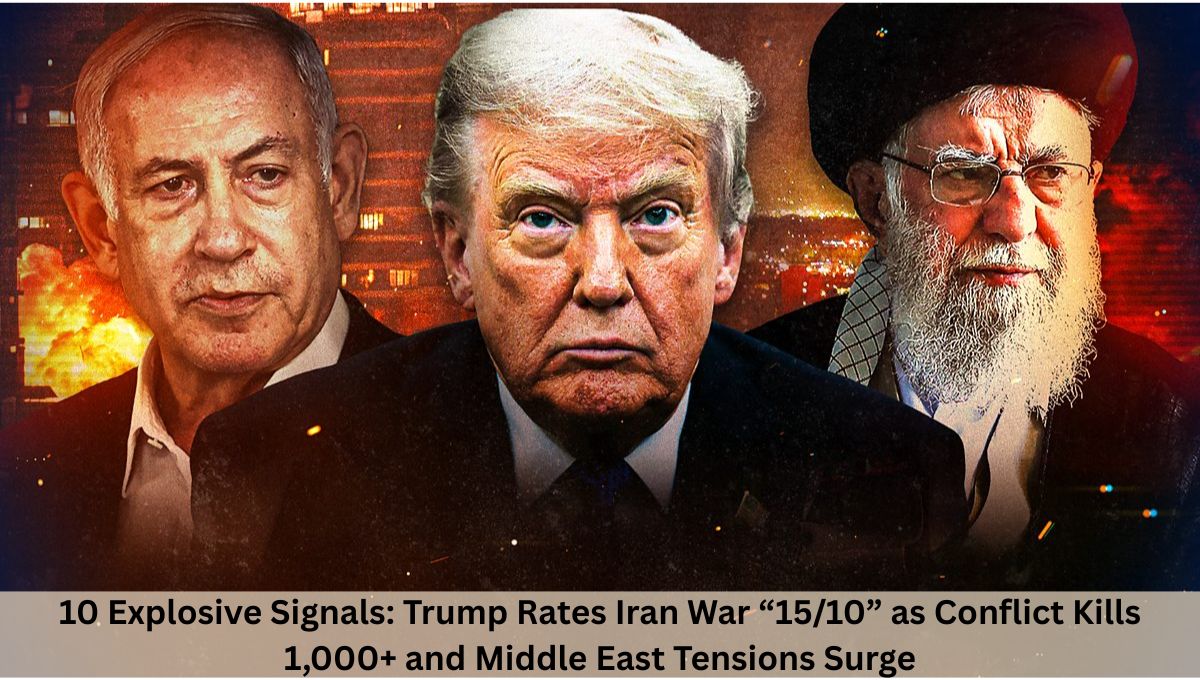
10 Explosive Signals: Trump Rates Iran War “15/10” as Conflict Kills 1,000+ and Middle East Tensions Surge, disrupting global markets. The escalating war between the United States and Iran has entered a dangerous new phase as US President Donald Trump declared the American military campaign against Tehran a resounding success, rating the war effort “15 out of 10.”
Trump’s remarks came as the conflict entered its sixth day and casualties in Iran surpassed 1,000 people. The intensifying military operations — involving US and Israeli forces — have triggered fears of a wider regional war that could reshape the geopolitical balance of the Middle East.
As missiles, drones, and airstrikes continue across the region, global leaders and markets are watching closely to determine whether the conflict will remain contained or spiral into a prolonged war involving multiple countries.
10 Explosive Signals: Trump Rates Iran War “15/10” as Conflict Kills 1,000+ and Middle East Tensions Surge
Trump Gives US Military “15 out of 10” Rating
Speaking to technology executives at the White House, President Donald Trump praised the US military’s performance in the war with Iran and claimed the campaign had made extraordinary progress in a matter of days.
“We’re doing well on the war front, to put it mildly,” Trump said. “Somebody asked me on a scale of 10 how I’d rate it. I said about a 15.”
The comment reflects the administration’s confidence that the ongoing military operation is rapidly weakening Iran’s military capabilities and leadership structure.
Trump suggested that Iranian leadership figures were increasingly being eliminated in targeted strikes.
“We’re in a very strong position now, and their leadership is just rapidly going,” the president said. “Everybody that seems to want to be a leader, they end up dead.”
The remarks signal Washington’s belief that the campaign is significantly destabilizing Iran’s command structure.
War Enters Sixth Day With Intensifying Strikes
The conflict began with sweeping US-Israeli airstrikes on Iranian military infrastructure and has quickly expanded into a complex regional confrontation.
The White House says American forces have already struck more than 2,000 targets across Iran since the operation began.
Military officials say the campaign is focused on crippling:
- Iran’s ballistic missile capabilities
- Drone production and launch facilities
- Naval assets
- Military command centers
- Intelligence networks
Trump said Iran’s weapons systems were being dismantled rapidly.
“Their arsenal of ballistic missiles is being wiped out,” he said. “They’re losing their launchers, they’re losing everything.”
Despite these claims, Iran has continued launching missiles and drones toward Israeli territory and US bases in the region.
US Submarine Sinks Iranian Warship
One of the most dramatic developments of the war occurred when a US submarine sank an Iranian warship in international waters.
The naval strike marked a significant escalation and represented the first time since World War II that a US submarine attacked a surface vessel in combat.
According to US officials:
- The vessel was struck without warning
- Approximately 32 sailors were rescued
- More than 100 crew members were reported missing or dead
Iran condemned the attack and warned that the United States would “regret” the operation.
The incident highlights the growing naval dimension of the conflict, particularly near critical global shipping routes.
Iran Vows Escalating Retaliation
Iran’s Islamic Revolutionary Guard Corps (IRGC) has warned that its retaliatory strikes will intensify in the coming days.
Tehran has already launched multiple missile and drone attacks targeting:
- Israeli territory
- US military bases
- Western diplomatic missions
Arab states across the Persian Gulf reported intercepting Iranian missiles overnight.
Saudi Arabia said it intercepted several drones and missiles aimed at strategic sites near Riyadh and the country’s eastern energy infrastructure.
Meanwhile, NATO air defenses reportedly shot down a ballistic missile heading toward Turkey. Iran has denied targeting Turkey and insisted it has no intention of attacking neighboring states.
However, the expanding scope of the conflict has already drawn more than a dozen countries into the crisis.
More Than 1,000 Dead as Regional War Expands
The human toll of the war is mounting rapidly. Iranian authorities say more than 1,100 people have died in the country since the conflict began.
Additional casualties have been reported across the region as missiles and drones strike military facilities and urban areas.
Israel has also launched major airstrikes across Iran, targeting military installations and intelligence facilities.
Meanwhile, Israeli forces have expanded operations against Hezbollah in Lebanon, raising fears that the conflict could evolve into a multi-front war.
Oil Markets React to Middle East Instability
The growing war has sent shockwaves through global energy markets. Brent crude oil prices have surged past $84 per barrel, marking a sharp increase since the conflict began.
The Middle East remains one of the world’s most critical energy regions, and any prolonged conflict could disrupt oil supplies.
Much of the concern centers on the Strait of Hormuz, a narrow maritime passage through which roughly one-fifth of the world’s oil supply passes.
Shipping traffic through the strait has already declined significantly.
To stabilize markets, the United States has announced plans to:
- Provide insurance guarantees for oil tankers
- Deploy naval escorts for ships
- Ensure safe navigation through the strait
However, analysts warn that it could take weeks before normal shipping flows resume.
Trump Warns Iranian Forces to Lay Down Arms
In addition to praising the military campaign, Trump issued a direct warning to Iranian military personnel.
He urged members of the Iranian armed forces, the Islamic Revolutionary Guard Corps, and police to lay down their weapons.
According to Trump, those who surrender will receive immunity. But those who continue fighting face certain death.
“They are only going to be killed,” Trump said. “Now is the time to stand up for the Iranian people and help take back your country.”
The statement appears to be part of a broader effort to weaken support for Iran’s ruling regime.
Appeal to Iranian Diplomats Worldwide
Trump also called on Iranian diplomats stationed abroad to defect and seek asylum. The president said those diplomats could play a role in shaping a new political future for Iran.
“We urge Iranian diplomats around the world to request asylum,” Trump said. “Help us shape a new and better Iran with great potential.”
The appeal highlights the administration’s broader political messaging aimed at encouraging internal opposition to the Iranian government.
Debate Over Iran’s Future Leadership
The war has created uncertainty over who will ultimately lead Iran following the killing of Supreme Leader Ayatollah Ali Khamenei during earlier strikes.
Trump suggested the United States should play a role in selecting Iran’s next leader.
He compared the situation to Venezuela, where Washington supported political changes following the removal of Nicolás Maduro.
Trump also rejected the idea that Khamenei’s son, Mojtaba Khamenei, should succeed him.
“Khamenei’s son is unacceptable to me,” Trump said. “We want someone that will bring harmony and peace to Iran.”
The comments have sparked intense debate among political analysts about whether Washington is pursuing regime change in Tehran.
Ground Invasion Debate
Despite the escalating air war, Trump has downplayed the likelihood of a ground invasion.
Speaking to NBC News, he described the idea as “a waste of time.” “They’ve lost everything,” Trump said.
“They’ve lost their navy. They’ve lost everything they can lose.” However, the president has previously refused to rule out deploying ground troops if necessary.
Defense Secretary Pete Hegseth said the duration of the war remains uncertain. “It could be six weeks, it could be eight weeks, it could be three,” he told reporters.
US Congress Backs the War Effort
In Washington, the Republican-controlled House of Representatives rejected an effort to halt the war under the War Powers Resolution.
The vote was 219 to 212, largely along party lines. The Senate had already rejected a similar measure earlier.
The decision effectively gives the Trump administration political backing to continue the military campaign.
Critics argue the war should require explicit congressional authorization. Supporters say halting operations now would weaken US national security.
Iran’s Nuclear Program Remains Central Issue
The White House continues to justify the war by arguing that Iran posed an imminent nuclear threat.
Trump repeated that justification during his recent remarks. “When crazy people have nuclear weapons, bad things happen,” he said.
US officials claim the strikes have significantly damaged Iran’s nuclear and missile infrastructure.
However, Israeli diplomats say Iran still retains significant capabilities. “There’s still a long way to go,” Israel’s ambassador to the United Nations said.
Growing Risk of a Wider War
The expanding conflict is increasingly drawing other countries into the crisis. Iran has targeted US bases and embassies across the Middle East.
Missile interceptions have been reported in:
- Saudi Arabia
- Turkey
- Israel
- Gulf states
A drone strike also hit a British air base in Cyprus, the first attack on European territory during the war.
Greece, the United Kingdom, and France are now reinforcing defenses on the island. These developments highlight how quickly the conflict could expand beyond Iran and Israel.
Iran Shifts Toward Drone Warfare
Military analysts say Iran appears to be shifting its strategy.
Rather than launching large ballistic missile attacks, Tehran is increasingly deploying drones. Drones typically carry smaller payloads and cause less damage than missiles.
However, they are:
- Cheaper to produce
- Harder to detect
- Easier to launch in large numbers
This strategy could allow Iran to sustain attacks for a longer period despite heavy losses to its missile systems.
Global Markets Feel the Impact
The war has already begun influencing financial markets. In addition to rising oil prices, investors are moving money into traditional safe-haven assets.
Gold and silver prices have surged as traders seek protection against geopolitical uncertainty. Government bond markets have also reacted to the growing instability.
Analysts warn that prolonged conflict could trigger wider economic consequences if energy supplies are disrupted.
The Future of the War Remains Uncertain
Despite confident statements from Washington, the duration and outcome of the war remain unclear.
Iran has shown no sign of abandoning its nuclear ambitions or missile programs. Tehran has also rejected reports suggesting it is seeking negotiations with the United States.
“We have no trust in the Americans and no intention of negotiating,” an adviser to the late Supreme Leader said on Iranian television.
With both sides signaling determination to continue fighting, the conflict could extend for weeks or even months.
Conclusion
The rapidly escalating war between the United States and Iran represents one of the most dangerous geopolitical crises in recent years.
President Donald Trump’s declaration that the war effort deserves a “15 out of 10” rating reflects the administration’s belief that the campaign is succeeding.
However, the growing death toll, expanding regional involvement, and mounting economic impacts suggest the conflict could have far-reaching consequences.
As the war enters its second week, the world is watching closely to see whether diplomatic efforts can prevent a prolonged regional conflict — or whether the Middle East is heading toward an even larger confrontation.
Also Read: 11 Stark Warnings: Why the US Could Run Low on Missiles if the Iran War Continues
Also Read: Intense Israeli strikes hit Iran and Lebanon as US warns the bombardment will ‘surge dramatically’
Related Posts:
- 11 Explosive Warnings as Trump Vows to ‘Knock the…

- Trump’s 20-Point Gaza Peace Plan Gains Urgent Global…

- 7 Powerful Measures: Trump Sanctions Russian Oil…

- Can the EU and NATO Impose Tariffs on India and…

- 5 Powerful Highlights as Trump Lands Second Nobel…

- Trump’s Breakthrough Gaza Ceasefire Deal 2025: Key Insights
