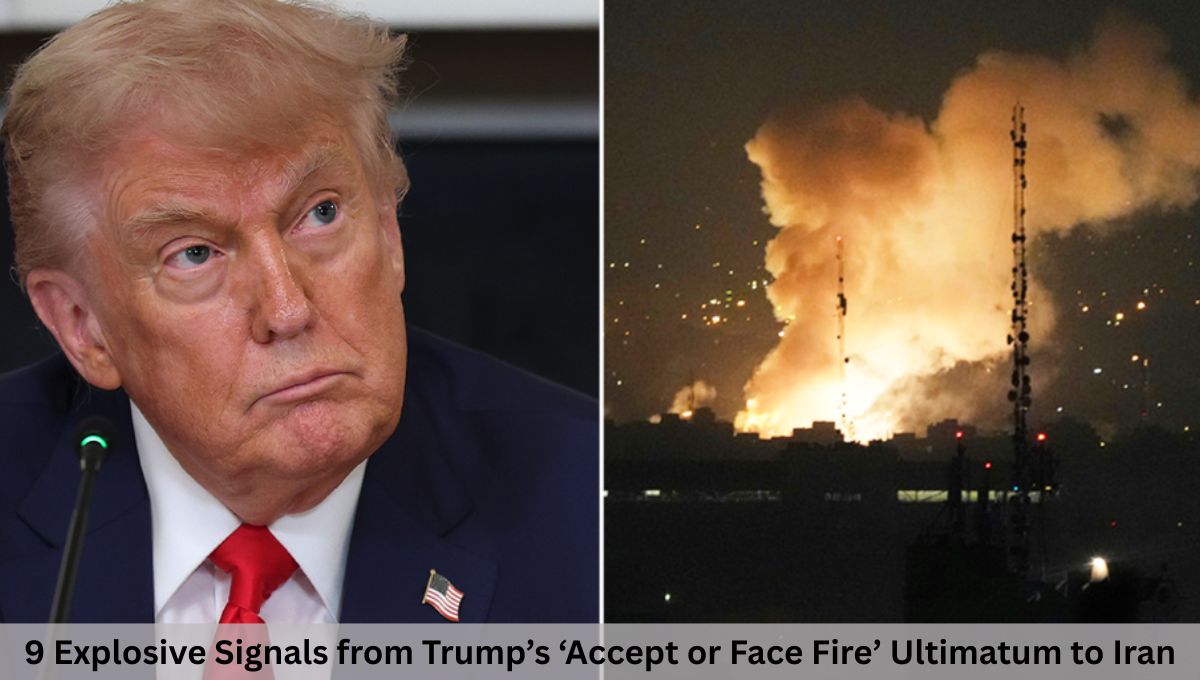
9 Explosive Signals from Trump’s ‘Accept or Face Fire’ Ultimatum to Iran that marks a dangerous new phase. United States President Donald Trump has sharply escalated pressure on Iran, warning that failure to agree to a nuclear deal with Washington would bring “very traumatic” consequences.
The warning came just a day after Trump hosted Israeli Prime Minister Benjamin Netanyahu at the White House, underscoring how diplomacy, military coercion, and regional war are converging into a single high-stakes confrontation.
Trump’s language — blunt, personal, and laced with threats — reflects a familiar strategy:
negotiate loudly, apply maximum pressure, and keep military force visibly on the table.
But this time, the context is far more combustible. The Middle East is still reeling from war, Iran is under intense internal strain, and the US is visibly reinforcing its military footprint in the region.
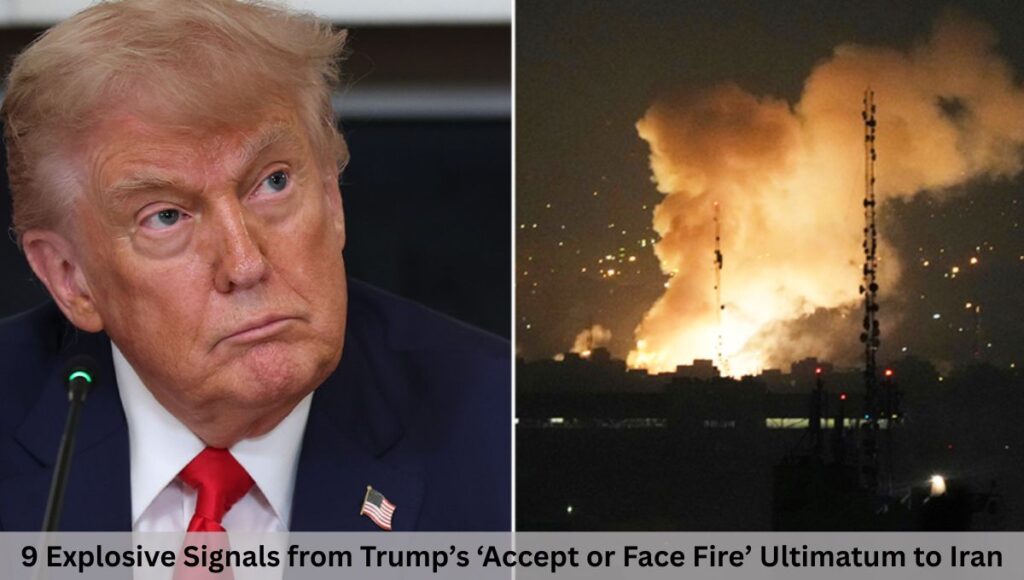
9 Explosive Signals From Trump’s ‘Accept or Face Fire’ Ultimatum to Iran
‘Very Traumatic’: Trump’s Stark Warning to Tehran
Speaking to reporters after his meeting with Netanyahu, Trump made clear that he views the coming weeks as decisive.
“We have to make a deal,” Trump said. “Otherwise, it’s going to be very dramatic. I don’t want that to happen, but we have to make a deal.”
He went further, warning that Iran’s refusal would have severe consequences.
“This will be very traumatic for Iran if they don’t make a deal,” he said. “If they don’t make a deal, then it’ll be a different story.”
Trump referenced “Midnight Hammer,” his administration’s codename for the June 2025 US strikes on Iran’s three main nuclear facilities — a reminder that Washington has already demonstrated its willingness to use force.
“They should have made a deal the first time,” Trump said. “Then they got Midnight Hammer instead.”
The Netanyahu Factor: Alignment, but Not Identical Goals
Trump described his meeting with Netanyahu as “very good,” saying the Israeli leader understands the stakes.
But while the two leaders are closely aligned, their priorities are not identical.
Netanyahu, speaking after the meeting while departing from Joint Base Andrews, said Trump believes Iran can be forced into a “good deal.”
“We have a close, genuine, and open relationship,” Netanyahu said. “The president believes the Iranians already understand who they are dealing with.”
Yet Netanyahu also expressed deep skepticism.
“I will not hide my general skepticism about the possibility of reaching any agreement with Iran,” he said, stressing that any deal must go beyond nuclear limits to include ballistic missiles and Iran’s regional proxies.
This divergence matters. Trump wants a deal — quickly. Netanyahu wants a deal only if it permanently constrains Iran’s broader military power.
‘Ultimately Up to Me’: Trump Asserts Final Authority
One striking aspect of Trump’s remarks was how explicitly he framed the decision as his alone.
“But it’s ultimately up to me,” Trump said. “If the deal isn’t a very fair deal and a very good deal with Iran, then it’s going to be a very difficult time for them.”
The statement reflects Trump’s personal, centralized approach to foreign policy — one in which institutional processes, allies, and even negotiations take a back seat to presidential judgment.
US Moves Aircraft Carriers as Pressure Builds
Even as Trump insists he prefers diplomacy, the military posture tells a parallel story.
According to multiple reports, the Pentagon has ordered preparations for deploying a second aircraft carrier strike group to the Middle East.
The USS Abraham Lincoln is already in the region, accompanied by guided-missile destroyers.
Now, the USS Gerald R. Ford, the world’s largest aircraft carrier, has been ordered to redeploy from the Caribbean toward the Middle East, placing enormous American firepower within striking distance of Iran.
Trump himself amplified the signal by sharing a Wall Street Journal report on the deployment on Truth Social — without comment.
Why Aircraft Carriers Matter
Aircraft carriers are not subtle tools. Their presence is meant to be seen.
Two carrier strike groups in the region would give the US:
- Continuous air superiority
- Rapid strike capability
- Missile defense coverage for allies
- A powerful deterrent signal to Iran
Former US defense officials have described the move as pressure rather than preparation for immediate war — but they caution that such pressure carries inherent risks.
Indirect Talks in Oman: Diplomacy Under Duress
Despite the threats, diplomacy continues — narrowly.
The United States and Iran held indirect talks last week in Oman, the first such engagement in months.
Both sides described the talks as cautious but constructive, though no follow-up date has been publicly announced.
Trump said he expects progress “over the next month,” urging Iran to agree “quickly.”
Iran, however, has drawn firm red lines.
Iran’s Position: Nuclear Talks Only, Nothing More
Iran denies seeking nuclear weapons and insists its nuclear program is peaceful and lawful under the Treaty on the Non-Proliferation of Nuclear Weapons.
Foreign Minister Abbas Araghchi told Al Jazeera that Iran’s missile program is “never negotiable,” calling it a purely defensive matter.
Iranian officials have also warned Washington against allowing Israel to sabotage the talks.
“Our negotiations are exclusively with the United States,” said Iranian security chief Ali Larijani. “We are not engaged in any talks with Israel.”
Israel’s Shadow War and the Memory of June 2025
The talks are haunted by recent history.
In June 2025, Israel launched a major military offensive against Iran, killing senior military officials and nuclear scientists.
Iran responded with hundreds of missiles, some of which penetrated Israel’s air defenses.
The US then joined the campaign, striking three Iranian nuclear sites before a ceasefire was reached.
Trump later claimed the attacks “obliterated” Iran’s nuclear program — a claim experts say remains difficult to verify, particularly regarding Iran’s stockpiles of enriched uranium.
‘Midnight Hammer’: More Than a Metaphor
By invoking “Midnight Hammer,” Trump is doing more than referencing past strikes. He is signaling credibility.
“Last time, Iran decided they were better off not making a deal,” Trump said. “They were hit with Midnight Hammer. That did not work well for them.”
The message to Tehran is clear:
Washington is prepared to repeat — or escalate — military action if diplomacy fails.
Iran Under Pressure at Home
The timing is critical for Iran.
The country is facing renewed internal unrest after last month’s brutal crackdown on nationwide protests.
Thousands were killed, according to rights groups, and Iran is now entering the traditional 40-day mourning period — often a flashpoint for renewed demonstrations.
The Iranian government has accused the US of backing unrest, particularly after reports that thousands of Starlink satellite kits were smuggled into Iran following internet shutdowns.
Trump previously encouraged protesters, telling them “help is on the way” — comments Tehran interpreted as direct interference.
Balancing Diplomacy and Threats: Trump’s Strategy
Trump insists he prefers a deal.
“There was nothing definitive reached other than I insisted that negotiations continue,” he wrote after meeting Netanyahu. “If it can be consummated, that will be a preference.”
But his approach relies on tension — diplomacy backed by unmistakable force.
Former defense officials describe the strategy as coercive diplomacy:
create urgency, compress timelines, and leave adversaries uncertain about the next move.
Why the Next Month Matters
Trump has repeatedly referenced a one-month window.
“I guess over the next month, something like that,” he said, when asked about timing.
That deadline aligns with:
- Increased US military deployments
- Iran’s internal instability
- Israel’s push to expand the scope of talks
- Trump’s desire for a visible foreign-policy win
The convergence raises the stakes dramatically.
What Happens If Talks Fail
If negotiations collapse, several scenarios emerge:
- Expanded US sanctions
- Renewed Israeli strikes
- Direct US military action
- Regional escalation involving Hezbollah or Gulf targets
Gulf Arab states have already warned that any new war could spiral uncontrollably.
Global Implications Beyond the Middle East
This crisis is not regional alone.
Energy markets, global shipping lanes, and nuclear non-proliferation norms all hang in the balance.
A breakdown could send oil prices soaring, destabilize fragile economies, and undermine decades of arms-control architecture.
For global audiences, the question is not simply whether a deal is reached — but what kind of world emerges if it is not.
Conclusion: A High-Wire Moment for War and Peace
Donald Trump’s ultimatum to Iran — accept a deal or face “very traumatic” consequences — marks a defining moment in his second presidency.
With aircraft carriers moving, diplomacy narrowing, and memories of recent war still raw, the margin for error is thin.
Whether this ends in a negotiated agreement or another Middle Eastern conflict will depend not just on Tehran’s choices, but on how far Washington is willing to push its strategy of pressure — and how much risk the region, and the world, can absorb.
Also Read: 9 Explosive Signals: Iran Offers Uranium Dilution for Sanctions Relief as Nuclear Talks Intensify
Also Read: No negotiations, America attacking is the only hope: Iranian man’s plea to Trump before suicide
Related Posts:
- 11 Explosive Warnings as Trump Vows to ‘Knock the…

- Trump’s 2025 Gaza Peace Plan Signing and Historic…

- 5 Powerful Highlights as Trump Lands Second Nobel…

- 9 Explosive Revelations as Trump Declares His Health…

- 7 Crucial Insights Into Trump and Xi’s High-Stakes…
- Trump’s Historic Gaza Ceasefire Deal 2025 - Powerful…
