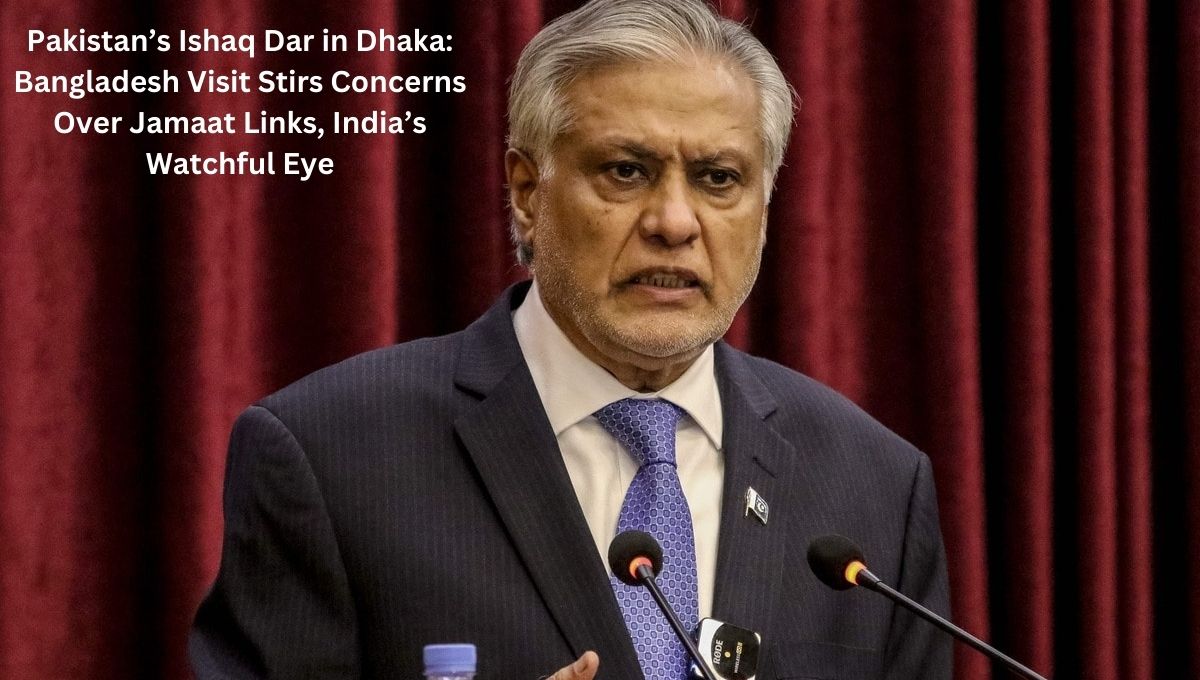
Sparking India’s unease, Pakistan’s Ishaq Dar in Dhaka: Bangladesh Visit Stirs Concerns Over Jamaat Links, India’s Watchful Eye. Pakistan’s Deputy Prime Minister and Foreign Minister Ishaq Dar has arrived in Dhaka for a three-day visit, the most senior Pakistani visit to Bangladesh in more than a decade. The trip, seen as a significant milestone in Pakistan-Bangladesh ties, has been overshadowed by controversy over Dar’s scheduled meetings with leaders of Jamaat-e-Islami Bangladesh, a hardline Islamist group long accused of minority suppression and anti-India positions.
India is watching the visit with unease, given the historic baggage of Pakistan-Bangladesh ties, Dhaka’s recent tilt toward Islamabad, and the fragile state of India-Bangladesh relations after the fall of Sheikh Hasina’s Awami League government in 2024.
Pakistan’s Ishaq Dar in Dhaka: Bangladesh Visit Stirs Concerns Over Jamaat Links, India’s Watchful Eye
A Historic Visit Amid Shifting Regional Ties
This marks the first high-level visit by a Pakistani foreign minister since 2012. Pakistan’s foreign ministry described it as a “significant milestone in Pakistan-Bangladesh relations.”
The visit comes as both nations, once bitter enemies since Bangladesh’s bloody liberation in 1971, are now seeking a rapprochement.
Dar’s agenda includes meetings with Bangladesh’s Interim Government leader Muhammad Yunus, Foreign Affairs Adviser Touhid Hossain, BNP chairperson Begum Khaleda Zia, and senior Jamaat-e-Islami leaders. He is also expected to finalize trade, investment, and visa agreements.
Bangladesh and Pakistan are set to sign several agreements during the visit, including measures to boost trade and ease official travel.
Cargo shipping has already begun between the two nations, and direct flights are expected soon, with Pakistani carriers Fly Jinnah and Air Sial cleared for operations.
Jamaat-e-Islami Meeting Sparks Alarm
The most controversial element of Dar’s Dhaka itinerary is his meeting with Jamaat-e-Islami Bangladesh, a hardline Islamist group historically linked to atrocities during the 1971 Liberation War.
Jamaat has been banned at various times in Bangladesh for alleged terror links, and it is notorious for its anti-India stance.
Observers say this engagement underscores Pakistan’s interest in cultivating groups sympathetic to its worldview in Dhaka. For India, this raises concerns of a Pakistan-backed Islamist revival on its eastern flank.
The Yunus Government’s Balancing Act
Chief Adviser Muhammad Yunus, who assumed office after the ouster of Sheikh Hasina in 2024, has been pushing for normalized ties with Pakistan.
In December 2024, Yunus met Pakistani Prime Minister Shehbaz Sharif in Egypt, calling for resolving old grievances and boosting trade.
“We kept missing each other for a long time as our relationship was frozen. We have to overcome the barriers,” Yunus said earlier this year during talks with Pakistan’s foreign secretary.
Under his interim leadership, Dhaka has:
- Revitalized talks on trade and economic cooperation.
- Approved visa exemptions for officials and diplomats between the two countries.
- Welcomed high-level Pakistani visits, including by Commerce Minister Jam Kamal Khan and Interior Minister Mohsin Naqvi.
For Yunus, building bridges with Pakistan is part of a broader strategy to diversify Bangladesh’s foreign relations, even if it risks alienating India.
India’s Uneasy Watch
India, once Bangladesh’s closest partner, now views these developments with suspicion. The Ministry of External Affairs recently dismissed allegations from Dhaka that exiled Awami League leaders were conducting anti-Bangladesh activities from Indian soil.
“The Government of India is not aware of any anti-Bangladesh activities by purported members of the Awami League in India or of any action that is contrary to Indian law,” New Delhi stated. “The Press Statement by the Interim Government of Bangladesh is thus misplaced.”
Tensions escalated after Dhaka accused India of backing the outlawed Awami League, warning it could damage bilateral friendship and trust.
Analysts argue that the fall of Sheikh Hasina was a strategic setback for India, as it enabled Pakistan to move closer to Dhaka at a time when Bangladesh also deepens ties with China.
1971 Genocide Shadows the Dialogue
The legacy of the 1971 Liberation War continues to cast a long shadow. Pakistan’s army has never formally apologized for the genocide that killed millions of Bengalis and saw systematic atrocities committed under Operation Searchlight.
A report in Northeast News highlighted that Islamabad remains reluctant to express remorse.
Instead, some Pakistani outlets have published provocative commentaries suggesting Bangladesh should be “reclaimed” as revenge for 1971.
For many in Bangladesh, this lack of apology remains a deep wound. The Yunus government’s outreach to Pakistan has drawn criticism domestically for ignoring the genocide issue.
Trade, Investment, and Connectivity Push
Despite historical baggage, economic cooperation is gaining momentum. Bangladesh and Pakistan agreed this week to revitalize the long-dormant Joint Economic Commission (JEC) and establish a new Trade and Investment Commission.
Bangladesh’s Commerce Adviser Sheikh Bashir Uddin said:
“We are working on reactivating the JEC and forming a new Trade and Investment Commission. If Bangladesh and Pakistan jointly, or through foreign investment, could produce intermediate goods, it would be mutually beneficial for both.”
Key trade developments include:
- Bangladesh pushing Pakistan to withdraw anti-dumping duties on hydrogen peroxide exports.
- Dhaka requesting reinstatement of a duty-free tea export quota.
- Discussions on collaboration in sugar and leather industries.
- Plans for direct shipping and air connectivity between Dhaka and Islamabad.
These moves suggest both countries are looking beyond politics to tangible economic opportunities.
Pakistan, Bangladesh, and China: A Strategic Triangle
The Dhaka visit also comes as Bangladesh and Pakistan deepen parallel ties with China. Bangladesh Army Chief General Waker-Uz-Zaman is currently visiting Beijing, highlighting Dhaka’s growing military dependence on China.
Meanwhile, in Islamabad, Chinese Foreign Minister Wang Yi met Pakistan’s Chief of Army Staff Asim Munir to discuss regional security, including India and Afghanistan.
Together, these engagements suggest a new axis forming between Dhaka, Islamabad, and Beijing, complicating India’s strategic calculus in South Asia.
India-Bangladesh Relations: From Ally to Uncertainty
India and Bangladesh once enjoyed a strong partnership, with New Delhi supporting Dhaka diplomatically and economically. However, ties soured after Hasina’s ouster and Dhaka’s accusations of Indian interference.
India remains Bangladesh’s top trading partner and a crucial security ally, but its influence appears to be waning as Dhaka courts Islamabad and Beijing.
For New Delhi, the prospect of Pakistan re-establishing influence in Dhaka is deeply concerning.
Analysts like Michael Kugelman note:
“Bangladesh had been one of India’s closest partners in its neighbourhood, and now it is flirting with India’s chief adversary.”
Domestic Backlash in Bangladesh
Not all Bangladeshis welcome the government’s overtures to Pakistan. Many civil society groups and political commentators argue that engaging Islamabad without addressing the 1971 genocide dishonors the memory of millions of victims.
The Northeast News report warned that Pakistan could exploit Dhaka as a base for anti-India activities, echoing recent remarks by Pakistani military officials about striking India “from the East” in a future conflict.
Such rhetoric fuels fears that Dhaka’s realignment could embolden radical groups and destabilize the region.
Conclusion: A Risky Diplomatic Gamble
Ishaq Dar’s Dhaka visit symbolizes a thaw in Pakistan-Bangladesh relations, offering new opportunities in trade, connectivity, and diplomacy. But it also exposes deep fault lines: the unresolved trauma of 1971, Bangladesh’s balancing act between India and Pakistan, and the looming presence of China.
For India, the visit is a red flag, underscoring the possibility of its strategic backyard slipping into the orbit of its rivals. For Bangladesh, it is a high-stakes gamble: can it engage Islamabad and Beijing without burning bridges with New Delhi?
The coming months will determine whether this outreach results in a genuine reset or simply deepens the fractures in South Asia’s already fragile geopolitical landscape.
Also Read: Bangladeshi Politicians Criticise PM Modi’s Vijay Diwas Post For Excluding Bangladesh’s Role
Also Read: 5 Key Shifts in Bangladesh–Pakistan Relations as Yunus Deepens Ties Amid ‘Map’ Row
Related Posts:
- Pakistan Foreign Minister Ishaq Dar’s Historic Visit…

- 5 Key Shifts in Bangladesh–Pakistan Relations as…

- 7 Shocking Reasons Why Bangladesh’s Yunus Govt Bowed…
- 9 Defining Stakes in Bangladesh’s Explosive…

- 9 Critical Pressures Trapping Pakistan’s Army Chief…

- Afghanistan–Pakistan War 2025: Inside the 48-Hour Ceasefire
