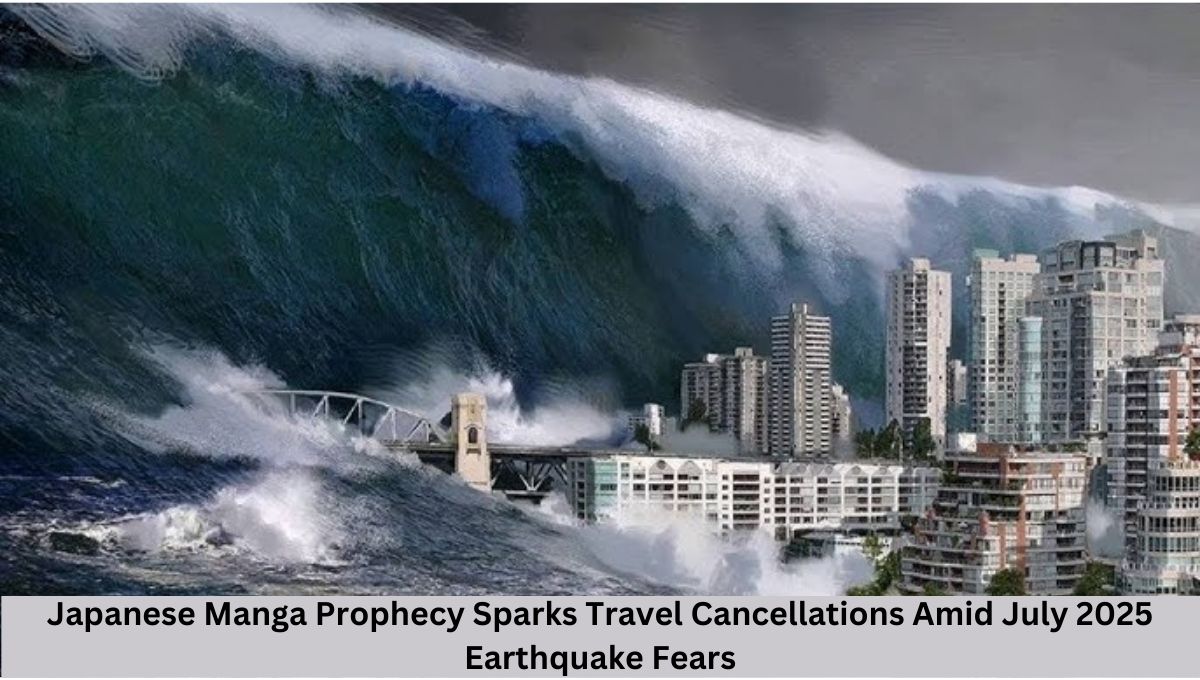
A chilling revelation by a Japanese Manga Prophecy Sparks Travel Cancellations Amid July 2025 Earthquake Fears. The prediction by Japanese manga artist Ryo Tatsuki is shaking up Japan’s tourism industry. Her prediction, detailed in the book “The Future I Saw (Complete Version)”, claims a catastrophic earthquake and tsunami will strike Japan in July 2025.
Despite reassurances from scientists that earthquakes cannot be predicted with certainty, tourists especially from East Asia are cancelling or postponing trips to Japan, gripped by fear fueled by social media and eerie coincidences from Tatsuki’s past predictions.
Japanese Manga Prophecy Sparks Travel Cancellations Amid July 2025 Earthquake Fears
The Manga That Started the Panic
The origin of the current hysteria is The Future I Saw, a manga first released in 1999 by Ryo Tatsuki. The Japanese manga prophecy gained traction after it eerily predicted the March 2011 Tohoku earthquake and tsunami, which claimed over 18,000 lives.
Her book even bore the chilling words: “Massive disaster in March 2011.” That coincidence was enough to convince many readers of Tatsuki’s abilities.
In 2021, a revised edition titled The Future I Saw (Complete Version) warned of an even greater catastrophe set to occur on July 5, 2025.
According to the manga, a massive underwater crack will open between Japan and the Philippines, triggering a tsunami “three times as tall” as the one in 2011.
This frightening Japanese manga prophecy also describes the sea “boiling,” a detail that has been interpreted by some as an underwater volcanic eruption.
Who Is Ryo Tatsuki The “New Baba Vanga”?
Ryo Tatsuki is being dubbed the “Japanese Baba Vanga” for her claimed prophetic visions.
Much like the Balkan mystic Baba Vanga famous for predicting 9/11 and Princess Diana’s death Tatsuki reportedly foretold not just the Tohoku disaster, but also the 1995 Kobe earthquake, the deaths of Freddie Mercury and Princess Diana, and even the Covid-19 pandemic.
Her predictions, shared through comic-style narratives, have earned her a cult following in Japan, Hong Kong, Thailand, and China.
Her books have sold over 900,000 copies, and The Future I Saw has also been published in Chinese, further amplifying her reach and influence.
Scientists Dispute the Prediction But Fear Persists
Despite the overwhelming interest, Japanese seismologists emphasize that there is no scientific basis for Tatsuki’s claims.
Experts agree that earthquake prediction remains scientifically unreliable. The Japan Meteorological Agency has not issued any specific alerts for July 2025, and officials urge the public to rely on expert guidance rather than unverified predictions.
Nonetheless, the fear is proving hard to shake. According to scientists, while the location described in the manga between Japan and the Philippines is indeed a tectonically active region, the exact timing of an earthquake cannot be known.
Tourism in Japan Suffers a Blow
The Japanese manga prophecy about a July 2025 earthquake is already taking a toll on the nation’s booming tourism industry.
Travel bookings to Japan dropped by up to 50% during the recent Easter holidays, particularly from Hong Kong and mainland China.
CN Yuen, managing director of Hong Kong-based travel agency WWPKG, confirmed that the cancellations have continued into May and are expected to worsen in the coming months.
“People just say they want to hold off their trip for now,” Yuen explained, highlighting the impact of what he calls “ingrained fear” among potential travelers.
Chinese Embassy Warning Adds to the Alarm
Adding fuel to the fire, the Chinese Embassy in Tokyo issued a warning last month advising citizens to take extra precautions against natural disasters in Japan.
Although the advisory did not reference Tatsuki or the manga specifically, its timing and wording contributed to the rising anxiety.
Posts on Chinese social media platform Weibo and video-sharing apps like Douyin (TikTok) have been dominated by discussions around the predicted disaster.
Hashtags like #July2025 Prediction are trending, with many users sharing disaster preparedness tips and evacuation plans.
Not Everyone Is Changing Their Plans
Despite the widespread fear, millions of tourists remain undeterred. According to the Japan National Tourism Organization, the country welcomed a record-breaking 10.5 million visitors in the first three months of 2025.
This includes 2.36 million tourists from mainland China, a 78% increase from last year, and 647,600 from Hong Kong.
Samantha Tang, a Hong Kong-based yoga instructor, admitted she cancelled her planned August trip to Wakayama due to the rumors.
But others, like Vic Shing from Hong Kong, say they are going ahead with their Japan travel plans in June. “Earthquake predictions have never been accurate,” he said. “And Japan handles disasters better than most countries.”
Government Officials and Scientists Push Back
In response to the prophecy’s impact, Miyagi Governor Yoshihiro Murai criticized the spread of unscientific rumors and their negative influence on tourism.
“It is a serious issue when highly unscientific information on social media affects travel and economy,” he said during a recent press conference.
Meanwhile, Japan’s Cabinet Office reiterated on X (formerly Twitter) that modern technology cannot accurately predict earthquakes, and encouraged people to base decisions on verified information from geological and meteorological agencies.
The “Prophecy Effect” and Social Media’s Role
The term “prophecy effect” is being floated by analysts to describe how predictions regardless of their scientific basis can trigger real-world consequences.
The influence of the Japanese manga prophecy is a powerful example of this phenomenon, with travel decisions and economic outcomes being shaped by belief rather than data.
Platforms like TikTok, Instagram, and Weibo are amplifying the issue, creating a feedback loop that increases anxiety and fuels cancellations.
Conclusion: Stay Informed, Not Fearful
While Ryo Tatsuki’s Japanese manga prophecy has stirred concern, experts stress the importance of evidence-based decision-making.
Japan remains one of the most disaster-resilient nations in the world, with advanced infrastructure, emergency planning, and public awareness campaigns in place.
Tourists are encouraged to stay informed through official channels and not base travel decisions on predictions that lack scientific validation.
As always, when traveling to any country located in the Ring of Fire, basic earthquake preparedness and travel insurance are wise steps.
Final Word:
The buzz around the July 2025 earthquake prediction by the so-called “Baba Vanga of Japan” underscores the growing power of social media and pop culture in shaping public behavior.
While there’s no scientific proof behind the Japanese manga prophecy, the fear it has generated is very real. Travelers are urged to stay calm, stay smart, and rely on science not superstition.
Also Read: 600-Year Dormant Russian Volcano Erupts After Megaquake, Sparks Tsunami Alerts
Also Read: Tourists cancel trips as Japanese Manga sparks earthquake fears