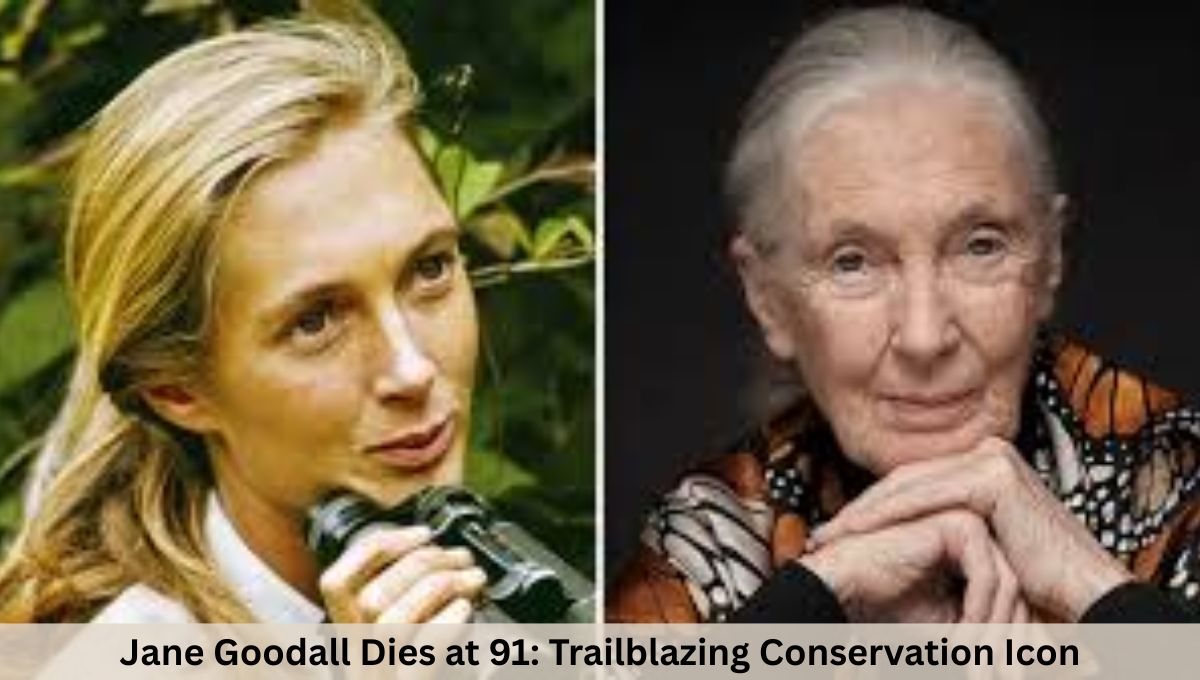
World-renowned primatologist Jane Goodall Dies at 91: Trailblazing Conservation Icon. Jane Goodall, the celebrated British primatologist, ethologist, and conservationist who revolutionized our understanding of chimpanzees and redefined humanity’s connection to nature, has died at the age of 91.
The Jane Goodall Institute announced her passing in a heartfelt statement, revealing that she died of natural causes while in California on a U.S. speaking tour. Even in her ninth decade, Goodall remained relentlessly active, traveling the world to spread her message of hope, conservation, and environmental responsibility. “She was a tireless advocate for the protection and restoration of our natural world, and her discoveries revolutionized science,” the institute said.
Jane Goodall Dies at 91: Trailblazing Conservation Icon
Early Life and Childhood Fascination with Animals
Born Valerie Jane Morris-Goodall in London in 1934, Jane’s fascination with animals began at an unusually young age. In her memoir In the Shadow of Man, she recalled hiding in a chicken coop for hours to watch a hen lay an egg—prompting her worried mother to call the police when she went missing. Instead of scolding her, her mother celebrated Jane’s curiosity, a pivotal moment Goodall later credited for shaping her path.
At 10 years old, she purchased her first book, Tarzan of the Apes, and dreamed of living in Africa among wild animals. Though ridiculed for such ambitions—especially as a young woman in postwar Britain—Jane held on to that dream.
At 18, she took a secretarial course and worked a series of jobs, saving every penny. By 1957, her determination paid off: she received an invitation to visit a friend’s farm in Kenya. That journey would change not just her life, but the course of science.
Meeting Louis Leakey and the Path to Gombe
In Nairobi, Jane met famed anthropologist and paleontologist Louis Leakey. Despite her lack of formal scientific training, Leakey recognized her extraordinary observational skills and passion. He hired her as his assistant and, in 1960, sent the then-26-year-old to what is now Tanzania to study wild chimpanzees at the Gombe Stream Game Reserve.
British authorities, wary of a young woman living alone in the wilderness, required her to bring a companion—so her mother accompanied her for the first months. At first, the chimpanzees fled whenever Jane approached. Patiently, she persevered, spending months quietly following them from a distance until they accepted her presence.
Her breakthrough came when she befriended an older male she named David Greybeard. He became the first chimpanzee to trust her, opening the door to a world previously unseen by human eyes.
Groundbreaking Discoveries That Changed Science
In the fall of 1960, Goodall made one of the most important discoveries in primatology: she observed David Greybeard stripping a twig of leaves and using it as a tool to fish termites from a mound. Until that moment, tool-making was believed to be an exclusively human trait.
“Now we must redefine tool, redefine man, or accept chimpanzees as humans,” Leakey famously remarked.
But her discoveries didn’t stop there. She documented that chimpanzees:
- Have individual personalities.
- Express emotions such as joy, sadness, grief, and fear.
- Form complex family bonds.
- Exhibit sibling rivalry, maternal affection, and even political strategies.
- Engage in aggressive territorial conflicts, which she later referred to as chimpanzee “wars.”
Her approach—naming the chimpanzees rather than numbering them, immersing herself in their lives, and emphasizing their individuality—was initially criticized by male-dominated academia. Yet, her intimate and empathetic methods yielded insights that transformed how humanity views not just chimpanzees, but animals as a whole.
The Rise of a Public Figure: National Geographic and Global Recognition
Goodall’s pioneering work came to global attention in 1963 when she appeared on the cover of National Geographic. Filmmaker Baron Hugo van Lawick was dispatched to Gombe to document her research. Their collaboration blossomed into romance, and the two married in 1964, later welcoming a son, Hugo Eric Louis, known as “Grub.”
The photographs and documentaries captured the public imagination. Iconic images—such as Goodall crouching opposite baby chimpanzee Flint, each reaching toward the other—cemented her as a global scientific icon.
Her unconventional methods and groundbreaking findings earned her a doctorate in ethology from Cambridge University in 1965, even though she had never completed an undergraduate degree.
Also Read: ‘An extraordinary legacy’: Tributes after chimpanzee expert Jane Goodall dies age 91
From Scientist to Global Activist
By the mid-1980s, Goodall had shifted her focus from fieldwork to global advocacy. A pivotal moment came in 1986 when she attended a conference in Chicago where researchers presented grim reports of habitat destruction and chimpanzees being used in laboratory experiments.
“I went to that conference as a scientist. I left as an activist,” she later said.
From then on, Goodall devoted her life to conservation, animal welfare, and environmental education. She founded the Jane Goodall Institute in 1977, which continues to support conservation programs, community-centered development, and the protection of great apes and their habitats.
She also created Roots & Shoots, a global youth program active in over 100 countries, encouraging young people to take action on behalf of animals, people, and the environment.
A Messenger of Peace and Global Voice for Nature
In 2002, Goodall was appointed a United Nations Messenger of Peace, a role in which she tirelessly promoted environmental stewardship and humanitarian values.
Even in her later years, she traveled nearly 300 days annually, often addressing packed auditoriums with a mix of scientific urgency and humor. Known for her soft-spoken voice, she frequently imitated chimpanzee calls during her talks, reminding audiences of the deep connections between humans and animals.
She often joked about Tarzan choosing “the wrong Jane,” but beneath her humor lay urgent calls to action against climate change, biodiversity loss, and deforestation.
Awards and Global Recognition
Over her lifetime, Goodall received countless honors:
- Templeton Prize (2021), recognizing her fusion of science and spirituality.
- Presidential Medal of Freedom (2025), the highest civilian honor in the United States.
- Dozens of honorary doctorates, fellowships, and international awards.
- Named Dame of the British Empire in 2004.
World leaders, celebrities, and fellow scientists paid tribute upon her death. UN Secretary-General Antonio Guterres said she left “an extraordinary legacy for humanity and our planet.” Actor Leonardo DiCaprio, a close friend, called her “a true hero for the planet.”
A Voice of Hope Amid Crisis
Despite witnessing habitat destruction and environmental degradation, Goodall was famous for her unwavering message of hope. She believed in the power of individual action to create global change.
“If one wants to reach people; if one wants to change attitudes, you have to reach the heart,” she often said. “You can reach the heart by telling stories, not by arguing with people’s intellects.”
During the COVID-19 pandemic, she began podcasting from her childhood home in England. Her Jane Goodall Hopecast featured conversations with scientists, activists, and artists, continuing her lifelong mission to inspire.
Controversial Yet Unforgettable: Her Trump Comparison
In 2016, during Donald Trump’s presidential campaign, Goodall made headlines when she compared his public performances to chimpanzee dominance displays.
“In many ways the performances of Donald Trump remind me of male chimpanzees and their dominance rituals,” she said, noting that loud displays of power—like branch-throwing and chest-thumping—were often meant to intimidate rivals.
Later, she described Trump as a “swaggering chimpanzee,” a remark that both amused and stirred controversy.
Legacy: Redefining Humanity’s Place in Nature
Goodall’s work blurred the line once thought to separate humans from animals. By documenting chimpanzees’ emotions, intelligence, and social complexity, she forced the world to reconsider what it means to be human.
Her life’s mission—to protect the natural world and inspire future generations—continues through the Jane Goodall Institute and Roots & Shoots. Her influence is evident in the countless scientists, conservationists, and activists she inspired.
Professor Cat Hobaiter, a primatologist at the University of St Andrews, summed it up:
“Jane gave up doing what she loved—spending time with chimpanzees—to tirelessly travel the world and share her passion with everyone she met. She changed science and inspired generations.”
Final Farewell
On the day of her death, Goodall was scheduled to plant trees with schoolchildren in California, a symbolic act reflecting her lifelong commitment to renewal and hope. When news broke of her passing, the first tree was planted in her name after a moment of silence.
As the world mourns, her words continue to resonate:
“We still have a window of time to slow down climate change and loss of biodiversity. But it’s a window that’s closing.”
Jane Goodall was more than a primatologist. She was a storyteller, activist, teacher, and a serene force of nature. She taught humanity that our closest relatives—the chimpanzees—are not so different from us, and that our responsibility to the Earth is both a privilege and a moral duty.
Her passing marks the end of an era, but her message remains urgent: to protect life, nurture compassion, and never lose hope.
Also Read: Saudi Arabia’s ‘Sleeping Prince’ Dies After 20-Year Coma
Related Posts:
- 7 Powerful Insights into Zohran Mamdani’s Historic…
- In 8 Moves, EU Targets China-Linked Refineries and…

- 7 Powerful Measures: Trump Sanctions Russian Oil…

- Afghanistan–Pakistan War 2025: Inside the 48-Hour Ceasefire

- Chemistry Nobel Prize 2025: Groundbreaking Discoveries
- ICC Issues Arrest Warrants for Taliban Leaders Over…