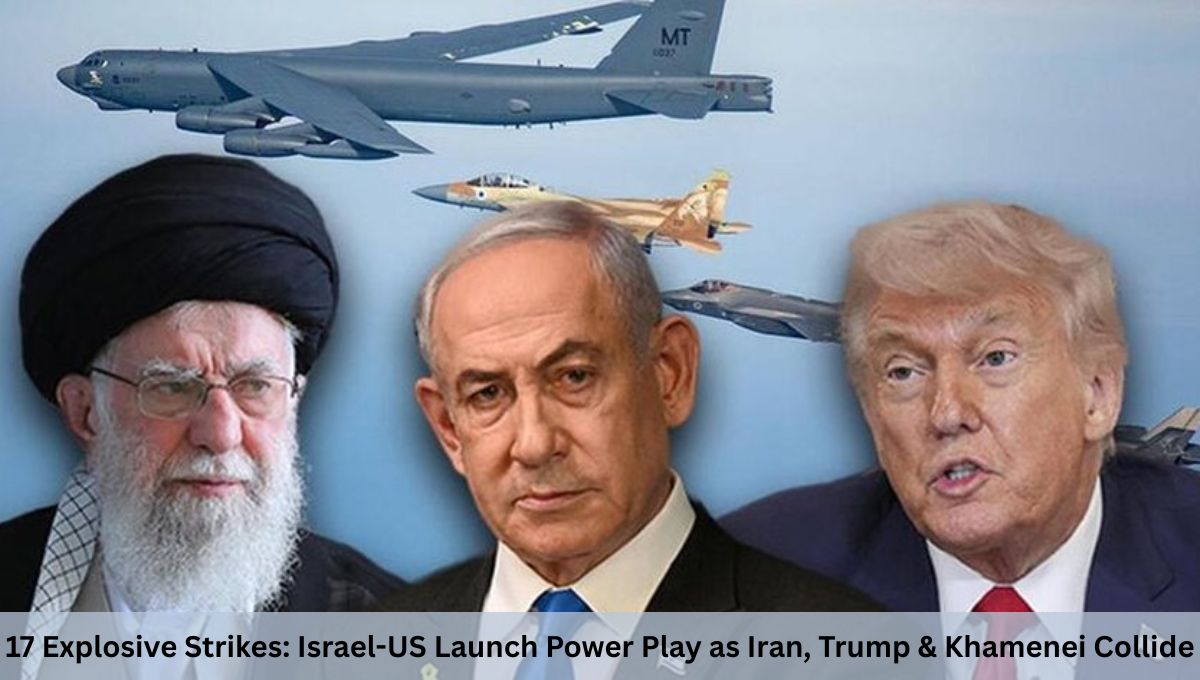
17 Explosive Strikes: Israel-US Launch Power Play as Iran, Trump & Khamenei Collide, sparking fears of a wider Middle East war. Explosions tore through Iran’s capital at dawn, shattering years of uneasy deterrence and pushing the Middle East toward one of its most dangerous military confrontations in decades.
In a dramatic escalation, Israel, backed by the United States, launched what both governments described as “pre-emptive” and “preventive” military strikes against Iran, hitting multiple targets across Tehran and beyond, including areas near the offices of Supreme Leader Ayatollah Ali Khamenei.
Within hours, U.S. President Donald Trump confirmed that American forces had begun “major combat operations” in Iran, declaring that the objective was to eliminate what Washington called “imminent threats” from the Iranian regime.
As sirens wailed across Israel, Iranian missiles streaked toward Israeli airspace, oil markets surged, airspace across multiple countries shut down, and millions of civilians on both sides braced for what could become a prolonged regional war.
17 Explosive Strikes: Israel-US Launch Power Play as Iran, Trump & Khamenei Collide
Explosions in Tehran: Strikes Near the Heart of Power
Early Saturday morning, residents of Tehran were jolted awake by a series of powerful explosions.
According to reports from the Associated Press and Reuters, at least three to four distinct strikes were heard in the capital.
Thick plumes of smoke rose from central districts that house some of Iran’s most sensitive institutions — including the presidential complex, the National Security Council, and areas close to the Supreme Leader’s offices.
Roads leading to Khamenei’s compound were immediately sealed off by security forces, while Iranian state television acknowledged explosions but offered no initial explanation.
A journalist on the ground described the blasts as “heavy, sustained, and clearly deliberate”, suggesting carefully planned targeting rather than random bombardment.
Khamenei Moved to a Secure Location
One of the most consequential revelations came shortly after the strikes.
According to Reuters, Iran’s 86-year-old Supreme Leader Ayatollah Ali Khamenei was not in Tehran at the time of the attack.
Iranian officials confirmed he had been transferred to a secure location days earlier as tensions with Israel and the United States escalated.
Khamenei has not been seen publicly in recent days, fueling speculation about the depth of intelligence penetration behind the strikes and the seriousness with which Tehran viewed the threat of an attack.
The targeting of areas near his offices marked one of the boldest symbolic escalations yet — striking at the physical heart of Iran’s political and religious authority.
Israel Confirms ‘Preventive Strike’
Israel moved quickly to confirm responsibility.
Defence Minister Israel Katz announced that Israel had launched a “pre-emptive attack against Iran to remove threats to the State of Israel.”
A nationwide state of emergency was declared immediately.
Schools were closed, public gatherings banned, workplaces shuttered except for essential services, and civilians were instructed to remain close to protected spaces.
“This is a proactive alert to prepare the public for the possibility of missiles being launched toward the State of Israel,” the Israeli military said.
Israel’s airspace was closed to civilian flights, with similar measures taken by Iran, Iraq, and other neighboring states.
Trump Confirms Major U.S. Combat Operations
Within hours, Donald Trump delivered a blunt message to the world.
In a video posted to his Truth Social account, the U.S. president confirmed that American forces had begun major combat operations inside Iran, describing the Iranian leadership as “a vicious group of very hard, terrible people.”
“Our objective is to defend the American people by eliminating imminent threats from the Iranian regime,” Trump said.
He accused Tehran of continuing to pursue nuclear weapons and long-range missile capabilities despite months of negotiations and previous military warnings.
Trump also acknowledged that American casualties were possible, stating plainly: “That often happens in war.”
Joint Israel-US Operation: Planned for Months
Multiple officials speaking anonymously to Reuters, AP, and other outlets confirmed that the strikes were jointly coordinated between Israel and the United States.
Israeli defense sources said the operation — reportedly named Operation Roaring Lion — had been planned for months, with the launch date decided weeks ago, even as diplomatic talks continued.
The emerging picture suggests three main categories of targets:
1. Missile Infrastructure
Sites in Kermanshah, Karaj, and Khorramabad, long associated with Iran’s ballistic missile program.
2. Government and Intelligence Buildings
Key ministries and symbols of state authority in Tehran, including the Ministry of Intelligence and Ministry of Defence.
3. Nuclear-Linked Facilities
Sensitive locations near Qom, Isfahan, Bushehr, and Parchin, one of Iran’s most guarded military sites.
Why Now? Nuclear Talks Collapse
The strikes came after months of stalled diplomacy.
The United States and Iran had held multiple rounds of talks aimed at reviving constraints on Tehran’s nuclear program.
Those negotiations ended without a breakthrough, with Washington accusing Iran of refusing to address core demands — particularly its ballistic missile development.
U.S. Secretary of State Marco Rubio had warned that Iran’s unwillingness to discuss missiles was a “big, big problem.”
Trump had earlier given Tehran a 10- to 15-day window to reach a deal, warning that “really bad things” would happen if no agreement emerged.
Those warnings are now reality.
Trump’s Message to the Iranian People
In one of the most extraordinary moments of the crisis, Trump directly addressed Iran’s population.
“Bombs will be dropping everywhere. When we are finished, take over your government — it will be yours to take.”
He portrayed the operation as a historic opportunity, claiming no previous U.S. president had been willing to use such force against the Iranian regime.
The rhetoric marked a clear shift from containment toward openly encouraging regime change, even as officials insisted the strikes were limited to military objectives.
Iran Responds: Missiles Toward Israel
Iran’s response was swift.
Within hours of the initial strikes, Iranian missiles were launched toward Israel, triggering air raid sirens across Tel Aviv, Jerusalem, northern and central Israel.
Israeli air defense systems were activated, intercepting incoming fire as explosions echoed across northern regions.
Iranian officials warned that retaliation would be “crushing”, adding that U.S. military bases and personnel across the Middle East would be legitimate targets.
Hospitals, Airspace, and Civilian Life Disrupted
The impact on civilian life was immediate:
- Hospitals in Israel moved patients and surgeries underground
- Airspace closed across Israel, Iran, Iraq, and parts of the Gulf
- Mobile networks disrupted in Tehran
- Long queues at petrol stations as residents tried to flee the capital
- Shelter-in-place orders issued at U.S. embassies and bases
India issued a travel advisory, urging its nationals in Israel to remain near shelters and avoid unnecessary movement.
Global Markets on Edge
Energy markets reacted sharply.
Iran is a founding member of OPEC and sits astride the Strait of Hormuz, through which nearly 20% of the world’s oil supply passes.
Fears of a supply shock pushed oil prices to six-month highs, while global stock markets wobbled amid uncertainty over whether the conflict would spread to the Gulf.
Historical Echoes: A Dangerous Pattern
This is not the first direct confrontation.
Last June, U.S. forces struck three Iranian nuclear facilities, prompting Iran to retaliate with missiles toward the Al Udeid Air Base in Qatar. That exchange stopped short of full-scale war.
What makes this moment different is:
- Direct strikes near Iran’s supreme leadership
- Open acknowledgment of joint U.S.-Israel combat operations
- Explicit discussion of regime change
- Missile exchanges involving civilian centers
Opposition and Symbolism: ‘We Overcame Haman’
Inside Israel, political divisions vanished overnight.
Opposition leader Yair Lapid declared full support for the operation, writing:
“There is no coalition and no opposition — only one people and one IDF.”
Yisrael Beytenu leader Avigdor Liberman invoked the Purim story, declaring:
“We overcame Haman — we will overcome Khamenei too.”
The symbolism underscored how deeply existential Israeli leaders view the confrontation.
Will This Become a Full-Scale War?
Analysts warn the region stands at a tipping point.
Iran retains significant missile capabilities and powerful regional proxies. Israel possesses overwhelming air superiority. The United States brings unmatched global firepower.
A prolonged conflict risks:
- Regional war across Lebanon, Syria, Iraq, and the Gulf
- Attacks on global shipping
- Severe civilian casualties
- Long-term economic shock
Yet off-ramps remain — if diplomacy resumes before escalation spirals further.
Conclusion: The World Holds Its Breath
The strikes on Tehran — near the offices of Iran’s Supreme Leader — have shattered assumptions that escalation could always be contained.
With missiles flying, leaders in secure bunkers, civilians sheltering underground, and markets trembling, the Middle East has entered a new and perilous phase.
Whether this moment marks a short, brutal exchange — or the opening chapter of a wider war — will depend on decisions made in the coming hours, not weeks. For now, the world watches — and waits.
Also Read: 9 Explosive Signals: Why US F-22s Flew “Invisible” to Israel as Iran Talks Teeter
Also Read: Explosions Heard Across Gulf, Iran Launches Strikes Targeting US Bases Across Region
Related Posts:
- 7 Key Revelations from Trump’s ‘Perfectly Normal’…

- 11 Explosive Warnings as Trump Vows to ‘Knock the…

- Trump’s 2025 Gaza Peace Plan Signing and Historic…

- Impacts of the Trump-Putin Call on Ukraine’s 2025 Strategy

- Can the EU and NATO Impose Tariffs on India and…

- 5 Powerful Highlights as Trump Lands Second Nobel…
