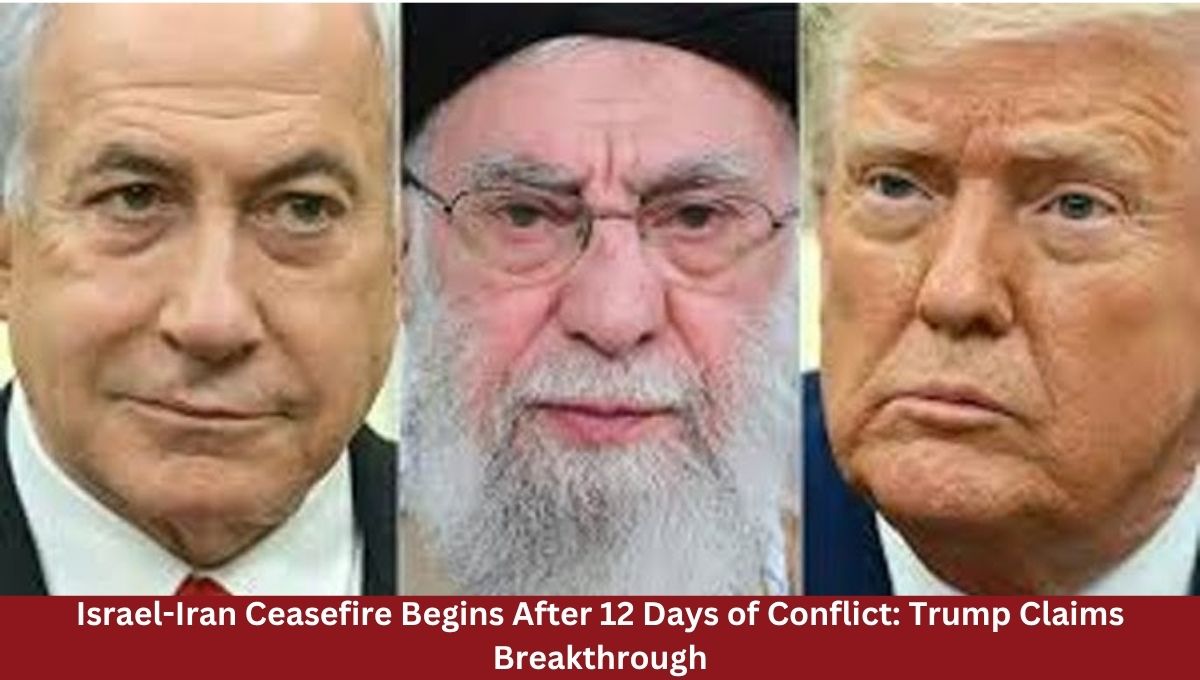
A tense calm has settled over the Middle East as Israel-Iran Ceasefire Begins After 12 Days of Conflict: Trump Claims Breakthrough. After 12 days of open conflict between Israel and Iran, a dramatic ceasefire was announced by U.S. President Donald Trump early Tuesday.
The ceasefire, announced just hours after a barrage of missiles and airstrikes, aims to end a war that many feared could spiral into a full-blown regional catastrophe involving the United States and other global powers.
At around 3:00 AM local time, powerful explosions rattled northern and central Tehran. Warplanes were reported overhead, even as the clock ticked down to the proposed 4:00 AM ceasefire time. These final strikes marked a violent end to nearly two weeks of military operations, with Iran saying its last missile salvos were meant to “punish Israel for its aggression.”
Israel-Iran Ceasefire Begins After 12 Days of Conflict: Trump Claims Breakthrough
Trump: “Get Me Bibi” – Inside the White House Push for Peace
According to senior White House officials, President Trump was instrumental in brokering the Israel-Iran ceasefire.
In a dramatic turn of events, Trump personally called Israeli Prime Minister Benjamin Netanyahu and instructed his staff to open back-channel communications with Tehran.
“Get me Bibi. We’re going to make peace,” Trump reportedly said in the Oval Office, as relayed by a White House insider.
The president directed Vice President JD Vance, Secretary of State Marco Rubio, and U.S. envoy Steven Witkoff to engage in talks with Iran.
The final breakthrough came after Qatar intervened, convincing Tehran to accept a truce proposal initiated by the U.S.
Trump later announced on Truth Social that both Iran and Israel had agreed to a “Complete and Total CEASEFIRE” to be phased in over 24 hours starting first with Iran, followed by Israel 12 hours later.
Iran’s Mixed Signals: Ceasefire Denial, Then Confirmation
Initially, Iranian Foreign Minister Seyed Abbas Araghchi posted on X (formerly Twitter) that there was “no agreement” on any ceasefire.
However, within hours, he reversed course, confirming that Iran had ceased its military operations as of 4:00 AM local time.
He praised Iran’s Armed Forces for “responding to any attack until the very last minute,” but indicated that operations had officially paused, contingent on Israel refraining from further aggression.
This move effectively signaled Iran’s reluctant acceptance of the ceasefire deal negotiated by the U.S. and Qatar.
Israel Stays Silent but Signals Compliance
While no official statement has been released by Israel’s Prime Minister’s office, Israeli sources told Hebrew media that Netanyahu had agreed to the ceasefire on the condition that Iran halt further attacks.
Israel’s military refused to comment publicly on President Trump’s announcement, though insiders confirmed that Tel Aviv was looking to wind down its military campaign.
Sources suggest that pressure from Washington and the threat of an expanding war involving the United States contributed to Israel’s decision to accept the ceasefire terms.
U.S. Bombing of Iranian Nuclear Sites: The Turning Point
The path to this fragile peace was paved with dangerous escalation. Over the weekend, U.S. B-2 bombers dropped 30,000-pound bunker-buster bombs on Iranian underground nuclear facilities.
In response, Iran launched retaliatory missile strikes on the U.S.-operated al-Udeid Air Base in Qatar. Fortunately, no injuries or casualties were reported.
The airstrikes marked a serious deviation from Trump’s usual “America First” stance and his earlier promise to avoid foreign military entanglements.
But the decision also positioned Trump as a decisive leader willing to act against nuclear threats.
Revolutionary Guards Issue Fiery Warning to U.S.
Despite agreeing to a ceasefire, Iran’s Revolutionary Guard remained defiant. General Mohammad Pakpour issued a direct threat to President Trump, warning that any future attacks on Iran would be met with “more crushing and regrettable responses.”
The warning reflects the fragile and deeply mistrustful nature of the truce. Meanwhile, Iran issued a chilling warning to residents of Ramat Gan, a city east of Tel Aviv, urging evacuation ahead of planned strikes though no missiles were ultimately launched at that target following the ceasefire announcement.
Who Blinked First: Netanyahu or Khamenei?
The big question now being asked across geopolitical circles: who blinked first?
Iran’s Supreme Leader Ayatollah Ali Khamenei denied that Iran surrendered, saying, “The Iranian nation isn’t a nation that surrenders.”
However, many analysts argue that it was Iran who initiated the ceasefire countdown by agreeing to stop hostilities at 4:00 AM giving Israel an opening to declare the war over.
Reports suggest that the Qatari Prime Minister played a crucial role by mediating between Tehran and Washington after Iran’s missile attack on the U.S. air base in Doha.
This allowed Vice President JD Vance and other American officials to finalize terms with Iran’s leadership.
Trump Hails Victory for Peace
In his Truth Social post, President Trump claimed full credit for the peace deal:
“On the assumption that everything works as it should, which it will, I would like to congratulate both Countries, Israel and Iran, on having the Stamina, Courage, and Intelligence to end, what should be called, ‘THE 12 DAY WAR.’”
He added that the war could have “gone on for years, and destroyed the entire Middle East,” but thanks to diplomacy and resolve, it didn’t and “never will.”
What Comes Next?
Though the ceasefire has brought a temporary halt to violence, tensions remain high. Both sides are watching closely for any signs of violation.
The U.S. has signaled readiness to retaliate if Iran or its proxies resume attacks. Meanwhile, Iran remains wary of further Israeli military actions.
As the region takes a tentative step back from the brink, all eyes are now on how long this Israel-Iran ceasefire will hold and whether Trump’s surprise diplomatic triumph can translate into lasting peace.
Conclusion:
The Israel-Iran war may have ended for now, but the political and military chessboard in the Middle East remains volatile. With Trump at the center of this dramatic truce, global attention is now shifting from the battlefield to the negotiating table where the real war for regional influence is just beginning.
Also Read: Trump Teases Major Move Amid Escalating Israel-Iran Conflict: “Nobody Knows What I’m Going to Do”
Also Read: World leaders express relief, urge diplomacy as shaky Israel-Iran ceasefire begins
Related Posts:
- 11 Explosive Warnings as Trump Vows to ‘Knock the…

- Trump’s 20-Point Gaza Peace Plan Gains Urgent Global…

- Dramatic Moments Behind Trump’s Gaza Peace Push and…

- 5 Powerful Highlights as Trump Lands Second Nobel…

- 11 Explosive Revelations From Ted Cruz’s Leaked…

- Afghanistan–Pakistan War 2025: Inside the 48-Hour Ceasefire
