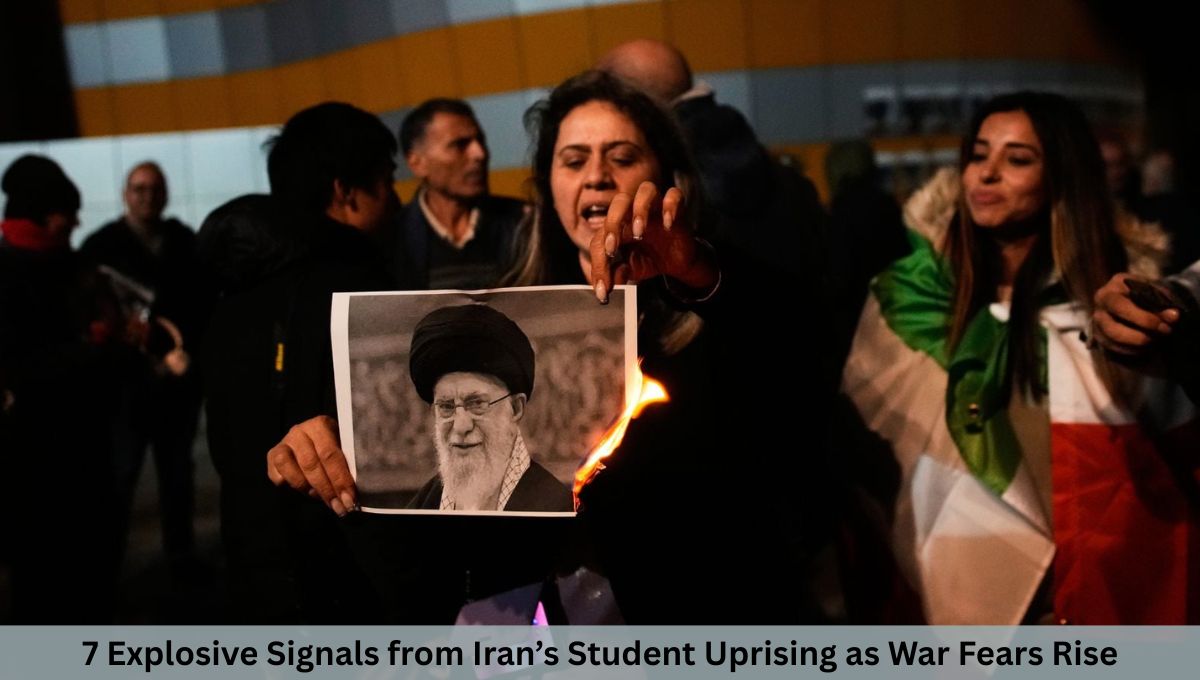
7 Explosive Signals from Iran’s Student Uprising as War Fears Rise ahead of nuclear talks in Geneva. Iran’s university campuses have once again become epicentres of political resistance, with student protests entering a third consecutive day amid an atmosphere of fear, defiance, and geopolitical tension.
From Tehran to Mashhad, demonstrations have spread despite warnings, arrests, and violent confrontations with security forces. The unrest comes weeks after a deadly nationwide crackdown that left thousands dead and tens of thousands detained—marking the most severe internal crisis since Iran’s 1979 Islamic Revolution.
As students chant “death to the dictator” and revive pre-revolutionary symbols, the protests are unfolding against the backdrop of intensifying U.S. military pressure and fragile nuclear negotiations with Washington.
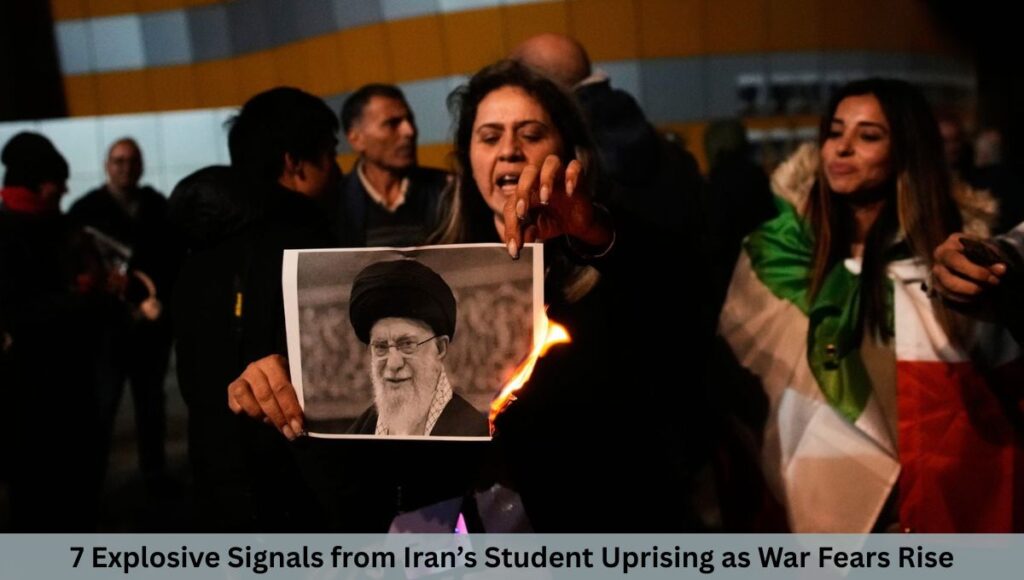
7 Explosive Signals from Iran’s Student Uprising as War Fears Rise
A Movement Rekindled on Campus
Universities reopened after January’s bloodshed with an air of caution. Instead, they reignited dissent.
Large demonstrations were reported at Tehran’s leading institutions, including Sharif University of Technology, University of Tehran, Amirkabir University, and Al Zahra University, where students burned flags, clashed with the Basij militia, and shouted slogans denouncing the state.
In Mashhad, protests were reported at Ferdowsi University of Mashhad, a city that was among the hardest hit during January’s crackdown.
According to videos circulated online and reports by the Human Rights Activists News Agency (HRANA), security forces intervened aggressively, leaving several students injured.
Conflicting Narratives: State TV vs Social Media
Iranian state television presented a sharply different version of events.
Broadcasts claimed that individuals “pretending to be students” attacked pro-government demonstrators who were condemning January’s unrest.
Officials alleged that these attackers hurled rocks and caused injuries, framing the violence as foreign-backed sabotage.
However, videos verified by international media showed Basij members confronting students, baton charges inside campuses, and ambulances entering university grounds.
Student Telegram channels reported disciplinary threats, expulsions, and arrests.
This growing divide between official narratives and citizen documentation has become a defining feature of Iran’s current crisis.
Chants, Symbols, and the Return of a Forbidden Flag
Saturday’s footage from Sharif University marked a symbolic escalation.
Students were seen chanting against Ali Khamenei, calling him a “murderous leader,” while others waved Iran’s pre-1979 lion-and-sun flag, openly expressing support for Reza Pahlavi, the exiled son of Iran’s last shah.
At Al Zahra University, students reportedly burned the Islamic Republic’s flag and chanted:
- “Death to the dictator”
- “For every one killed, a thousand will rise”
- “The blood that has been spilled will never be washed away”
In one of the most striking acts of mockery, students hung toy mice from trees to ridicule Khamenei—suggesting he was hiding underground like a mouse.
The Shadow of January’s Bloodshed
The renewed protests cannot be separated from the trauma of January. Iranian authorities acknowledge just over 3,000 deaths, blaming “terrorists” and foreign interference.
HRANA, however, reports more than 7,000 confirmed killings, while UN-linked estimates suggest the toll may exceed 20,000.
Former president Mohammad Khatami broke with his earlier position and called for the release of detainees, saying those arrested were guilty only of “despair and protest.”
His remarks signaled a rare shift among establishment reformists.
Yet thousands remain imprisoned, with families still mourning amid heavy surveillance and internet restrictions.
Basij, IRGC, and Campus Clashes
Iran’s universities are legally designated as spaces free from police interference. That principle has now collapsed.
Members of the Basij militia, affiliated with the Islamic Revolutionary Guard Corps (IRGC), have been repeatedly filmed confronting students inside campuses.
Scuffles at Sharif and Amirkabir universities left students bloodied, with some reportedly beaten while chanting slogans.
State media defended the Basij as “students honouring victims of foreign-backed riots,” while accusing protesters of celebrating deaths—claims strongly rejected by student groups and grieving families.
A Nation Under Sanctions and Siege
The unrest is unfolding as Iran’s economy buckles under sanctions, inflation, and unemployment.
Students say the protests initially began over economic hardship before rapidly transforming into a broader rejection of clerical rule.
Many see no future under a system they believe has exhausted both legitimacy and opportunity.
Iran’s Gen-Z—digitally connected, globally aware, and politically defiant—has emerged as the backbone of this movement.
U.S. Pressure and the Risk of War
As protests spread, tensions with Washington have escalated sharply.
U.S. President Donald Trump has warned that “really bad things will happen” if nuclear talks fail, while overseeing a major U.S. military buildup in the Middle East, including aircraft carriers, destroyers, and advanced air defenses.
Trump has publicly questioned why Iran has not “capitulated” under pressure, remarks echoed by his Middle East envoy Steve Witkoff.
Iran’s response has been defiant. Foreign ministry spokesperson Esmail Baghaei warned that any attack would be met “ferociously,” while stressing that Iran would not negotiate under threats.
Nuclear Talks: Diplomacy on a Knife’s Edge
Despite the hostility, diplomacy continues.
Oman’s foreign minister Badr Albusaidi confirmed that Iran–U.S. nuclear talks are scheduled in Geneva, with mediators urging both sides to “go the extra mile.”
Iranian Foreign Minister Abbas Araghchi said Tehran would present proposals reaffirming it has no intention of building a nuclear weapon and may revert to the Additional Protocol, granting UN inspectors enhanced access.
Yet officials acknowledge that the outcome may hinge on Trump’s personal judgment.
A Region on Edge
The stakes extend far beyond Iran.
The United States has begun withdrawing non-essential embassy personnel from parts of the Middle East, while several countries—including Sweden, Australia, and Poland—have urged citizens to leave Iran.
Iran has also reportedly agreed to a €500 million arms deal with Russia, including thousands of advanced shoulder-fired missiles, signaling preparations for potential escalation.
Speaking at the UN Human Rights Council, Iran’s deputy foreign minister Kazem Gharibabadi warned that war would engulf the entire region, not just Iran and the U.S.
Fractured Opposition, United Grief
Perhaps most ominous for the Iranian government is the emergence of coordinated opposition.
Five Kurdish political parties have announced a coalition aimed at bringing down the government, declaring that the Islamic Republic has “lost all legitimacy” and survives only due to fragmented resistance.
Meanwhile, mourning ceremonies for protest victims continue across Iran, defying state-imposed norms. Families clap, play music, and raise victory signs—not in celebration, but as acts of defiance.
What Comes Next?
Iran stands at a crossroads.
- Students refuse to retreat
- Security forces show no sign of restraint
- Diplomacy competes with the drumbeat of war
- Economic pressure deepens public anger
Whether these protests evolve into a sustained nationwide movement—or are crushed like those in January—may depend as much on decisions made in Geneva and Washington as on the courage displayed inside Iran’s universities.
What is clear is this:
Iran’s campuses are no longer just centres of learning—they are frontlines of a historic struggle.
Also Read: 9 Explosive Facts Driving Iran’s Deepening Protest Crisis
Also Read: Iranian students rally as universities reopen after nationwide protests
Related Posts:
- 7 Dead in Explosive Iran Protests as Economic Anger…

- 11 Explosive Developments as Iran Warns US Over…
- 7 Powerful Measures: Trump Sanctions Russian Oil…

- Afghanistan–Pakistan War 2025: Inside the 48-Hour Ceasefire

- 13 Shocking Facts About the Brown University…
- Trump’s 20-Point Gaza Peace Plan Gains Urgent Global…
