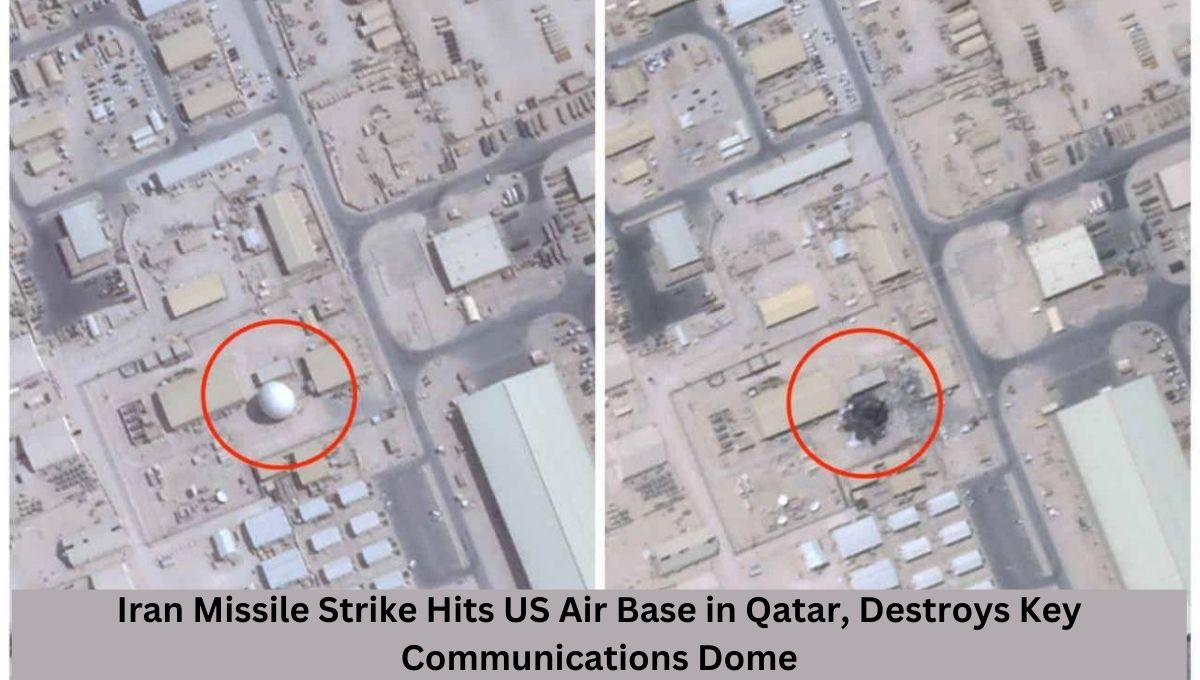
A satellite imagery has confirmed that Iran Missile Strike Hits US Air Base in Qatar, Destroys Key Communications Dome. An Iranian missile strike on June 23 destroyed a key US military communications dome at Al Udeid Air Base in Qatar, one of the most critical American military installations in the region. The strike came in retaliation for a US bombing campaign on Iranian nuclear sites and marks the first time Iran has struck a significant US military terminal in Qatar.
Iran Missile Strike Hits US Air Base in Qatar, Destroys Key Communications Dome
Satellite Images Confirm Iran Hit Geodesic Dome
According to high-resolution satellite images provided by Planet Labs PBC and reviewed by multiple media outlets, including the Associated Press and Business Insider, a $15 million geodesic dome that housed advanced satellite communications equipment was completely destroyed in the attack.
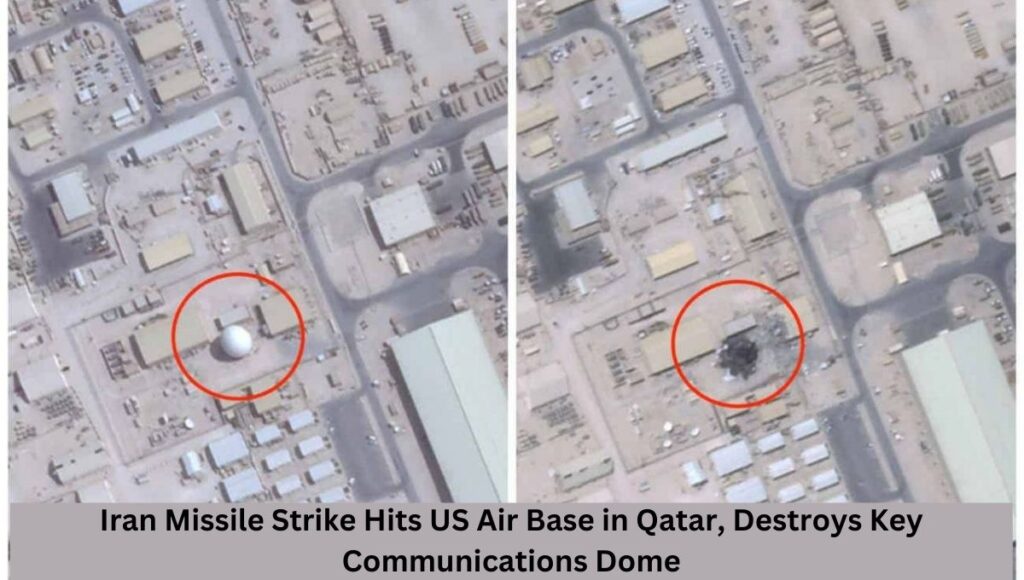
Images captured on June 23, just hours before the missile strike, show the dome intact. However, images from June 25 reveal a scorch mark where the dome once stood and visible damage to a nearby building.
The dome, known as a modern enterprise terminal, was crucial for secure voice, video, and data transmission between US forces in the Middle East and military leadership globally.
Pentagon Confirms Direct Hit, But Says Damage Was Minimal
In a statement, Pentagon spokesperson Sean Parnell confirmed that a ballistic missile launched by Iran directly hit Al Udeid, specifically damaging the dome.
However, Parnell emphasized that the overall damage was minimal and that “Al Udeid Air Base remains fully operational.”
There were no injuries or fatalities, and military operations at the base continued uninterrupted. This marks the first official US acknowledgment of a successful Iranian hit on the Al Udeid base.
Trump: Iran Gave Advance Warning, Allowed Preparation
Former President Donald Trump, speaking via Truth Social, revealed that Iran had provided advance notice of the missile strike through diplomatic channels.
He said this gave the US and Qatar enough time to activate defense systems and ensure the safety of personnel.
“I want to thank Iran for giving us early notice, which made it possible for no lives to be lost, and nobody to be injured,” Trump wrote.
“Only one of 14 missiles was allowed to strike, and it was heading in a nonthreatening direction.”
Despite the strike, Trump called it a “very weak response” to the US-led bombing of three Iranian nuclear sites: Natanz, Isfahan, and Fordow.
Iran Claims Success, Says US Communications Were Cut
Iranian state media and officials have claimed that the strike was “destructive and powerful,” boasting that they had successfully “cut off” communications at the Al Udeid base.
While the destruction of the geodesic dome does represent a symbolic blow, US officials have denied that critical communications or operations were disrupted.
The adjacent structures at the base, including runways and operational facilities, remained unaffected.
An adviser to Iran’s Supreme Leader Ayatollah Ali Khamenei said the strike was aimed at sending a clear warning without escalating the situation into full-scale war.
Strategic Significance of Al Udeid Air Base
Al Udeid Air Base, located just southwest of Doha, hosts the forward headquarters of the US Central Command (CENTCOM) and is a central hub for air operations in the Middle East.
The base supports over 10,000 US troops and is key to coordinating regional operations, including those in Iraq, Syria, and Afghanistan.
The now-destroyed communications dome, installed in 2016, was essential to secure satellite links for strategic command-and-control functions.
Though costly, its role was part of broader military modernization aimed at improving battlefield coordination.
Iran Fired 14 Missiles – 13 Intercepted, One Hits Dome
The missile attack on June 23 was part of a larger Iranian retaliation for the US and Israeli strikes on Iran’s nuclear infrastructure.
US defense sources confirm that 14 missiles were launched toward Al Udeid, of which 13 were intercepted by Patriot missile defense systems.
General Dan Caine, chairman of the Joint Chiefs of Staff, described the operation as “one of the most complex, real-time air defense challenges we’ve faced.” He noted the intense debris field, with “a lot of metal flying around.”
“Between attacking missiles, interceptors, and their remnants crashing back down, our air defenders had only seconds to act,” he said.
It remains unclear whether the dome was directly hit by the one surviving missile or damaged by falling debris from interceptions.
US Moved Aircraft Ahead of the Attack
In anticipation of the strike, US forces reportedly relocated aircraft and other critical assets away from vulnerable positions. This precautionary move helped prevent further destruction at Al Udeid.
Officials say the missile that struck was likely allowed to land on a predesignated area, seen as noncritical. The Pentagon has not disclosed whether the damaged dome will be rebuilt or replaced.
Israel, Qatar, and US Notified in Advance
Iran reportedly sent advance notice of the attack to Israel, Doha, and Washington, hoping to avoid casualties and further escalation. This diplomatic backchannel communication is credited with preventing loss of life.
Following the attack, Trump said that the strike “got it out of their system,” suggesting that Iran’s response was symbolic, not aimed at causing serious harm.
He added, “Perhaps Iran can now proceed to peace and harmony in the region, and I will enthusiastically encourage Israel to do the same.”
Ceasefire Reached After Iran-Israel War
The missile strike came just before a US-brokered ceasefire ended the 12-day Iran-Israel conflict, which included massive airstrikes and hundreds of missiles and drones launched between the two countries.
Israel’s military campaign targeted not only nuclear facilities but also senior Iranian commanders, some of whom are reported to have been killed. Tehran’s retaliation included missile attacks on US positions in Qatar and Iraq.
Despite the flare-up, the ceasefire has held, with both sides showing restraint since June 25.
US Faces Questions Over Preparedness and Budget Cuts
While the Al Udeid base remains fully functional, the strike has renewed scrutiny of US defense preparedness, especially given earlier budget cuts to agencies like the National Weather Service (NWS) and FEMA, and now concerns about infrastructure resilience in overseas military installations.
Senator Chuck Schumer and other Democrats have called for a Senate investigation into whether Trump-era staffing cuts have weakened America’s ability to detect and prevent missile threats.
The White House has denied that budget reductions had any impact on the strike or defense readiness. “Assigning any blame to President Trump would be depraved,” said Press Secretary Karoline Leavitt.
Conclusion: Symbolic Strike, Operational Strength Remains
The June 23 Iranian missile strike on Al Udeid Air Base is the first confirmed successful hit on a major US military asset in Qatar by Iran. Though the destruction of the communications dome is noteworthy, the lack of casualties and operational disruption points to a strategic calculation by Iran to retaliate without escalating.
Trump’s framing of the incident as a “controlled conflict” with diplomatic warning underscores the fragile balance in US-Iran-Israel relations. The episode also highlights both the vulnerability and resilience of even the most fortified military bases in the age of ballistic threats.
As the dust settles, the world watches to see if this calculated response marks the end of hostilitiesor a brief pause before the next escalation.
Also Read: Israel-Iran War Escalates: Cluster Bombs, Missile Strikes, and Fading Hopes for Peace
Related Posts:
- US Quietly Removes Jets from Qatar Base Amid Iran Threat

- US Sanctions 50 Entities in Major Iran Oil Trade…

- Israel’s Operation Rising Lion: Satellite Images…
- Israel Strikes Iranian Airfields, Destroys 15 Jets…
- 15 Explosive Signals as the US Masses War-Ready…

- 11 Explosive Warnings as Trump Vows to ‘Knock the…
