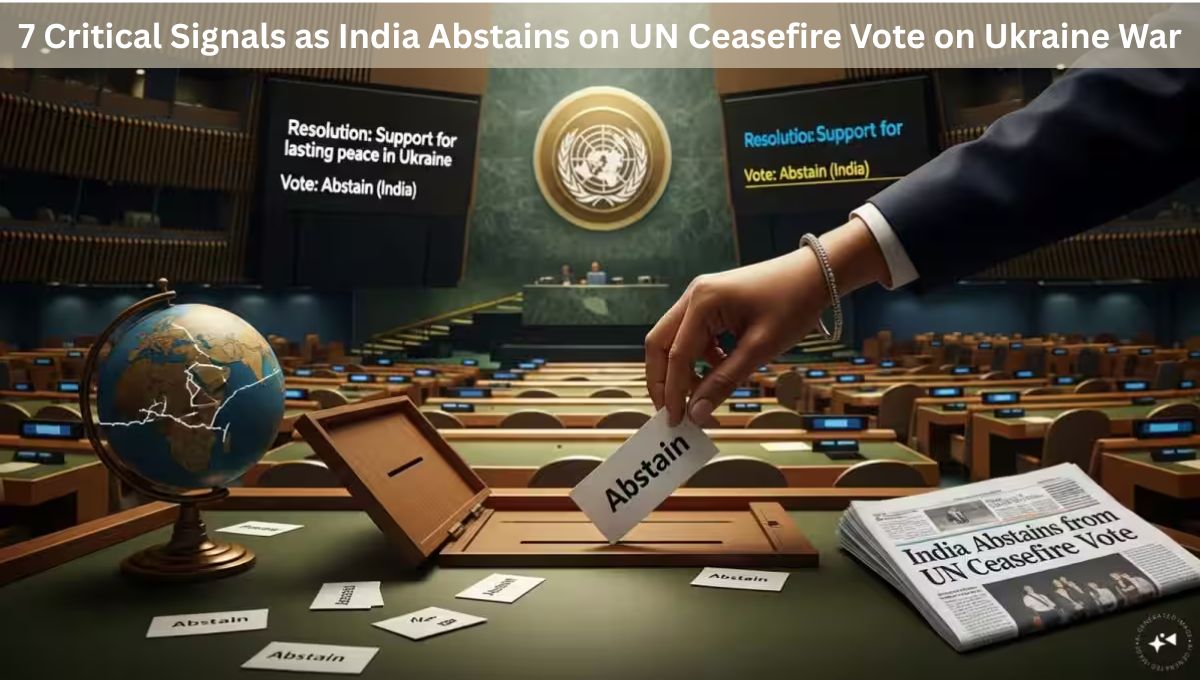
7 Critical Signals as India Abstains on UN Ceasefire Vote on Ukraine War, backing diplomacy over war. India on Tuesday abstained from voting on a United Nations General Assembly resolution that called for an immediate, full, and unconditional ceasefire between Russia and Ukraine—once again underscoring New Delhi’s carefully calibrated position on one of the most consequential conflicts of the 21st century.
The resolution, titled “Support for Lasting Peace in Ukraine,” was introduced by Kyiv and adopted on the fourth anniversary of Russia’s full-scale invasion of Ukraine, with 107 votes in favour, 12 against, and 51 abstentions out of the UN’s 193 member states.
India was among the 51 abstaining countries, joining nations as diverse as China, Brazil, South Africa, Bangladesh, Sri Lanka, the United Arab Emirates, Bahrain—and notably, the United States.
India’s decision, while consistent with its previous voting pattern on the conflict, once again placed New Delhi at the centre of global debate:
balancing international law, strategic autonomy, humanitarian concern, and geopolitical realism.
7 Critical Signals as India Abstains on UN Ceasefire Vote on Ukraine War
What the UN Resolution Called For
The General Assembly resolution adopted on Tuesday was one of the most comprehensive UN texts on Ukraine since the war began in February 2022.
The resolution called for:
- An immediate, full, and unconditional ceasefire
- A comprehensive, just, and lasting peace in line with international law
- Respect for the sovereignty, independence, unity, and territorial integrity of Ukraine
- The exchange of prisoners of war
- The release of all unlawfully detained persons
- The return of civilians forcibly transferred or deported, including children
- Protection of civilians and civilian infrastructure
- An end to attacks on critical energy facilities
The text reaffirmed commitment to the Charter of the United Nations, stressing that any peace settlement must respect Ukraine’s internationally recognised borders, including its territorial waters.
How India Voted — And With Whom
India chose to abstain, neither supporting nor opposing the resolution.
Other countries that abstained included:
- India
- China
- Brazil
- South Africa
- Bangladesh
- Sri Lanka
- United Arab Emirates
- Bahrain
- United States
The abstentions reflected a broad coalition of countries that, for different reasons, remain cautious about endorsing UN texts perceived as politically charged or potentially disruptive to ongoing diplomatic efforts.
India has consistently abstained on major UN votes related to the Russia-Ukraine war since 2022, maintaining what it describes as a principled and balanced position.
India’s Stated Position: Dialogue Over Polarisation
While India did not issue a detailed explanation during the vote itself, its broader position on the conflict has remained largely unchanged.
India has repeatedly emphasized:
- The need for dialogue and diplomacy
- The importance of an immediate cessation of violence
- Concern over the humanitarian impact of the war
- Respect for the UN Charter and international law
- Avoidance of actions that deepen global polarisation
New Delhi has also consistently argued that there can be no military solution to the conflict and that lasting peace can only be achieved through negotiations acceptable to both sides.
Why India Abstained Instead of Voting Yes
For global audiences, India’s abstention may appear puzzling—especially given the resolution’s focus on peace, ceasefire, and humanitarian relief.
However, India’s calculus involves several layers:
1. Strategic Autonomy
India’s foreign policy tradition prioritises independent decision-making, resisting alignment with any single geopolitical bloc.
2. Language and Framing
New Delhi has often expressed reservations about resolutions that:
- Place exclusive blame on one party
- Do not sufficiently encourage direct negotiations
- Risk entrenching positions rather than facilitating compromise
3. Geopolitical Balancing
India maintains:
- Long-standing defence and energy ties with Russia
- Expanding strategic partnerships with the West
- A leadership role among developing and non-aligned nations
Voting in favour could be seen as tilting decisively toward one camp.
Zelensky’s Reaction: Gratitude to Supporters
Ukrainian President Volodymyr Zelensky welcomed the adoption of the resolution, thanking the 107 nations that voted in favour.
In a post on X, Zelensky said:
“I am grateful to each of the 107 countries that stood with Ukraine today in defense of life at the @UN. The General Assembly adopted our resolution in support of a lasting peace, with clear calls for a full ceasefire and the return of our people.”
He described the resolution as a necessary step toward lasting peace and pledged continued cooperation with international partners.
Notably, Zelensky did not directly criticise abstaining countries, reflecting Kyiv’s awareness of the complex diplomatic terrain.
UN Secretary-General’s Stark Warning
Marking four years since Russia launched its full-scale invasion, UN Secretary-General Antonio Guterres issued one of his strongest statements yet.
Calling the war:
- A violation of the UN Charter
- A threat to regional and international peace
- A stain on the collective conscience of humanity
Guterres warned that:
- The longer the war continues, the deadlier it becomes
- Civilians bear the brunt of the conflict
- 2025 has already seen the highest number of civilian deaths since the invasion
He reiterated his call for an immediate, full, and unconditional ceasefire, stressing that peace must respect Ukraine’s sovereignty and territorial integrity.
The Human Cost: A War That Keeps Escalating
Senior UN officials painted a grim picture of the conflict’s toll.
Rosemary DiCarlo, Under-Secretary-General for Political and Peacebuilding Affairs, told the Security Council that:
- Over 15,000 civilians have been killed
- More than 41,000 injured
- Millions displaced
- A generation of children has lost years of education
She highlighted the severe impact of winter, with intensified attacks on Ukraine’s energy infrastructure leaving civilians without heat or power.
At the same time, she acknowledged that civilians in Russia have also been affected by Ukrainian strikes, urging both sides to halt attacks on energy facilities.
Nuclear Risk and Global Alarm
The UN also raised alarm about the risks to Ukraine’s nuclear facilities, describing the situation as an “unconscionable game of nuclear roulette.”
Any accident or miscalculation, officials warned, could have catastrophic consequences far beyond the region—underscoring why the conflict remains a global security concern.
Why the United States Also Abstained
One of the most striking aspects of the vote was the United States abstaining—a sharp departure from its earlier, unconditional support for Ukraine at the UN.
Washington argued that certain language in the resolution could:
- Distract from ongoing diplomatic negotiations
- Reduce flexibility for peace talks
The US delegation sought separate votes on key paragraphs reaffirming Ukraine’s sovereignty and international law, but this procedural motion was rejected.
The abstention reflects shifting dynamics following leadership changes in Washington and a renewed emphasis on negotiated outcomes over declaratory resolutions.
Europe Divided, Israel Breaks Ranks
While most European nations voted in favour, divisions were visible elsewhere:
- The European Union failed to agree on a new sanctions package due to Hungary’s opposition
- Israel, in a rare move, voted in favour of the resolution—breaking with the US
- Israel later announced humanitarian aid to Ukraine, including power generators for Kyiv
These shifts highlight how alliances around the Ukraine war are becoming more fluid.
India’s Abstention in Historical Context
India’s vote fits a broader pattern seen since 2022:
- Abstentions in UN General Assembly votes
- Calls for diplomacy over sanctions
- Humanitarian assistance without military involvement
India has also engaged both sides diplomatically, hosting dialogues and maintaining communication channels.
For New Delhi, abstention is not neutrality—it is a deliberate attempt to retain leverage and credibility with all parties.
Global South Perspective
Many countries in the Global South share India’s concerns:
- The war’s impact on food, fuel, and fertiliser prices
- Disruptions to global supply chains
- Perceived double standards in international responses to conflicts
India’s position resonates with nations seeking peace without being drawn into great-power rivalries.
What This Vote Means for Diplomacy
The resolution’s passage shows broad global support for a ceasefire—but the high number of abstentions underscores deep divisions over how peace should be pursued.
For India, the message is consistent:
- Support peace
- Reject violence
- Encourage dialogue
- Avoid bloc politics
Whether this approach helps bridge divides—or risks being seen as overly cautious—remains a subject of global debate.
What Comes Next
Key developments to watch include:
- Possible new rounds of Russia-Ukraine talks
- UN-led humanitarian initiatives
- Shifts in US and European diplomatic strategies
- Continued pressure from the Global South for negotiations
India is likely to continue advocating diplomacy while avoiding formal alignment with either side.
Bottom Line
India’s abstention on the UN ceasefire resolution is not an endorsement of war, nor a rejection of peace. It reflects a strategic balancing act shaped by geopolitics, principle, and pragmatism.
As the Russia-Ukraine conflict enters its fifth year, India’s stance highlights a central reality of today’s world order:
peace is widely desired, but consensus on how to achieve it remains elusive.
For global audiences, the vote underscores how the Ukraine war continues to reshape diplomacy—not just in Europe, but across the entire international system.
Also Read: 7 Explosive Signals as US Sets June Deadline to End Ukraine-Russia War
Related Posts:
- 7 Powerful Measures: Trump Sanctions Russian Oil…

- In 8 Moves, EU Targets China-Linked Refineries and…

- Trump’s 20-Point Gaza Peace Plan Gains Urgent Global…

- 7 Critical Reasons the Donbas Is the Most Explosive…
- Afghanistan–Pakistan War 2025: Inside the 48-Hour Ceasefire

- 20-Point Breakthrough: Trump-Led Peace Plan That…
