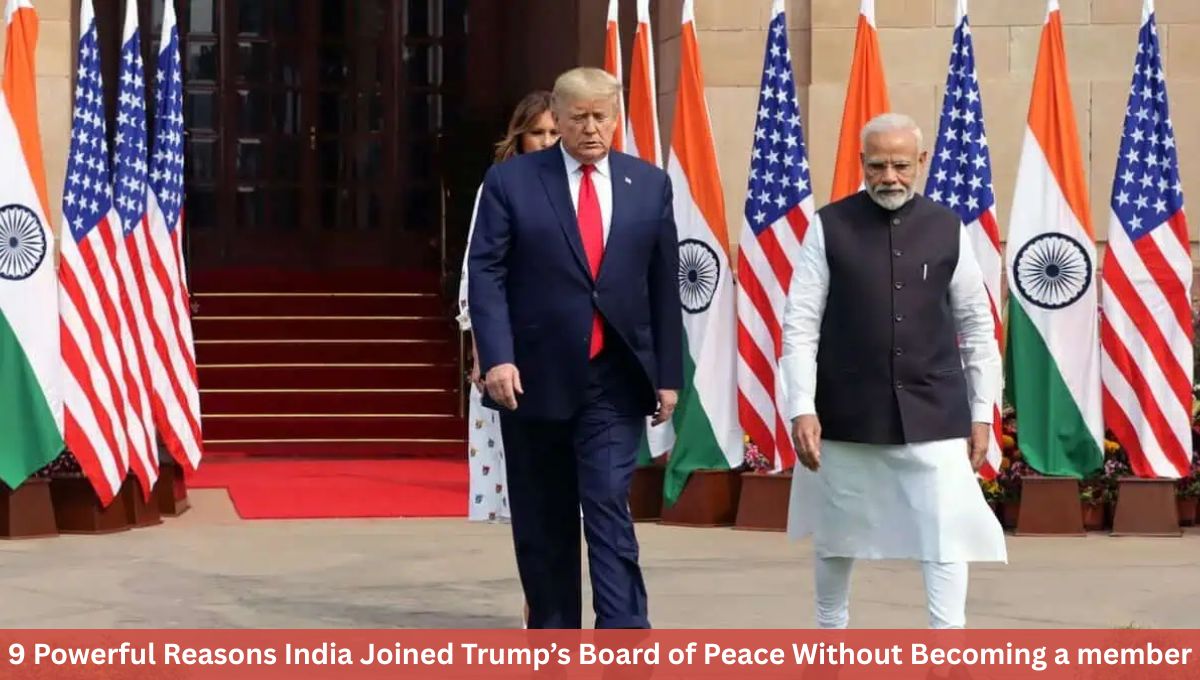
9 Powerful Reasons India Joined Trump’s Board of Peace Without Becoming a member: choosing cautious engagement. When Donald Trump convened the inaugural meeting of his ambitious and controversial Board of Peace in Washington, the optics were carefully choreographed. Dozens of nations gathered. Billions of dollars were pledged. Gaza’s future was discussed in lofty terms of stability, reconstruction, and global peace.
Yet one decision stood out.
India did not join the Board of Peace as a member. Instead, New Delhi chose to attend only as an observer.
That choice—subtle but deliberate—offers a revealing window into how India is navigating a volatile mix of Gaza diplomacy, United Nations legitimacy, Pakistan’s presence on the board, and an unpredictable Trump White House.
This article explains why India’s observer status is not hesitation—but strategy.
9 Powerful Reasons India Joined Trump’s Board of Peace Without Becoming a member
What Is Trump’s Board of Peace?
The Board of Peace was initially announced by President Trump as part of the second phase of a US-brokered ceasefire between Israel and Hamas.
Its stated purpose was narrow:
- Oversee the Gaza ceasefire
- Coordinate humanitarian aid
- Facilitate reconstruction
But the mandate expanded rapidly.
Trump described the board as a mechanism not only for Gaza, but for “global conflict resolution”, hinting it could intervene in international disputes worldwide—potentially overlapping or even superseding the role of the United Nations.
That ambition immediately raised alarms in many capitals, including New Delhi.
Composition of the Board of Peace
Member Countries (27 Nations)
The board’s core membership reflects a strong West Asian tilt, alongside select US political partners:
- Israel
- Egypt
- Jordan
- Saudi Arabia
- United Arab Emirates
- Qatar
- Turkey
- Bahrain
- Pakistan
- Argentina, Hungary, Vietnam, Cambodia, among others
Notably absent:
permanent members of the UN Security Council such as Russia, China, France, and the UK, weakening the board’s international legitimacy.
Observer Countries: Where India Fits In
Twenty-two countries attended as observers, including:
- United Kingdom
- Germany
- Italy
- Japan
- European Union
India was represented by its Deputy Chief of Mission in Washington, Namgya Khampa, signalling participation—without endorsement.
9 Strategic Reasons India Chose Observer Status
1. Preserving UN Centrality in Global Diplomacy
India remains deeply invested in the United Nations system. Any platform perceived as a parallel authority risks undermining institutions where India seeks reform and greater influence.
Although Trump claimed the board would work “in conjunction with the UN,” his remarks about “looking over” the UN triggered unease.
For New Delhi, observer status avoids legitimising a rival global body.
2. Gaza Support Without Political Ownership
India has publicly supported:
- Gaza humanitarian relief
- Reconstruction efforts
- UNSC Resolution 2803
Observer status allows India to back these goals without assuming responsibility for outcomes driven largely by US-Israeli priorities.
3. Trump’s Personal Project Problem
Indian policymakers see the Board of Peace as closely tied to Trump personally, not institutionally embedded in US foreign policy.
If Trump leaves office, the board’s relevance could evaporate.
India’s approach:
engage, assess durability, keep an exit option open.
4. The Pakistan Factor
Pakistan’s presence as a full board member sharply influenced India’s calculus.
Trump has repeatedly claimed—without evidence—that he mediated between India and Pakistan, even alleging tariff threats.
India has rejected these claims outright. Remaining completely outside the board risked Pakistan shaping narratives unchallenged.
Observer status allows India to monitor discussions and block any attempt to internationalise bilateral disputes.
5. Avoiding Gaza Governance Entanglement
The board discussed:
- International Stabilisation Forces
- Police restructuring
- Hamas disarmament
These are deeply contentious issues with long-term risks. India prefers distance from enforcement mechanisms, especially military deployments.
6. West Asia Stability and Economic Corridors
Peace in West Asia directly impacts India’s strategic projects, including the India-Middle East-Europe Economic Corridor.
Observer status gives India situational awareness without binding commitments.
7. Managing Relations with the Trump White House
India is simultaneously negotiating:
- An interim India-US trade framework
- Technology cooperation initiatives
- Strategic alignment in the Indo-Pacific
Non-attendance could have been read in Washington as diplomatic disengagement. Observer participation avoids that signal without surrendering autonomy.
8. Credibility Gap in Gaza Reconstruction Pledges
Trump announced:
- $7 billion pledged by nine countries
- $10 billion US contribution
Yet UN estimates put Gaza reconstruction costs at up to $70 billion.
India is wary of grand announcements without implementation mechanisms, especially amid ongoing ceasefire violations.
9. Listening to Gaza’s Ground Reality
Voices from Gaza remain deeply sceptical.
Residents question:
- Where the money will go
- Why Palestinians lack representation
- How reconstruction can occur amid ongoing violence
India’s limited role reflects realism: diplomacy must not outrun facts on the ground.
Why India Stayed Away from Full Membership
India declined to attend Trump’s January unveiling of the board in Davos.
The reasons remain consistent:
- Unclear charter
- Open-ended global mandate
- Trump chairing indefinitely
- Risk of UN marginalisation
Observer status allows reassessment as the board evolves—or fades.
Global Skepticism Mirrors India’s Caution
Several countries—including France, Norway, and the UK—have declined membership.
European diplomats privately question:
- Legal authority
- Democratic accountability
- Operational clarity
India’s stance aligns with this broader scepticism.
What Comes Next for India?
India will likely:
- Monitor outcomes of Gaza reconstruction efforts
- Track whether the board overreaches beyond Gaza
- Reassess if UN-aligned frameworks are sidelined
Membership remains unlikely unless the board’s mandate narrows and gains multilateral legitimacy.
Conclusion: Engagement Without Endorsement
India’s decision to join Trump’s Board of Peace as an observer is not ambiguity—it is precision diplomacy.
New Delhi has:
- Kept channels open with Washington
- Avoided legitimising a controversial parallel body
- Protected UN primacy
- Guarded against Pakistan-driven narratives
- Preserved strategic flexibility
In a fragmented global order, observer status has become India’s diplomatic off-ramp—allowing engagement today without obligations tomorrow.
Also Read: 8 Islamic Nations Make Historic Move to Join Trump’s Bold Board of Peace
Also Read: India attends 1st meet of Trump’s ‘Board of Peace’ on Gaza as observer
Related Posts:
- Trump’s 2025 Gaza Peace Plan Signing and Historic…

- 7 Shocking Reasons FIFA’s Peace Prize for Trump…

- Trump’s 20-Point Gaza Peace Plan Gains Urgent Global…

- 5 Powerful Highlights as Trump Lands Second Nobel…

- 7 Explosive Takeaways as India Observes Trump’s Bold…
- Dramatic Moments Behind Trump’s Gaza Peace Push and…
