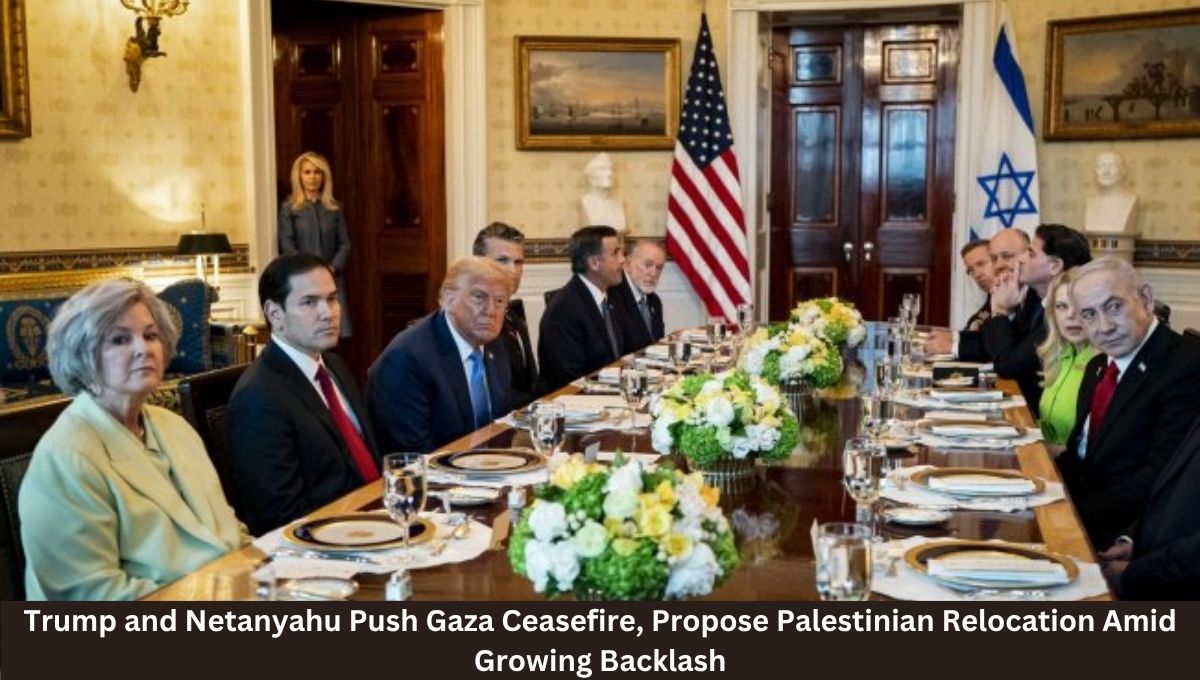
In a high-stakes series of meetings this week in Washington, D.C., Trump and Netanyahu Push Gaza Ceasefire, Propose Palestinian Relocation Amid Growing Backlash. U.S. President Donald Trump and Israeli Prime Minister Benjamin Netanyahu unveiled bold new moves in the ongoing Gaza conflict, including a controversial Palestinian relocation plan and a near-final Gaza ceasefire agreement. The talks held over two days also touched on Iran, Syria, and Israel’s domestic unrest.
Netanyahu used the occasion to nominate Trump for a Nobel Peace Prize in recognition of recent U.S. military strikes on Iranian nuclear sites, declaring them a “historic victory.” Yet while Netanyahu was warmly received in Washington, back home in Israel, his popularity continues to nosedive amid widespread protests and an intensifying corruption trial.
Trump and Netanyahu Push Gaza Ceasefire, Propose Palestinian Relocation Amid Growing Backlash
Netanyahu Nominates Trump for Nobel Peace Prize
During a White House dinner on Monday, Netanyahu opened with a symbolic gesture nominating Trump for the Nobel Peace Prize. “It’s the nomination of you for the peace prize, which is well-deserved,” Netanyahu told Trump.
The nomination follows a U.S. military strike on three Iranian nuclear sites, authorized by Trump just weeks earlier. Netanyahu hailed the mission as a game-changer:
“Our partnership produced a historic victory.” Trump responded with characteristic bravado, saying the strikes “obliterated” Iran’s capabilities, and hinting at their significance with a thinly veiled reference to World War II’s atomic bombings.
Trump Opens Door to Iran Talks
In a surprising diplomatic pivot, Trump revealed that Iran has quietly reached out to the U.S. for possible talks in the wake of the strikes.
“They want to talk,” Trump said. “I hope we’re not going to have to strike again.” He even floated the idea of lifting sanctions in the future, saying he hopes to give Iran “a chance at rebuilding.”
The remarks mark a significant shift in tone and could lay the groundwork for future U.S.-Iran negotiations.
Gaza Ceasefire Deal: Final Issue Remains
The central focus of the Trump-Netanyahu summit was a potential 60-day Gaza ceasefire between Israel and Hamas.
Trump’s Middle East envoy Steve Witkoff announced that only one major issue remains unresolved. “We had four issues, and now we’re down to one,” Witkoff said.
That final hurdle involves Israeli military withdrawal maps, specifically around the Philadelphi Corridor along the Egypt-Gaza border.
The draft agreement includes the release of 10 living hostages and the remains of nine others currently held by Hamas.
Netanyahu: “We Still Have to Finish the Job in Gaza”
Despite progress in ceasefire talks, Netanyahu emphasized that Israel’s military operation is far from over.
“We still have to finish the job in Gaza, release all our hostages, and eliminate Hamas’ military and government capabilities,” he said.
Still, he acknowledged that a breakthrough is close, stating: “We think that we’ve gotten closer to it, and I hope we can cross the line.”
Trump and Netanyahu Propose Palestinian Relocation
The most controversial proposal to emerge from the talks was a plan to relocate Palestinians from Gaza to other countries a move both leaders framed as “free choice.”
“If people want to stay, they can stay; but if they want to leave, they should be able to leave,” Netanyahu said.
Trump called the idea “brilliant,” claiming cooperation from regional allies is already underway. Netanyahu confirmed that several Arab nations are in discussions about absorbing Palestinians seeking to leave Gaza.
The proposal has already drawn sharp criticism from Palestinian leaders, human rights organizations, and officials across the Middle East, who view it as forced displacement.
Trump Avoids Two-State Question, Defers to Netanyahu
Asked whether he still supports a two-state solution, Trump punted the question to Netanyahu, saying: “I don’t know.”
Netanyahu responded with a hardline stance: “I think the Palestinians should have all the powers to govern themselves, but none of the powers to threaten us. That means sovereign power of security always remains in our hands.”
He added that the October 7 Hamas attack demonstrated the dangers of granting Palestinians full statehood, likening the atrocities to those committed during the Holocaust.
Trump’s Vision: Gaza as “The Riviera of the Middle East”
Earlier this year, Trump proposed turning Gaza into a luxury hub, claiming the U.S. should take control and transform the war-torn strip into the “Riviera of the Middle East.”
While Trump reiterated this vision during the summit, critics argue that the idea is detached from reality and undermines Palestinian self-determination.
Syria Sanctions Lifted: “Iran is Out”
Trump also announced that the U.S. has lifted sanctions on Syria, claiming that the Assad regime has collapsed and that Iran’s influence via Hezbollah is no longer a threat.
Netanyahu welcomed the decision, calling it an opportunity to reset relations with Syria and secure Israeli borders. “Before that, Iran was essentially running Syria through Hezbollah. Now Iran is out of the picture,” Netanyahu said.
Qatar and Proximity Talks
Mediating efforts for the Gaza ceasefire are being led by Qatar, which has played a central role in previous Israel-Hamas negotiations.
Qatari officials met with senior U.S. diplomats in Washington ahead of Netanyahu’s visit. Witkoff confirmed plans to travel to Doha for continued proximity talks.
Hamas Ceasefire Conditions
Despite Israel’s tough stance, Hamas has softened its demands, with negotiators confirming the group now seeks:
- A permanent ceasefire
- UN-supervised humanitarian aid
- Full Israeli military withdrawal to pre-March 2 positions
A senior Hamas official told CNN: “We’re ready to return the hostages in one day we just want a guarantee that the war won’t resume.”
Netanyahu’s Hostage Policy
Netanyahu remains firm that no ceasefire will be approved without the return of all hostages—both living and dead.
“We are determined to achieve all our objectives,” he said. “The release of all our hostages, the elimination of Hamas’s military and governing capabilities.”
Families of hostages continue to hold daily protests, demanding a full release clause be included in any agreement.
Netanyahu’s Domestic Challenges
While Netanyahu was celebrated in Washington, the atmosphere in Israel is far less favorable. His recent visit to Kibbutz Nir Oz site of some of the worst October 7 atrocities was met with scathing criticism.
Signs along the road read: “Mr. Abandonment.” Families of hostages accused him of using the war as political cover to avoid accountability.
A recent survey showed that 73% of Israelis want Netanyahu to resign, and his Likud Party’s approval ratings have plummeted.
Netanyahu’s Corruption Trial
Adding to the pressure is Netanyahu’s ongoing corruption trial involving charges of bribery, fraud, and breach of trust.
He has requested multiple delays to his hearings, often citing “security concerns” as justification. Critics argue that Netanyahu is using the war to stall justice.
In Washington, Trump went as far as to suggest dropping the charges, sparking outcry from Israeli judicial watchdogs.
Weaponizing Anti-Semitism
One of the most contentious aspects of Netanyahu’s rhetoric has been his use of “anti-Semitism” to silence critics.
While global anti-Semitism is a real threat, many including Jewish Israelis have voiced concern that the term is being manipulated to deflect criticism of Israel’s actions in Gaza.
“Many of us are Zionists,” said one Tel Aviv protester. “We love our country. But we can’t support the mass killing of civilians.”
Final Thoughts: Fragile Gains, Uncertain Future
The Trump-Netanyahu summit marks a pivotal moment in Middle East diplomacy. With a possible 60-day ceasefire, bold new proposals, and shifts in regional alliances, momentum is building. Yet Netanyahu faces mounting pressure at home, and Trump’s Palestinian relocation proposal risks inflaming an already volatile region.
As Trump concluded: “It’s a tragedy, and he [Netanyahu] wants to get it solved, and I want to get it solved. I think the other side wants to get it solved. A lot of hate, long-term hate but we think we’re going to have it solved pretty soon.”
Also Read: Gaza Ceasefire Talks Stall in Doha as Trump Hosts Netanyahu at White House
Also Read: Netanyahu, Trump discuss forced transfer of Palestinians out of Gaza
Related Posts:
- 5 Powerful Highlights as Trump Lands Second Nobel…

- Dramatic Moments Behind Trump’s Gaza Peace Push and…

- Trump’s 2025 Nobel Peace Prize Snub: Politics Over…

- 7 Shocking Reasons FIFA’s Peace Prize for Trump…

- Trump’s Nobel Peace Prize Bid: Gaza Peace Plan, 8…

- Trump Deserves Nobel Peace Prize, Says White House,…