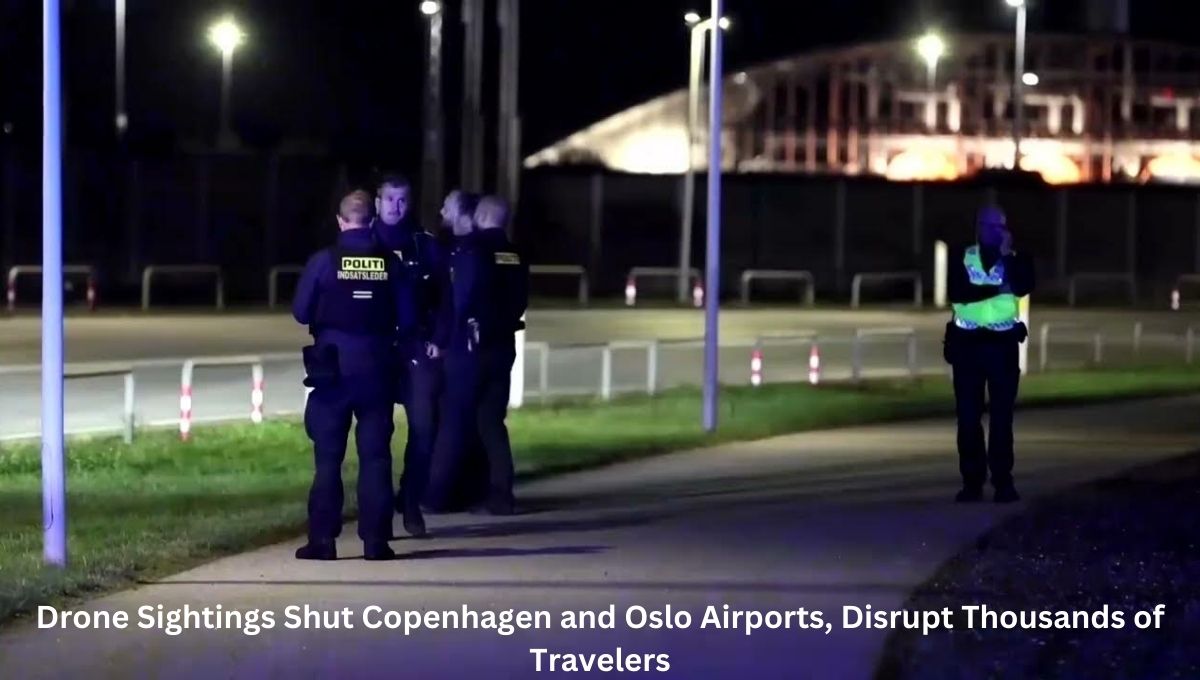
Drone Sightings Shut Copenhagen and Oslo Airports, Disrupt Thousands of Travelers in major travel chaos across Scandinavia. Two of Scandinavia’s busiest airports — Copenhagen in Denmark and Oslo in Norway — were forced to shut down for several hours between Monday night and early Tuesday after multiple drone sightings in restricted airspace.
The incidents disrupted travel for tens of thousands of passengers, triggered large-scale flight diversions across the Nordic region, and raised new concerns about aviation security at a time when Europe is already on high alert over Russian drone and fighter jet activity.
Authorities in both Denmark and Norway confirmed that large, unidentified drones had been observed flying near their primary international airports. While flights resumed within hours, delays and cancellations continued well into Tuesday. Police described the incidents as serious and coordinated, but the operators remain unknown.
Drone Sightings Shut Copenhagen and Oslo Airports, Disrupt Thousands of Travelers
Copenhagen Airport Forced to Close for Four Hours
Multiple Large Drones Detected
Copenhagen Airport, the largest in Scandinavia and serving nearly 30 million passengers annually, was shut down at 8:26 p.m. local time on Monday (18:26 GMT) after two to three large drones were spotted in the vicinity.
Chief Superintendent Jens Jespersen of the Danish Police told reporters the drones appeared to be operated by individuals with advanced capabilities.
“We have concluded that this was what we would call a capable operator,” Jespersen said, noting that the drones flew from multiple directions, switched their lights on and off, and remained in the area for several hours before vanishing.
Police described the activity as deliberate, adding that the drones were “bigger than what you as a private individual can buy.”
Flights Suspended, Thousands Affected
For nearly four hours, no take-offs or landings were allowed. Flight-tracking site Flightradar24 reported that at least 35 incoming flights were diverted to alternate airports, including Billund and Aarhus in Denmark, as well as Malmö and Gothenburg in Sweden.
By midnight, the total disruption had risen to around 100 flights diverted or cancelled, impacting more than 20,000 passengers.
An airport spokesperson confirmed that Copenhagen’s airspace reopened at 12:20 a.m. Tuesday local time (6:20 p.m. ET), but warned of continued delays and cancellations throughout the day.
Heightened Police and Military Response
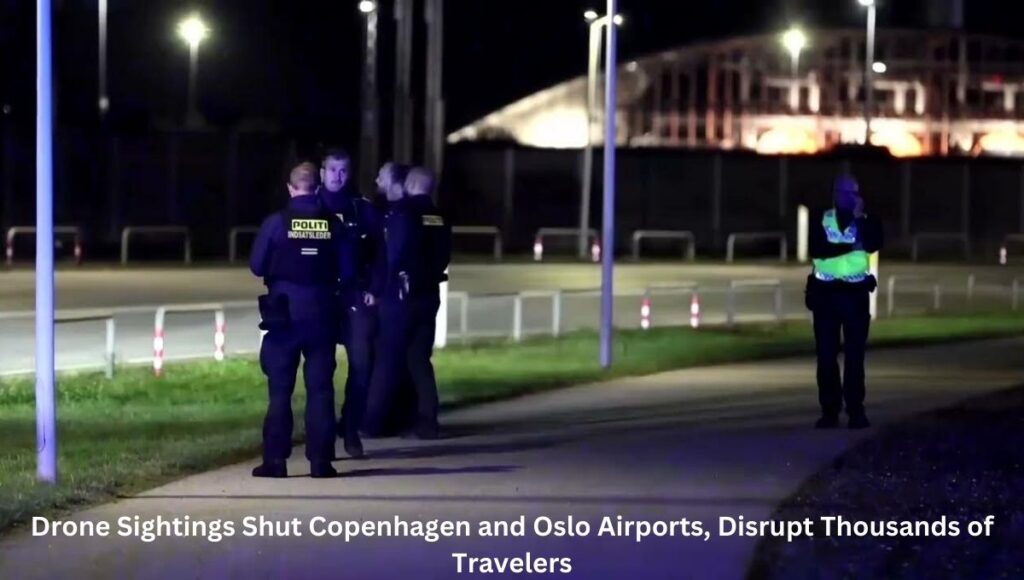
Police deployed armed units to the airport and confirmed that the Danish armed forces were activated during the incident. Authorities declined to provide details about the “measures” being implemented, citing operational security.
Deputy Police Inspector Jakob Hansen said it was too early to determine whether the drones originated from Russia or were linked to other incidents.
In a social media post, Ukrainian President Volodymyr Zelensky referred to “Russia’s violation of NATO airspace in Copenhagen,” though EU and NATO leaders have not confirmed any attribution.
Oslo Airport Also Targeted by Drones
Airspace Closed for Three Hours
Just hours after Copenhagen reopened, Oslo Gardermoen Airport, Norway’s busiest, also reported a drone sighting. At midnight local time (22:00 GMT), airport operator Avinor closed airspace and redirected flights.
“This means that incoming flights are now being redirected to the nearest airport,” said Avinor spokesperson Monica Iren Fasting.
Operations resumed around 3:22 a.m. (8:22 p.m. ET), but not before significant disruption to schedules across the region.
Police Investigation Underway
Norwegian police confirmed they were investigating, with a heavy security presence deployed to the airport. Operations manager Gisle Sveen of the Eastern Police District told national broadcaster NRK that authorities were attempting to locate the drone pilot but had not yet succeeded.
“We have taken measures to try to locate this drone, but we have not yet been able to locate the drone pilot,” Sveen said.
Earlier Drone Arrests in Oslo
The Oslo incident followed an earlier arrest of two foreign nationals on Monday for allegedly flying drones over the restricted Akershus Fortress, a medieval castle used for government events. Authorities have not confirmed whether that episode is connected to the airport disruption.
Wider Regional Concerns
European Airspace Violations
The Scandinavian drone incidents come amid a wave of airspace violations across Europe, many involving Russia.
- Estonia reported last Friday that three Russian MiG-31 fighter jets violated its airspace for 12 minutes.
- Poland said earlier this month that 19 Russian drones entered its territory, prompting the Polish Air Force and NATO allies to shoot down some of them — the first Russian drones downed over NATO soil since the Ukraine war began in 2022.
- Romania also confirmed a Russian drone incursion into its airspace.
These incidents prompted emergency meetings of NATO’s North Atlantic Council and the UN Security Council, where Western allies condemned Russia for escalating tensions.
UK Foreign Secretary Yvette Cooper told the UNSC:
“Your reckless actions risk direct armed confrontation between NATO and Russia. Our alliance is defensive, but be under no illusion we stand ready to defend NATO’s skies and NATO’s territory.”
Russia denied the accusations, with its ambassador to the UN insisting that recent MiG flights were conducted “strictly in accordance with international airspace regulations.”
Possible Links Under Scrutiny
Danish police stressed there was currently “nothing that immediately links” the drone events in Copenhagen and Oslo to each other or to Russian activity. However, the timing and scale have fueled speculation.
Some Swedish media outlets reported drone sightings over the sea between Denmark and Sweden around the same time as the Copenhagen closure, though authorities have not confirmed these accounts.
Also Read: Russia’s involvement in drone sightings cannot be ruled out, Danish PM says
Passenger Impact and Travel Disruptions
Flight Diversions Across Scandinavia
Flight diversions rippled across the region as airports scrambled to manage rerouted traffic.
- Copenhagen-bound flights were diverted to Billund, Aarhus, Malmö, and Gothenburg.
- Oslo-bound flights were redirected to Stavanger and Bergen, among other Norwegian airports.
Passengers described confusion at departure gates and on board aircraft as pilots announced sudden diversions.
Airline staff advised travelers to check flight status updates directly with their carriers, as backlogs mounted.
Over 20,000 Passengers Affected
Copenhagen Airport alone estimated that around 20,000 passengers were directly impacted. By Tuesday morning, Eurocontrol — Europe’s air traffic management body — reported ongoing cancellations across Scandinavia.
Aviation analysts said the disruption highlighted how even small-scale drone activity can paralyze major transport hubs.
Drone Threats to Aviation Safety
Civil vs. Military Drones
While police declined to specify the type of drones observed, duty officer Anette Ostenfeldt told AFP that the Copenhagen drones were “bigger than what you as a private individual can buy.”
Experts noted that such drones could be commercial-grade or modified military hardware, raising questions about the operator’s intent.
Safety Risks
Unidentified drones pose multiple dangers to aviation:
- Collision Risk: A drone strike could damage jet engines or cockpits.
- Operational Shutdown: Even unarmed drones force authorities to halt flights until cleared.
- Security Threat: Drones can be used for surveillance, interference, or carrying payloads.
Aviation consultant Peter Sandberg told Danish TV:
“What we saw last night was not a toy. These were capable machines, flown in a coordinated way, and that’s a big red flag for airport security.”
Political and Security Reactions
Denmark and Norway Tighten Measures
Authorities in Denmark and Norway said they were implementing new security measures but did not disclose details. Both countries have increased military readiness near airports and sensitive sites.
Danish police confirmed that the armed forces had been activated during the Copenhagen incident, though no hostile intent has yet been established.
NATO Monitoring the Situation
NATO officials said they were closely monitoring developments, given the broader context of Russian incursions. While no evidence links the Scandinavian drone sightings to Moscow, the incidents have deepened unease across the alliance.
Recent Incidents Heightening Tensions
The Scandinavian disruptions came just days after a cyberattack on Collins Aerospace, a major aviation technology provider, which disrupted systems at London Heathrow, Berlin, and Brussels airports.
Though unrelated, analysts said the coincidence underscores the multiple vulnerabilities facing Europe’s aviation sector — from drones to cyberwarfare.
Also Read: Denmark Airport Drone Shutdowns: Aalborg Closure, ‘Hybrid Attack’ Fears, NATO on Alert
What Happens Next?
Ongoing Investigations
Police in both Denmark and Norway continue to investigate, seeking to trace the origin of the drones and identify potential suspects. No arrests have yet been made in connection with the airport incidents.
Authorities emphasized that, so far, there is no indication the drones were intended to cause harm, but their presence forced precautionary shutdowns.
Aviation Industry Concerns
Airline industry groups urged governments to strengthen counter-drone defenses at major airports.
The International Air Transport Association (IATA) has repeatedly warned that drone incursions are becoming a growing global threat, citing similar shutdowns at London’s Gatwick Airport in 2018 and Madrid-Barajas in 2020.
Travelers Advised to Remain Alert
Copenhagen and Oslo airports urged passengers to monitor flight status updates and expect lingering disruptions throughout the week as airlines work to reset schedules.
Conclusion
The unexpected closure of Copenhagen and Oslo airports due to drone sightings left thousands of passengers stranded and raised fresh alarm about the vulnerability of Europe’s critical air hubs.
Authorities believe a “capable operator” deliberately flew large drones into restricted airspace, but the identity and motive remain unclear.
While flights have resumed, the incidents highlight the potential of drone technology to cause widespread disruption, whether through hostile intent or reckless interference. As Europe confronts increasing airspace violations by Russia and rising regional tensions, the mystery drones over Scandinavia serve as a stark reminder that aviation security faces evolving, unpredictable threats.
Related Posts:
- Denmark Airport Drone Shutdowns: Aalborg Closure,…

- Munich Airport Shuts Down After Drone Sightings,…
- Afghanistan–Pakistan War 2025: Inside the 48-Hour Ceasefire

- In 8 Moves, EU Targets China-Linked Refineries and…

- 7 Powerful Measures: Trump Sanctions Russian Oil…

- 11 Explosive Revelations From Ted Cruz’s Leaked…