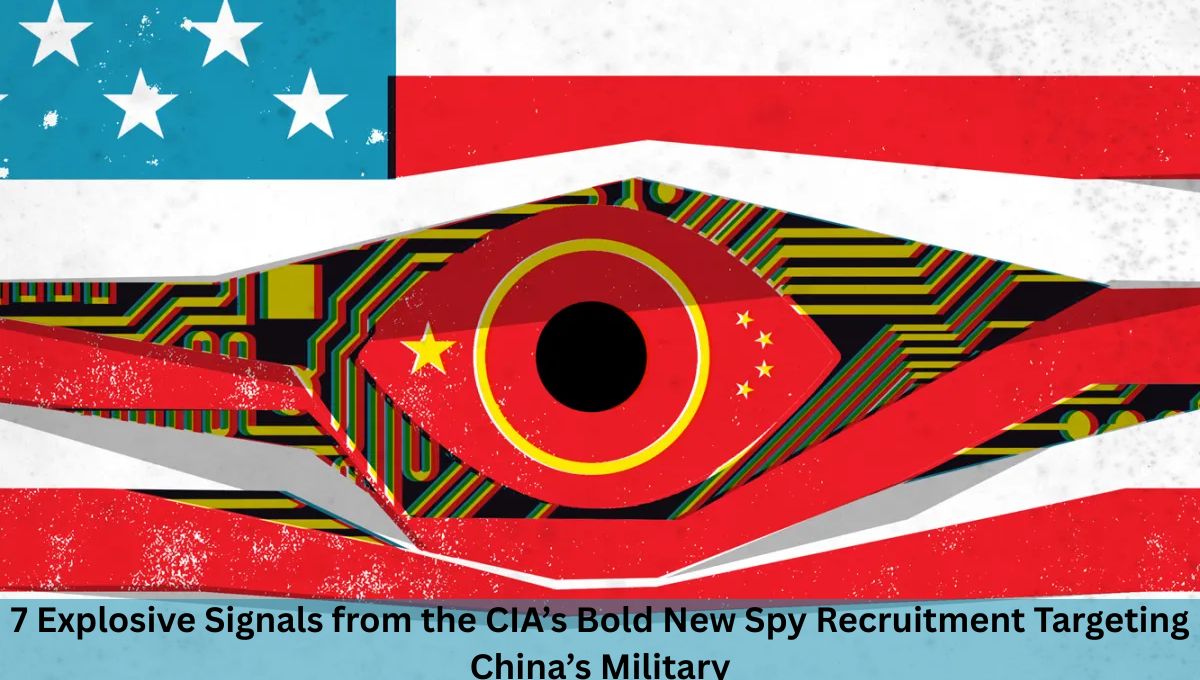
7 Explosive Signals from the CIA’s Bold New Spy Recruitment Targeting China’s Military to rebuild its intelligence network in Beijing. The global intelligence battle between Washington and Beijing has entered a striking new phase.
In a highly unusual public move, the Central Intelligence Agency has released a Mandarin-language recruitment video directly appealing to members of China’s armed forces. The cinematic short film, published on YouTube, encourages disillusioned Chinese military officers to secretly contact the CIA using the encrypted Tor Browser.
The message is blunt, emotional, and strategically timed. It arrives amid deepening turmoil inside China’s military establishment and an accelerating geopolitical rivalry that many analysts now describe as a new Cold War.
This article breaks down what the video shows, why it matters, and what it reveals about the evolving intelligence war between the world’s two most powerful nations.
7 Explosive Signals from the CIA’s Bold New Spy Recruitment Targeting China’s Military
A Rare Public Recruitment Push by the CIA
Espionage agencies traditionally operate in the shadows. Public recruitment appeals—especially those aimed at hostile military forces—are exceptionally rare.
Yet the CIA’s new video is part of a growing series that openly targets citizens of strategic rivals, including China and Russia.
The agency has confirmed that earlier videos have successfully led to the recruitment of new intelligence sources, prompting it to expand the campaign.
This latest installment marks a significant escalation:
it focuses explicitly on Chinese military personnel, a group traditionally considered one of the most tightly controlled and difficult intelligence targets in the world.
Inside the CIA’s New Mandarin-Language Video
The video runs just under two minutes and is tightly scripted for emotional impact.
A Disillusioned PLA Officer
The central character is a fictional mid-level officer in the People’s Liberation Army (PLA). He is shown performing routine duties while narrating growing doubts about China’s leadership.
“The only thing our leaders are interested in protecting is their own pockets,” the narrator says, alleging corruption and self-interest among senior officials.
The officer is later shown at home with his wife and young daughter, expressing fear about the future China’s leadership is shaping for the next generation.
Ancient Strategy Meets Modern Espionage
In a striking narrative choice, the video references Sun Tzu, the ancient author of The Art of War.
“The greatest victory is to triumph without fighting,” the narrator reflects—before accusing China’s leadership of recklessly pushing the country toward conflict.
The implication is clear:
sharing information with the CIA is framed not as betrayal, but as a higher form of patriotism.
A Dramatic Decision
In the final scenes, the officer removes a bag from a secure military safe, drives through a checkpoint, and parks alone in a deserted lot. He opens a laptop and contacts the CIA using the Tor network.
“This is my way of fighting for my family and my nation,” he says.
The video ends with stark text on the screen:
“The fate of the world is in your hands.”
How the CIA Wants Chinese Officers to Make Contact
The video is accompanied by written instructions explaining how to securely contact the CIA through encrypted channels.
The agency asks viewers:
- Do you have information about high-ranking Chinese leaders?
- Are you a military officer or connected to defense institutions?
- Do you work in intelligence, diplomacy, science, economics, or advanced technology?
The CIA provides step-by-step guidance on using Tor and virtual private networks—tools normally restricted or discouraged within China.
Why the CIA Is Targeting China’s Military Now
Xi Jinping’s Military Purges
The timing of the video is critical.
Under Xi Jinping, China has carried out sweeping anti-corruption campaigns within the PLA. Since 2023, more than 20 senior military officials have been investigated or removed.
The most dramatic move came with the removal of top generals from the powerful Central Military Commission—China’s highest military decision-making body.
While Beijing frames these actions as discipline enforcement, foreign analysts see a deeper pattern:
consolidation of power, fear of internal disloyalty, and rising distrust within the ranks.
A Window of Vulnerability
US intelligence officials believe such purges create openings.
Officers who fear political elimination—even if loyal—may feel exposed, insecure, and disillusioned. These conditions historically provide fertile ground for espionage recruitment.
The CIA has not officially linked the video to specific purges, but senior officials acknowledge the overlap is “notable.”
Rebuilding a Network Once Crippled
Between 2010 and 2012, China dismantled much of the CIA’s human intelligence network inside the country.
According to multiple investigations, at least 30 CIA-linked sources were killed or imprisoned after Beijing penetrated a covert CIA communications system.
The episode remains one of the most devastating intelligence failures in modern US history.
Since then, rebuilding China-focused human intelligence has been a top CIA priority.
Public-facing digital recruitment—once unthinkable—is now part of that effort.
CIA Director’s Message: “The Videos Are Working”
CIA Director John Ratcliffe has openly defended the strategy.
He has stated that earlier Mandarin-language videos reached millions of Chinese citizens and directly contributed to new intelligence sources coming forward.
“If the videos didn’t work, we wouldn’t be releasing more,” a CIA official told US media.
The agency believes China’s internet controls—the so-called Great Firewall—are far from perfect, allowing such content to circulate despite official censorship.
Beijing’s Furious Response
China’s government reacted sharply.
The Ministry of Foreign Affairs condemned the video as infiltration and sabotage by “foreign anti-China forces.” Spokesman Lin Jian warned that Beijing would take “all necessary measures” to safeguard national security.
While Chinese authorities did not specify what actions they would take, past responses suggest heightened counterintelligence surveillance, stricter internal controls, and potential retaliation against perceived US intelligence operations.
Beijing has previously labeled similar CIA outreach efforts as “naked political provocation.”
Espionage Goes Public in the Digital Age
From Tradecraft to Theater
What makes this campaign remarkable is not just its target—but its style.
The CIA’s videos resemble short films more than intelligence briefings.
They rely on:
- Emotional storytelling
- Family-oriented moral framing
- Cinematic visuals
- Psychological resonance rather than ideology
This reflects a broader shift in modern espionage, where influence, perception, and narrative warfare increasingly complement traditional spycraft.
Information Warfare Beyond the Battlefield
Analysts say the campaign blurs lines between intelligence collection and psychological operations.
Rather than quietly recruiting individuals one by one, the CIA is broadcasting doubt—encouraging internal questioning within elite institutions of a rival power.
For Beijing, the threat is not only information leakage, but erosion of trust inside the military hierarchy.
A New Phase in the US–China Strategic Rivalry
American officials now routinely describe China as the top strategic challenge facing the United States.
The rivalry spans:
- Military power
- Technology and AI
- Supply chains
- Space and cyber domains
- Intelligence and counterintelligence
This CIA campaign underscores how central human intelligence remains—even in an age dominated by satellites, algorithms, and cyber tools.
Risks for Potential Recruits
For any Chinese military officer, responding to the CIA’s call carries extraordinary risk.
China’s counterintelligence apparatus is among the world’s most aggressive. Punishments for espionage can include life imprisonment or execution.
The CIA emphasizes secure communication methods, but no system is foolproof—especially against a state with vast surveillance capabilities.
The stakes could not be higher.
What Comes Next?
Several questions now loom large:
- Will China tighten military loyalty controls even further?
- Will other intelligence agencies adopt similar public recruitment campaigns?
- Can the CIA sustainably rebuild human networks inside China without provoking harsher crackdowns?
One thing is clear:
the intelligence war between Washington and Beijing is no longer entirely hidden.
It is unfolding—boldly and publicly—on screens around the world.
Final Takeaway
The CIA’s new recruitment video is more than an intelligence outreach effort. It is a signal.
A signal that:
- The US sees opportunity inside China’s military turbulence
- Espionage is adapting to the digital, psychological age
- The global power struggle is increasingly fought inside minds, not just borders
As strategic rivalry deepens, the line between secrecy and spectacle continues to blur—reshaping how nations compete in the 21st century.
Also Read: Alexis Wilkins Denies Mossad Spy Claims Amid Kash Patel Relationship
Also Read: The CIA is openly calling on Chinese officials to spy for the U.S. Will they listen?