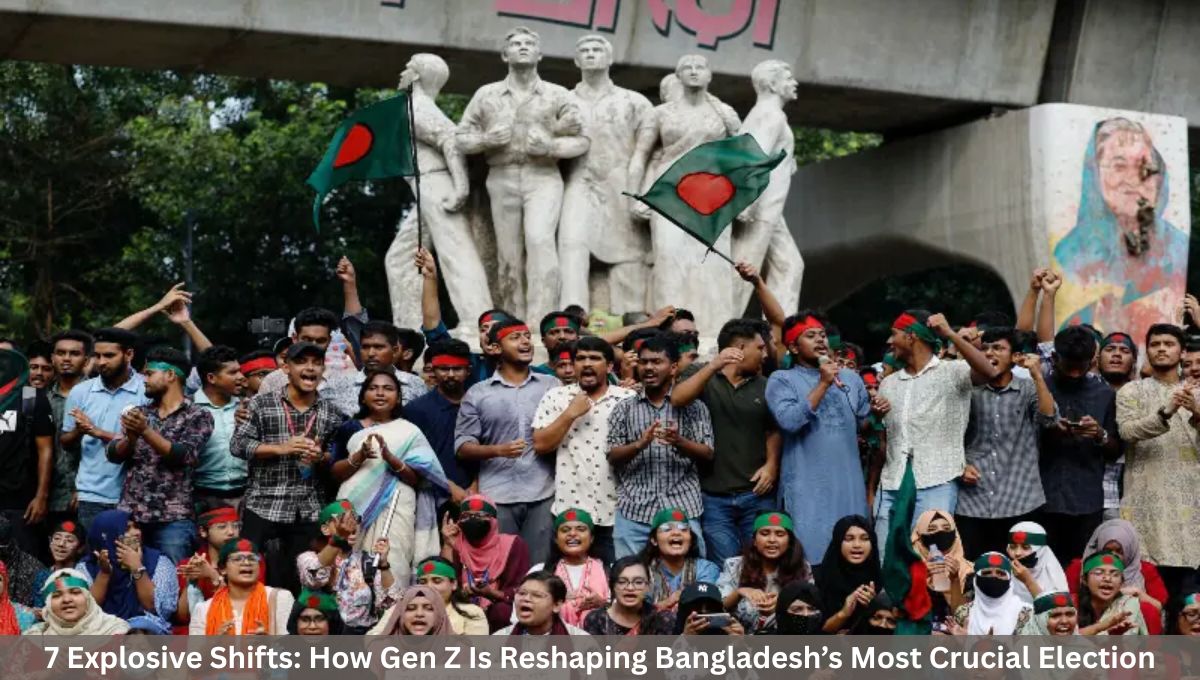
7 Explosive Shifts: How Gen Z Is Reshaping Bangladesh’s Most Crucial Election after the fall of Sheikh Hasina. Bangladesh is heading into what analysts and youth activists alike are calling the country’s first genuinely competitive parliamentary election in more than a decade.
Scheduled for February 12, 2026, the vote comes after the dramatic downfall of former Prime Minister Sheikh Hasina in August 2024, following months of student-led protests and a violent state crackdown.
For the first time since 2009, the election landscape is no longer dominated by the Awami League’s iconic “boat” symbol. Instead, campaign posters of the Bangladesh Nationalist Party’s (BNP) “sheaf of paddy,” Jamaat-e-Islami’s “scales,” and dozens of independent candidates line streets across cities and villages. At the heart of this transformation is Generation Z.
Roughly one in four voters is under the age of 30, and their political awakening—born out of street protests, social media mobilisation, and disillusionment with authoritarian governance—has become a defining force in this election.
7 Explosive Shifts: How Gen Z Is Reshaping Bangladesh’s Most Crucial Election
From One-Party Dominance to Open Contestation
For 15 years, Sheikh Hasina’s Awami League governed Bangladesh with tightening control over institutions, elections, and political dissent.
Opposition parties were frequently marginalised through arrests, legal cases, and election boycotts, resulting in polls widely criticised by domestic observers and international actors.
That era ended abruptly in 2024. Student protests erupted after the reinstatement of a controversial job quota system favouring descendants of independence-era freedom fighters. What began as a policy dispute escalated into a nationwide uprising.
According to human rights groups, security forces used lethal force against demonstrators, resulting in more than a thousand deaths—figures the former government disputed but which later investigations kept under scrutiny.
Hasina resigned and fled to India in August 2024. An interim government led by Nobel Peace Prize laureate Muhammad Yunus assumed power, pledging electoral reforms, accountability, and a return to democratic norms.
Why This Election Is Different
Analysts argue that the February 2026 election differs fundamentally from those held under Hasina’s rule for three reasons:
competition, participation, and uncertainty.
The Awami League remains barred from contesting, following legal actions against its leadership over the 2024 crackdown.
While the party disputes the legitimacy of these cases and has called for a boycott, its absence has opened political space rather than suppressing turnout.
Surveys conducted by Dhaka-based think tanks suggest more than 90 percent of registered voters intend to cast ballots.
This is a striking reversal from previous elections marked by apathy, fear, and pre-determined outcomes.
The Rise of Gen Z as a Political Force
Generation Z did not merely inherit this election—it helped create it.
Young activists were the backbone of the 2024 uprising, coordinating protests through encrypted messaging apps, livestreaming police actions, and framing their demands in the language of rights, transparency, and dignity rather than traditional party loyalties.
Many of these activists later attempted to formalise their influence by launching a youth-driven political party. However, analysts note that translating street mobilisation into electoral machinery proved difficult.
Lacking organisational depth and funding, the Gen Z party eventually aligned with a Jamaat-e-Islami–led coalition to gain reach.
Despite this, Gen Z voters remain ideologically diverse. Polling suggests they are less motivated by religious identity or liberation-era symbolism and more focused on corruption, employment, inflation, and freedom of expression.
“Generation Z will carry considerable weight in determining the outcome,” said Parvez Karim Abbasi of the Centre for Governance Studies, noting that many young voters remain undecided even days before polling.
BNP: Frontrunner with High Expectations
The Bangladesh Nationalist Party enters the election as the perceived frontrunner. Led by Tarique Rahman, son of former Prime Minister Khaleda Zia, the BNP is contesting nearly all parliamentary seats.
Rahman, who returned to Bangladesh after years in exile following the change in government, has framed the election as a referendum on restoring democratic institutions and economic stability.
In interviews, he has said the party expects to win enough seats to form a government but has avoided predicting a landslide.
Political analysts caution that the BNP’s challenge will be managing expectations. Many voters view it as the most viable alternative to the Awami League, rather than as a transformative force in its own right.
Jamaat-e-Islami’s Resurgence
Once banned and politically sidelined, Jamaat-e-Islami is poised for its strongest electoral showing in decades, according to opinion polls cited by analysts.
The party, which opposed Bangladesh’s independence in 1971 and faced severe repression under Hasina, has re-entered mainstream politics following legal reversals after 2024.
Jamaat’s leaders have emphasised anti-corruption credentials and social justice themes, downplaying religious rhetoric in public campaigning.
Surveys suggest its perceived “clean image” resonates with voters frustrated by decades of graft.
Still, critics warn that a Jamaat-led coalition could reshape Bangladesh’s secular framework. The party insists it seeks governance based on accountability and moral values, not theocratic rule.
Awami League Supporters Adrift
Although barred from contesting, the Awami League’s electoral legacy continues to shape the race. Millions of its former supporters now face a choice between rival parties or independent candidates.
Polling data indicates that nearly half of previous Awami League voters may shift to the BNP, while roughly a third lean toward Jamaat-e-Islami. Analysts say this redistribution could be decisive in close constituencies.
The party leadership has officially called for a boycott, but grassroots compliance appears uneven. Many long-time supporters have signalled they will vote regardless, prioritising stability over party loyalty.
Economic Anxiety Drives Voter Behaviour
Bangladesh’s economy looms large over the election. High inflation, depleted foreign reserves, and slowing investment have strained household finances.
Since 2022, Dhaka has sought billions of dollars in external financing from the International Monetary Fund and the World Bank.
According to surveys by Communication & Research Foundation and Bangladesh Election and Public Opinion Studies, corruption ranks as voters’ top concern, followed by inflation and unemployment.
“Voters prioritise economic competence over ideology,” the survey noted, highlighting expectations for leaders who demonstrate accountability and practical governance.
Regional Stakes: India, China, and Beyond
The election outcome will also reverberate beyond Bangladesh’s borders.
India’s influence has waned since Hasina—widely seen as New Delhi’s closest ally in Dhaka—fled to India after her ouster.
China, meanwhile, has expanded its engagement through infrastructure projects and diplomatic outreach.
Analysts suggest a BNP-led government would seek balanced relations with both powers, while a Jamaat-influenced coalition could recalibrate ties toward Pakistan and China.
Jamaat leaders deny any foreign alignment, insisting policy will be guided by national interest.
A Referendum on Freedom and Voice
For first-time voters like 21-year-old Mohammad Rakib, the election represents more than party competition.
“People had no voice before,” he said. “I hope whoever comes to power will allow freedom of expression and real voting.”
That sentiment echoes across campuses and urban neighbourhoods, where young voters view participation itself as an act of reclaiming citizenship.
What Comes Next for Bangladesh
A decisive outcome on February 12 could stabilise Bangladesh’s political trajectory after years of unrest. A fractured parliament, however, risks prolonging uncertainty and delaying reforms.
Regardless of who forms the next government, one reality is clear:
Bangladesh’s political centre of gravity has shifted.
Generation Z—once dismissed as apathetic or inexperienced—has forced open the system and asserted itself as a lasting stakeholder in the country’s democratic future.
As ballots are cast and counted, the election will test whether that energy can translate into accountable governance—or whether old patterns will reassert themselves under new leadership.
Also Read: 7 Shocking Developments After Bangladesh Student Leader’s Assassination
Related Posts:
- 7 Alarming Twists in the Sheikh Hasina–Tulip Siddiq…

- Bangladesh Bans Sheikh Hasina’s Awami League Under…
- 6 Shocking Signals as Hindu Awami League Leader Dies…

- 9 Defining Stakes in Bangladesh’s Explosive…

- 11 Powerful Moments as Tarique Rahman Returns to…

- 171 Gaza Flotilla Activists Deported Amid Alleged Torture