9 Defining Stakes in Bangladesh’s Explosive Post-Hasina Election That India Is Watching Closely amid uncertain Dhaka–Delhi ties. Bangladesh goes to the polls in what may be the most consequential election in its half-century history — not only for its own democratic future, but for India’s regional security calculus, South Asia’s balance of power, and the strategic competition involving China and Pakistan.
The February election is the first national vote since Sheikh Hasina was forced from power in August 2024 after a bloody, student-led uprising that ended her 15-year rule.
It is also the first election in nearly three decades where neither of Bangladesh’s two dominant political matriarchs — Sheikh Hasina and Khaleda Zia — appear on the ballot.
For India, which shares its longest land border with Bangladesh, the stakes could scarcely be higher.
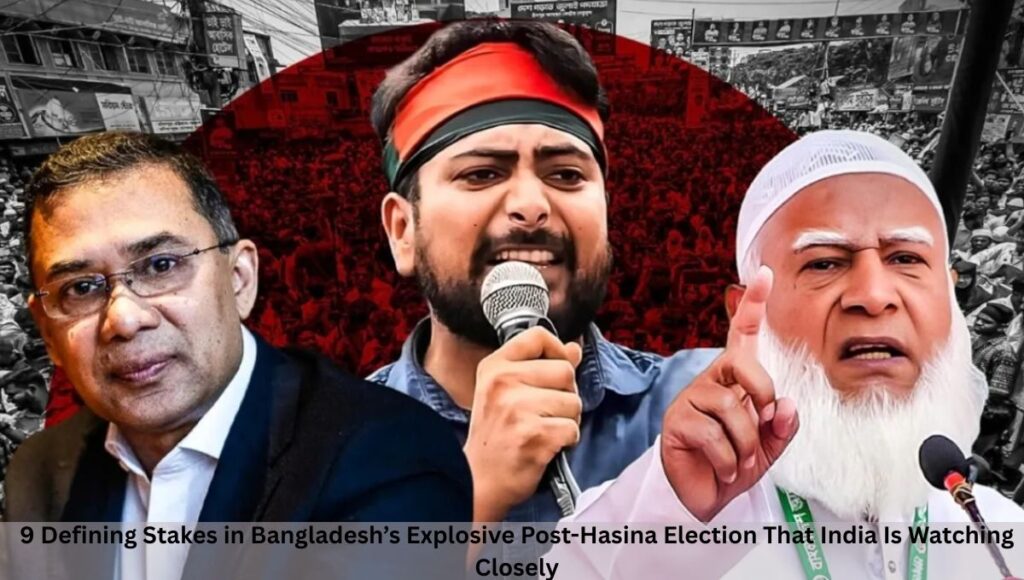
9 Defining Stakes in Bangladesh’s Explosive Post-Hasina Election That India Is Watching Closely
Why This Bangladesh Election Matters Beyond Its Borders
Bangladesh is not just another neighbour for India. It borders five Indian states, surrounds India’s northeast on three sides, and sits astride critical land and maritime trade routes connecting South Asia to Southeast Asia.
Under Sheikh Hasina’s Awami League, ties with India reached unprecedented levels of cooperation — from counterterrorism coordination to trade, power sharing, and transit agreements.
That equilibrium has collapsed over the past 18 months.
In its place:
- Rising anti-India sentiment
- Deep diplomatic and trade rifts
- China and Pakistan rapidly expanding influence
This election will determine whether Bangladesh pivots back toward pragmatic engagement with India — or continues drifting into a more adversarial regional posture.
From Stability to Upheaval: The Fall of Sheikh Hasina
The roots of the current crisis lie in July–August 2024, when protests against a controversial quota system for government jobs morphed into a nationwide revolt against Hasina’s rule.
Security forces responded with lethal force. International media and rights groups estimated over 1,400 people were killed.
As protests swelled and crowds surrounded her residence, Sheikh Hasina fled to India by military helicopter on August 5, 2024.
Her party, the Awami League, was later banned from contesting elections by the interim administration led by Nobel laureate Muhammad Yunus.
Hasina now remains in India, while Bangladesh has convicted her in absentia for alleged crimes against humanity and formally sought her extradition — a demand New Delhi has so far refused.
A Historic First: Bangladesh Votes Without Its ‘Begums’
This election marks a watershed moment.
- Sheikh Hasina — in exile in India
- Khaleda Zia — former prime minister and Hasina’s lifelong rival — passed away in December 2025
For the first time since the 1990s, Bangladesh’s political stage is led by a new generation of actors, most notably:
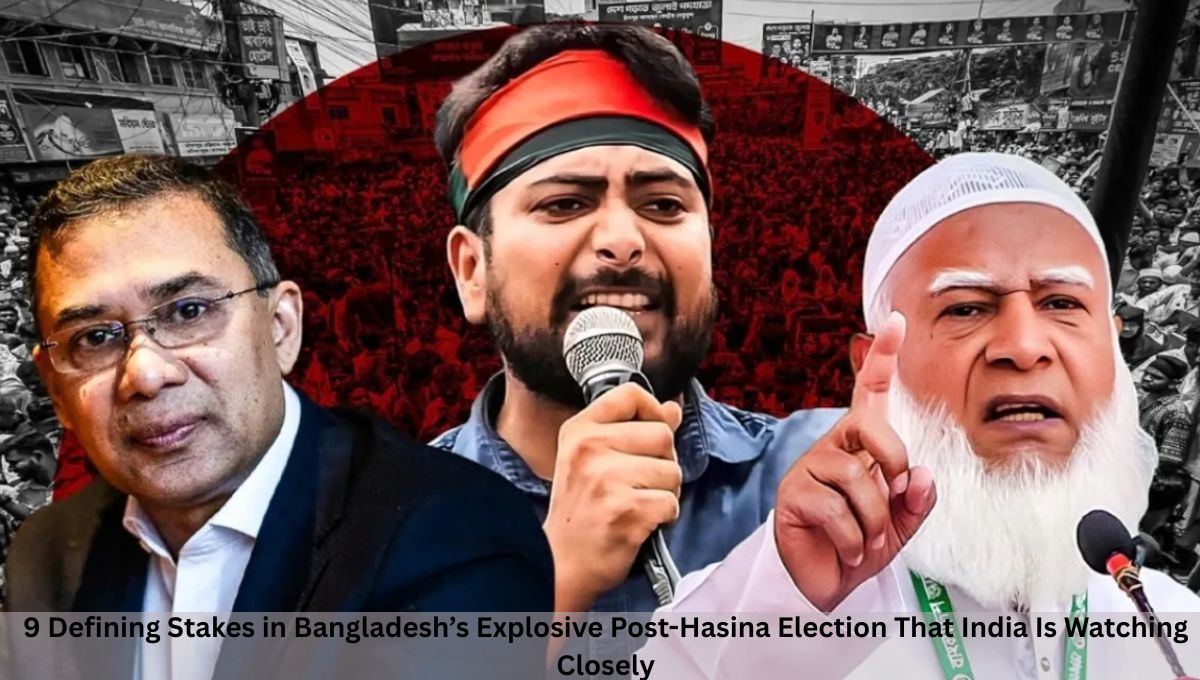
Key Contenders
- Bangladesh Nationalist Party (BNP) led by Tarique Rahman, Khaleda Zia’s son
- Jamaat-e-Islami–led alliance, including the student-founded National Citizen Party (NCP)
With the Awami League absent, the election has become a two-bloc contest, with polls suggesting a narrow BNP lead but a strong Islamist challenge.
Tarique Rahman and the BNP: India’s Uneasy Best Bet
Tarique Rahman, 60, returned to Bangladesh in December 2025 after 17 years in exile in London.
Widely tipped to become the next prime minister, he has tried to reposition the BNP as a liberal-centrist, democratic alternative to Hasina’s rule.
The BNP’s manifesto, titled “Bangladesh Before All”, emphasizes:
- Democratic restoration
- Rule of law
- Economic revival
- Pragmatic foreign relations
India and the BNP
India’s ties with the BNP have historically been strained, especially during its 2001–2006 rule, when:
- Border instability increased
- Anti-India insurgent groups found space
- Relations cooled sharply
Yet political reality has forced a reassessment.
India’s External Affairs Minister S. Jaishankar has met Tarique Rahman, delivered a personal letter from Prime Minister Narendra Modi, and signaled readiness to “script a new chapter” in bilateral ties after democratic transition.
The Jamaat Factor: From Pariah to Power Broker
Perhaps the most striking feature of this election is the resurgence of Jamaat-e-Islami, once banned and politically marginalized.
Now leading an 11-party alliance, Jamaat has:
- Allied with the student-led National Citizen Party
- Softened its public tone on India
- Explicitly mentioned India in its manifesto as a “friendly and cooperative” neighbour
- Omitted Pakistan entirely from its foreign policy document
In a historic first, Jamaat has even fielded a Hindu candidate, Krishna Nandi, from Khulna.
Yet skepticism remains deep in New Delhi. Jamaat’s past links to extremist groups and its collaboration with Pakistan during the 1971 war still cast a long shadow.
India–Bangladesh Ties at a Historic Low
Relations between New Delhi and Dhaka have deteriorated sharply since Hasina’s ouster.
Trade Fallout
- Bangladesh banned Indian yarn and goods via land routes
- India suspended transhipment access through its ports
- Readymade garment imports from Bangladesh via land borders halted
- Nearly 42% of Bangladesh’s exports to India affected
India’s exports to Bangladesh have dropped by over 5%, while Bangladesh’s garment sector — the backbone of its economy — faces mounting stress.
Visa Freeze
- India suspended most visa services for Bangladeshis
- Bangladesh reciprocated by halting visas in Delhi, Agartala, and Siliguri
The rupture has affected medical tourism, business travel, and people-to-people ties that once anchored the relationship.
China Steps In, Pakistan Returns
As India adopted a wait-and-watch approach, China moved swiftly.
Beijing is now involved in:
- Reviving the Lalmonirhat airbase near India’s Siliguri Corridor (Chicken’s Neck)
- Modernising Mongla Port, Bangladesh’s second-largest seaport
- A Teesta river water management project
- A defence deal for a drone manufacturing plant near India’s border
Adding to India’s discomfort, Yunus made China his first overseas visit, breaking decades of diplomatic tradition.
Meanwhile, Bangladesh’s warming ties with Pakistan have raised alarm bells:
- Direct flights resumed after 14 years
- Direct sea links between Chittagong and Karachi
- Military delegations exchanged
- Reports of interest in JF-17 fighter jets, co-produced by China and Pakistan
This is the closest Dhaka–Islamabad engagement since 1971.
Minorities, Media, and Democratic Anxiety
The post-Hasina period has seen rising concern over:
- Violence against minorities, especially Hindus
- Attacks on journalists and media houses
- Mob violence and cultural vandalism
Rights groups documented over 2,400 incidents involving minorities between August 2024 and March 2025.
The lynching of Hindu garment worker Dipu Chandra Das over blasphemy allegations sparked global outrage.
India has publicly raised concerns, while Bangladesh has accused New Delhi of politicizing the issue.
Press freedom has also suffered, with journalists detained, threatened, or pushed off air amid a climate of fear.
The Garment Industry: Economic Lifeline Under Stress
Bangladesh’s garment sector:
- Accounts for 80% of exports
- Employs nearly 4 million workers, mostly women
Six months of falling exports, labour unrest, and US tariffs have pushed the industry into crisis.
A recent US–Bangladesh trade deal reduced tariffs to 19% and introduced limited zero-duty quotas tied to US cotton imports — offering some relief but little certainty.
Industry leaders say only a stable, elected government can restore buyer confidence and revive exports.
What Lies Ahead for India
India would have preferred continuity under the Awami League. That option is gone.
Now, New Delhi faces hard choices:
- Engage a BNP-led government with caution
- Keep channels open with Jamaat despite historical mistrust
- Manage China and Pakistan’s expanding footprint
- Decide how to handle Sheikh Hasina’s extradition request
Analysts agree that a decisive election result, rather than a fractured mandate, is crucial for Bangladesh’s stability — and for resetting relations with India.
Conclusion: A Turning Point for South Asia
This election is not merely about choosing Bangladesh’s next government.
It is about:
- The future of democracy after a Gen Z uprising
- The direction of India–Bangladesh relations
- The strategic contest unfolding across South Asia
As millions cast their votes, India is watching closely — aware that what happens in Dhaka will reverberate far beyond Bangladesh’s borders.
Also Read: Is BNP’s Tarique Rahman the change post-Hasina Bangladesh is looking for?