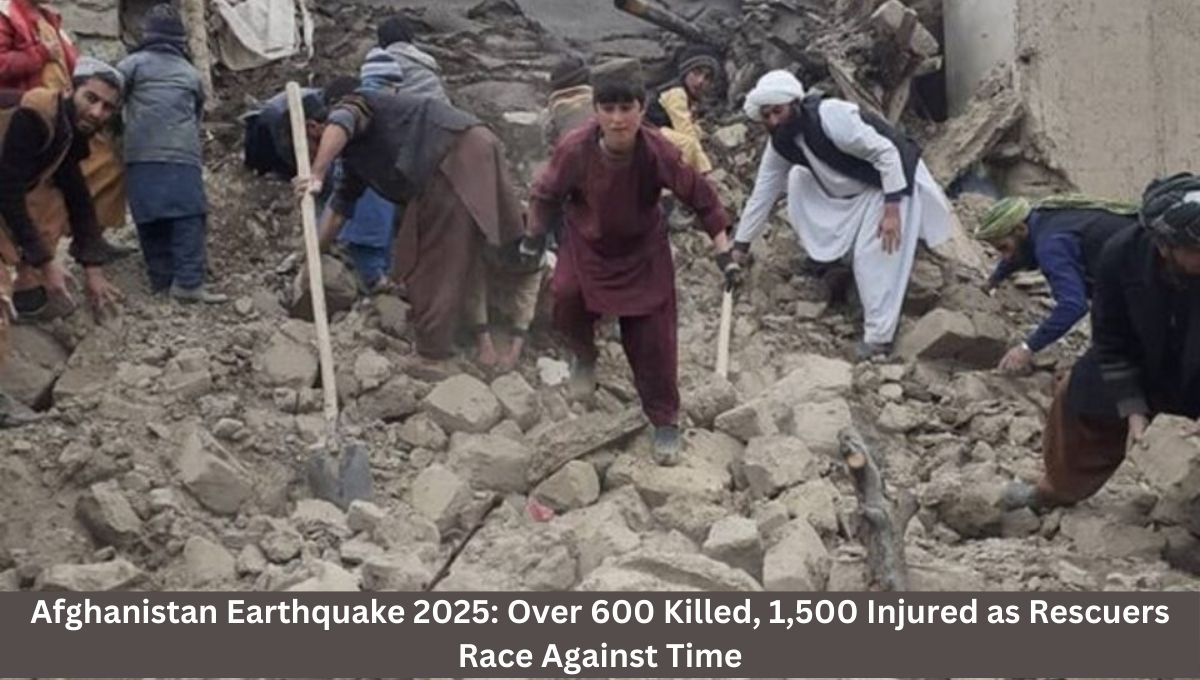
Devastating Afghanistan Earthquake 2025: Over 600 Killed, 1,500 Injured as Rescuers Race Against Time. A powerful 6.0-magnitude earthquake struck Afghanistan’s mountainous eastern region late on Sunday night, killing over 600 people and injuring more than 1,500 others, according to Afghan authorities.
Entire villages were flattened in Kunar province, while nearby Nangarhar also reported significant destruction. The earthquake, one of the deadliest in recent years, struck just before midnight and sent shockwaves across Afghanistan and into neighboring Pakistan.
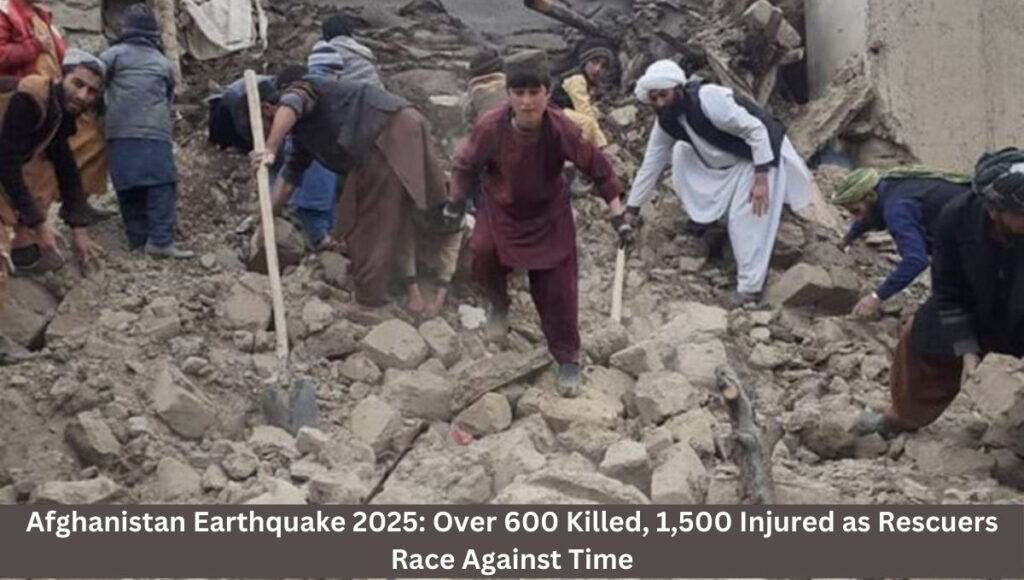
Afghanistan Earthquake 2025: Over 600 Killed, 1,500 Injured as Rescuers Race Against Time
Epicenter and Seismic Details
The United States Geological Survey (USGS) reported the quake’s epicenter 27 kilometers northeast of Jalalabad in Nangarhar province.
The tremor struck at a relatively shallow depth of 8 to 10 kilometers, making its impact more destructive.
The quake was felt as far away as Kabul more than 100 miles from the epicenter and across Pakistan’s Khyber Pakhtunkhwa and Punjab provinces, including cities like Peshawar, Islamabad, and Lahore.
Seismologists warn that shallow earthquakes are particularly dangerous as seismic waves travel quickly to the surface, causing severe ground shaking and destruction.
Death Toll and Casualties
- At least 622 people confirmed dead, according to the Taliban-run Interior Ministry.
- More than 1,500 people injured across Kunar and Nangarhar.
- Three villages in Kunar — Nurgal, Chawkay, and Watapur completely razed.
- Hundreds more homes across mountain districts severely damaged or destroyed.
Abdul Mateen Qani, spokesperson for the Afghan Interior Ministry, said the number of dead could rise as rescue teams reach remote hamlets. “A large number of houses were destroyed in Kunar,” he said.
Survivors Pulled from Rubble
Rescuers, soldiers, and local villagers worked through the night, pulling survivors from the rubble.
Helicopters ferried the injured to hospitals in Jalalabad, where Reuters footage showed stretchers being unloaded at a military base.
Hospitals in the region are overwhelmed, with casualties lying on floors and being treated in makeshift wards.
A survivor in Jalalabad said: “We were sleeping when the walls collapsed. I lost my children, and my wife is injured. The ground kept shaking, and people were screaming everywhere.”
Relief Efforts and Challenges
Rescue operations are underway, but landslides and blocked mountain roads have slowed progress. Relief workers say reaching remote villages in Kunar’s rugged terrain remains the biggest challenge.
The Taliban’s state-run Bakhtar News Agency (BNA) reported that:
- 40 military flights carried injured and dead to hospitals.
- Thousands of security and rescue personnel have been mobilized.
- Teams from Kabul and nearby provinces are en route with supplies.
However, officials confirmed that no foreign governments had yet offered direct assistance as of Monday morning.
Eyewitness Accounts
The quake left lasting trauma for people even far from the epicenter.
- In Kabul, resident Ahmad Zameer said the tremors jolted his neighborhood. “Everyone rushed outside in fear. We thought our building would collapse.”
- In Pakistan, residents of Islamabad and Peshawar described doors rattling and walls swaying for several seconds.
Social media videos showed panicked families rushing into the streets, while other footage captured collapsed mud-brick homes and survivors digging with bare hands.
Aftershocks Worsen Fear
The region was struck by at least five aftershocks, the strongest measuring 5.2 magnitude, according to the USGS.
The Indian National Centre for Seismology (NCS) reported tremors ranging from 4.3 to 5.0 magnitude at depths between 40–160 km in the hours after the main quake.
Many families spent the night outdoors, fearing further collapses.
Humanitarian Crisis Deepens
The earthquake struck Afghanistan at a time of severe humanitarian crisis.
The Taliban-led government is grappling with:
- Cuts to international aid, including $1.7 billion in U.S.-funded programs withdrawn.
- Widespread hunger and food shortages.
- A fragile healthcare system ill-equipped for mass casualties.
Taliban spokesperson Zabihullah Mujahid posted on X that all available resources would be used for rescue and relief.
However, aid agencies warn the scale of destruction may overwhelm Afghanistan’s limited capacity.
The United Nations in Afghanistan said it was “deeply saddened” and confirmed its teams were delivering emergency assistance.
Historical Context: Afghanistan’s Earthquake Vulnerability
Afghanistan sits at the collision zone of the Indian and Eurasian tectonic plates, making it highly prone to earthquakes, especially in the Hindu Kush mountain range.
- June 2022: A 6.1 quake killed at least 1,000 people.
- October 2023: A 6.3 quake in western Afghanistan killed more than 2,000, one of the deadliest disasters in recent years.
- The Herat region has also seen multiple destructive quakes, underlining the country’s high vulnerability.
Poorly constructed mud-brick homes and lack of resilient infrastructure worsen the death toll whenever earthquakes strike.
International Response
So far, no foreign governments have announced direct aid. However, humanitarian organizations are expected to mobilize in the coming days.
Observers note that Afghanistan’s isolation under Taliban rule may complicate foreign assistance, delaying the delivery of food, tents, and medical supplies urgently needed in affected districts.
Comparison with Past Earthquakes
- June 2022 (6.1 magnitude): 1,000 deaths, mostly in Paktika province.
- October 2023 (6.3 magnitude): Taliban estimated 4,000 deaths, UN reported 1,500.
- September 2025 (6.0 magnitude): Over 600 killed, 1,500 injured, and three villages razed in Kunar.
This makes the 2025 quake the deadliest since 2023, and among the most destructive in eastern Afghanistan in decades.
Pakistan Feels the Shocks
Pakistan’s Meteorological Department confirmed tremors were felt in Khyber Pakhtunkhwa and Punjab, including Islamabad, Peshawar, Abbottabad, Swat, and Mansehra.
Authorities there reported no major casualties but noted minor damage to structures near the border.
Survivors in Need
Aid groups say survivors urgently need:
- Shelter: Thousands left homeless with winter approaching.
- Medical supplies: Hospitals overwhelmed by critical injuries.
- Food and water: Many villages cut off due to blocked roads.
Rescue teams continue searching rubble for survivors, but officials fear the death toll will climb.
Conclusion: A Nation in Mourning
The Afghanistan earthquake of September 2025 has devastated communities in Kunar and Nangarhar, killing over 600 people and injuring thousands more. Entire villages lie in ruins, survivors are traumatized, and relief efforts are hampered by the country’s economic and political isolation.
For Afghans, earthquakes are a grim reminder of their vulnerability not only to natural disasters but also to the fragility of life in one of the world’s poorest, conflict-ridden nations.
The international community now faces a crucial decision: whether to overcome political barriers and extend humanitarian assistance to a people in desperate need.
Also Read: Drake Passage Earthquake: 7.5-Magnitude Quake Rattles Antarctic Waters, No Tsunami Threat
Also Read: Afghanistan earthquake: What we know – and what we don’t
Related Posts:
- Another Earthquake Strikes Afghanistan After 1,400…
- Afghanistan Earthquake 2025: Over 800 Dead as…
- Third Earthquake Strikes Afghanistan: Death Toll…
- 6.3-Magnitude Earthquake Devastates Northern Afghanistan
- Afghanistan–Pakistan Border Clashes 2025: Key Facts…

- Afghanistan–Pakistan War 2025: Inside the 48-Hour Ceasefire
