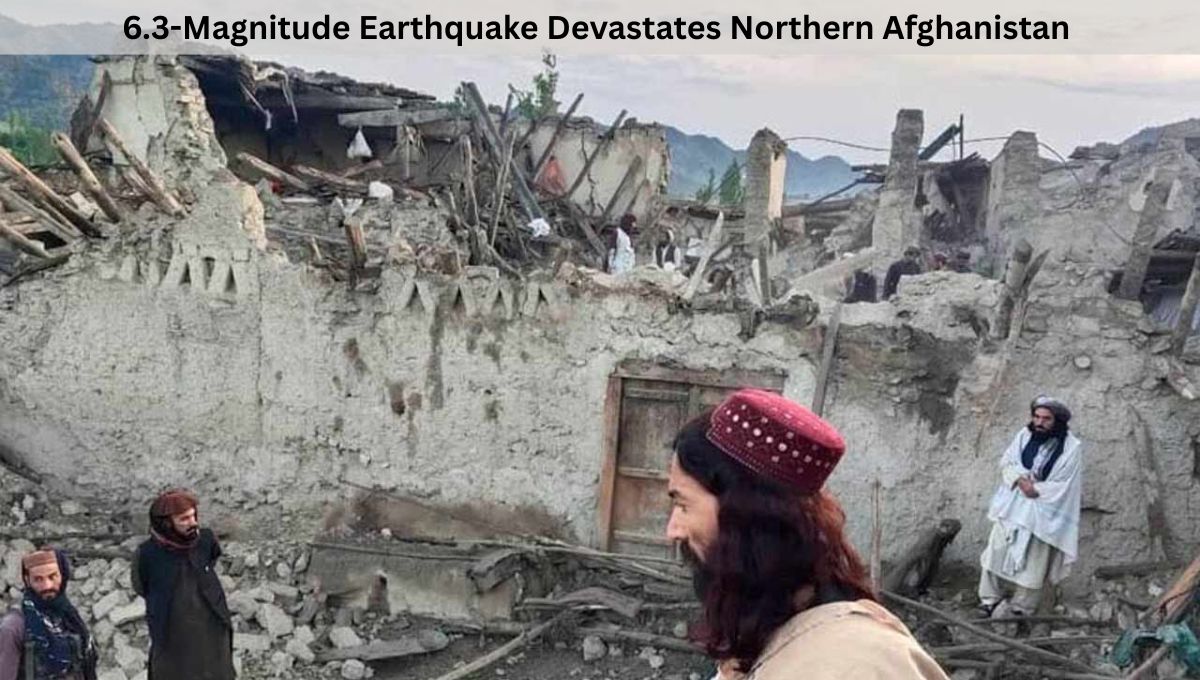
6.3-Magnitude Earthquake Devastates Northern Afghanistan — 20 dead, 320 injured in powerful night tremor. A powerful 6.3-magnitude earthquake struck northern Afghanistan near the historic city of Mazar-i-Sharif in the early hours of Monday, killing at least 20 people and injuring more than 320, according to the country’s health ministry.
The United States Geological Survey (USGS) said the quake occurred around 12:59 a.m. local time (20:29 GMT Sunday), with its epicenter near Khulm in Balkh province and a depth of 28 kilometers (17 miles). Tremors were felt as far away as Kabul, Islamabad, and Mashhad, shaking homes and sending terrified residents fleeing into the streets.
The National Center for Seismology (NCS) in India and the European-Mediterranean Seismological Centre (EMSC) confirmed the magnitude and location of the quake, which struck at a depth of 23 to 28 kilometers — shallow enough to cause significant surface damage.
6.3-Magnitude Earthquake Devastates Northern Afghanistan
USGS issues ‘orange alert’ for casualties and damage
In its initial assessment, the USGS PAGER system issued an “orange alert”, warning that “significant casualties are likely and the disaster is potentially widespread.” “Past events with this alert level have required a regional or national level response,” the agency cautioned.
The tremor hit while most residents were asleep, compounding the impact. “Significant casualties are likely,” USGS analysts noted, emphasizing that many buildings in Afghanistan are non-reinforced mud structures prone to collapse during seismic events.
Casualties and destruction across Balkh and Samangan provinces
According to Sharafat Zaman, spokesperson for the Taliban Ministry of Public Health, “Around 320 people have been injured and more than 20 have been killed,” stressing that the figures are preliminary and likely to rise as rescue operations continue.
Provincial officials in Balkh and Samangan reported that most injuries occurred when residents jumped from rooftops or upper floors in panic as their homes began to shake.
Samim Joyanda, spokesperson for the Samangan health department, told Reuters that “A total of 150 people injured and seven martyred were transferred to health centers as of this morning.” Later, the number of confirmed deaths rose to 20 as more bodies were pulled from rubble.
Blue Mosque damaged in Mazar-i-Sharif
One of Afghanistan’s most iconic landmarks, the Blue Mosque (Shrine of Hazrat Ali) in Mazar-i-Sharif — renowned for its 15th-century turquoise-tiled minarets — sustained visible damage.
According to AFP, parts of one minaret broke off and fell into the courtyard, scattering colorful tiles and debris. The site, a major Shia pilgrimage destination, is believed to house the tomb of Imam Ali, the son-in-law of Prophet Muhammad.
Videos circulating on social media — though unverified — showed debris-strewn courtyards and rescue workers carrying bodies from collapsed homes. In one clip, panicked residents were seen praying in the open as aftershocks rippled through the city.
Power outages and communication breakdown
The quake also triggered a nationwide power outage, according to officials. Electricity transmission lines from Uzbekistan and Tajikistan — key suppliers to Afghanistan — were damaged, plunging parts of Kabul and northern provinces into darkness.
Telecommunication disruptions further hindered rescue efforts, with authorities struggling to assess the full scale of destruction in remote mountainous villages.
Panic and chaos in Mazar-i-Sharif
Residents of Mazar-i-Sharif described terrifying scenes as the earthquake struck in the middle of the night.
“I woke up to the sound of cracking walls. Everything was shaking violently,” said resident Abdul Rahman. “People ran into the streets shouting verses from the Quran. We thought it was the end.”
An AFP correspondent in the city said hundreds of residents spent the night outdoors, fearing aftershocks and further building collapses.
Haji Zaid, spokesperson for the Taliban governor in Balkh, confirmed “many people are injured in the Sholgara district,” adding that most injuries were minor but “damage to homes and public buildings is widespread.”
A history of deadly earthquakes
Afghanistan sits atop the collision zone of the Indian and Eurasian tectonic plates, making it one of the world’s most seismically active regions. The Hindu Kush mountain range is especially prone to shallow, destructive earthquakes.
In recent years, the country has suffered several catastrophic quakes:
- August 31, 2025: A 6.0-magnitude quake in eastern Afghanistan killed over 2,200 people and injured more than 2,800.
- October 2023: Four powerful quakes near Herat killed more than 1,000 people and injured 2,400.
- June 2022: A 6.1-magnitude tremor in Nangarhar province killed more than 1,100, one of the deadliest in decades.
Since 1900, Afghanistan’s northeast has recorded 12 earthquakes exceeding magnitude 7.0, according to the British Geological Survey.
Humanitarian crisis worsened by disasters
The quake compounds an already dire humanitarian crisis. Since the Taliban’s takeover in 2021, Afghanistan has faced drought, famine, sanctions, and dwindling international aid.
The United Nations has warned that more than half the Afghan population faces food insecurity, while millions have been displaced or deported from neighboring Pakistan and Iran.
Aid organizations say frequent natural disasters are stretching limited emergency response capacity, as foreign funding for disaster relief and development has plummeted.
“The Afghan people are enduring disaster after disaster — from droughts to earthquakes — with very little international assistance,” said a UN field coordinator. “This latest quake again shows how vulnerable the population is.”
Challenges in rescue and relief operations
Poor infrastructure and mountainous terrain have slowed rescue operations, particularly in rural areas accessible only via unpaved roads.
The National Disaster Management Authority (NDMA) said that teams were being deployed from Kabul and Balkh, but limited fuel and damaged communication networks delayed coordination.
In Samangan province, hospitals were reportedly overwhelmed. Makeshift medical tents were set up to treat victims with broken bones, head injuries, and trauma.
A local doctor at Mazar-i-Sharif’s regional hospital told AFP, “We are running short of blood and medical supplies. Many patients arrived barefoot, covered in dust. We fear the numbers will rise as we reach remote villages.”
International community reacts
Neighboring countries expressed condolences and offered support. Pakistan’s Prime Minister extended solidarity with Afghan victims, while Iran’s Red Crescent said it was “ready to dispatch medical and rescue teams.”
The UN Office for the Coordination of Humanitarian Affairs (OCHA) said its teams were “assessing damage and mobilizing aid partners” for emergency response.
Humanitarian experts fear that sanctions and banking restrictions may hinder the speed of financial aid reaching affected regions.
Mazar-i-Sharif: From historic pride to tragic ground zero
Mazar-i-Sharif, Afghanistan’s fourth-largest city, has long been a symbol of cultural heritage and resilience. Known for its Blue Mosque, Sufi shrines, and bustling bazaars, it serves as a commercial and spiritual hub in northern Afghanistan.
The damage to its most iconic landmark — the Blue Mosque of Hazrat Ali — has deeply saddened residents. “This mosque is our heart,” said a local caretaker. “Seeing its minaret fall feels like losing a part of our soul.”
Cultural preservation experts fear that centuries-old structures, weakened by neglect and previous quakes, may be irreparably damaged.
A nation repeatedly tested by nature and neglect
Afghanistan’s vulnerability to earthquakes is amplified by decades of conflict that have crippled building standards and weakened governance structures.
Most rural homes are built from mud and timber, unable to withstand even moderate shaking.
Experts say without seismic-resistant construction and early warning systems, such tragedies will continue.
“Afghanistan sits on one of the most dangerous fault lines in the world,” said Brian Baptie, a seismologist with the British Geological Survey. “The risk is structural — both geological and societal.”
Global calls for renewed humanitarian aid
In the aftermath, humanitarian groups renewed calls for restoring global aid flows to Afghanistan.
“The international community must separate politics from humanitarian needs,” said an official from Doctors Without Borders. “People are dying from preventable disasters simply because funding has dried up.”
The Taliban government has urged international donors to send emergency supplies, food, and medicine, while pledging transparency in distribution. However, global agencies remain cautious due to sanctions and concerns about corruption and access.
Resilience amid ruin
Despite the devastation, scenes of solidarity have emerged. Local volunteers are digging through debris with bare hands. Families are donating food and blankets to survivors sleeping outdoors.
“Our people have faced war, hunger, and earthquakes,” said a resident of Balkh province. “We have nothing — but we have each other.”
As night falls again over Mazar-i-Sharif, aftershocks continue to rattle nerves. The death toll may rise, but so too does the determination of Afghans to endure.
Conclusion
The 6.3-magnitude earthquake in northern Afghanistan is a stark reminder of the country’s fragile geography and political isolation. As rescue efforts continue in Balkh and Samangan provinces, officials warn that many may still be trapped under rubble.
With at least 20 dead and 320 injured, the tragedy adds to a growing list of disasters testing Afghanistan’s resilience — and underscores the urgent need for global humanitarian re-engagement.
Also Read: 6.1-Magnitude Earthquake Rocks Western Türkiye: Buildings Collapse, Dozens Injured
Also Read: Earthquake today: 5.8 magnitude shallow quake strikes Russia’s Kamchatka region