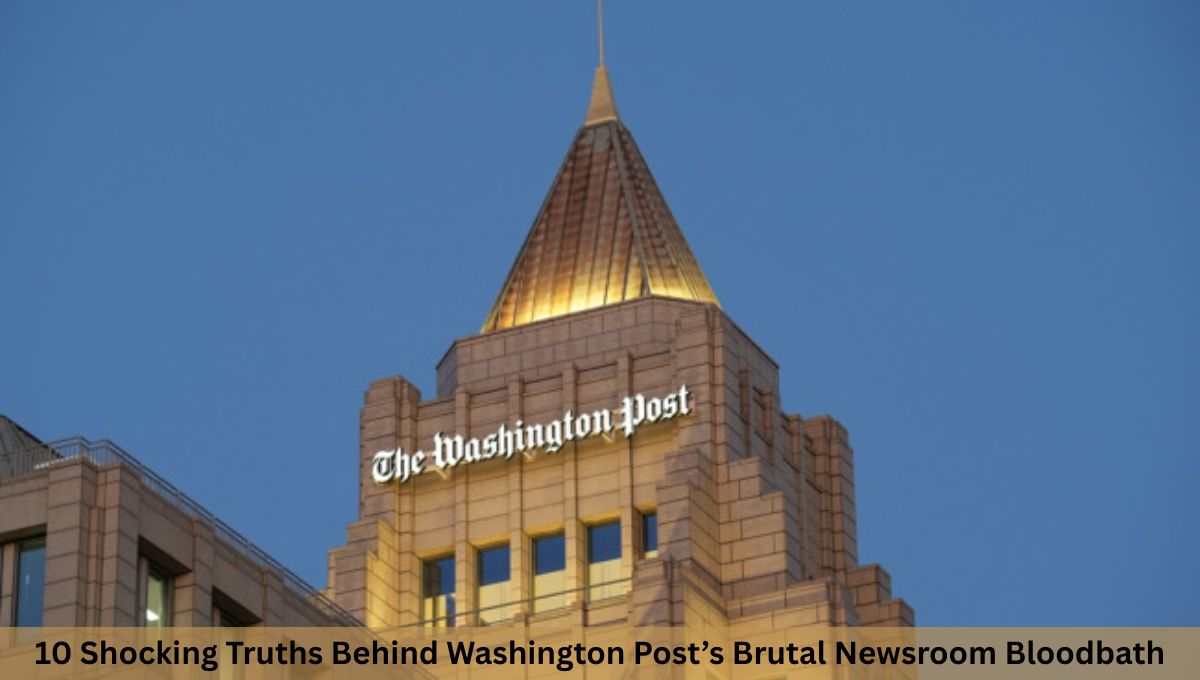
10 Shocking Truths Behind Washington Post’s Brutal Newsroom Bloodbath and the lasting damage to global journalism and public trust. In what many journalists are calling one of the darkest moments in modern media history, The Washington Post has laid off more than 300 journalists and staff, eliminating roughly one-third of its workforce in a sweeping restructuring that has sent shockwaves through newsrooms worldwide.
The scale and nature of the cuts—gutting foreign bureaus, dismantling international desks, effectively ending its sports section, slashing local reporting, and hollowing out the business and editing divisions—represent far more than a routine corporate downsizing. For many inside and outside the paper, this was not merely a layoff cycle. It was a fundamental retreat from global journalism.
The emotional fallout has been raw and public. Correspondents reported losing their jobs from war zones, bureau chiefs announced entire regions had been erased, and senior editors warned that the public—not just journalists—would pay the price.
This article breaks down 10 critical truths behind the Washington Post layoffs, what they reveal about the crisis gripping global media, and why this moment may mark a turning point for the future of international journalism.
10 Shocking Truths Behind Washington Post’s Brutal Newsroom Bloodbath
1. The Scale: One-Third of the Washington Post Is Gone
The layoffs announced in early 2026 affected approximately 33% of the Washington Post’s total workforce, spanning nearly every department across the organisation.
Unlike previous cost-cutting rounds that spared the newsroom, this restructuring struck at the heart of editorial operations. Hundreds of journalists—many with decades of experience—were dismissed in a single wave.
Employees were instructed to stay home as emails were sent confirming who had lost their jobs, a process staff described as cold, chaotic and deeply traumatic.
One Post employee summed up the mood bluntly:
“It’s an absolute bloodbath.”
2. Foreign Bureaus: The Backbone of Global Reporting Gutted
Perhaps the most alarming aspect of the Washington Post layoffs was the near-dismantling of its international reporting infrastructure.
Entire bureaus across Asia, Europe, the Middle East and parts of Africa were eliminated or hollowed out.
Senior editors confirmed that large sections of the foreign desk were cut simultaneously.
- Berlin bureau: Entirely shut down
- Middle East desk: Correspondents and editors eliminated
- New Delhi bureau: Bureau chief laid off
- Kyiv coverage: Severely reduced amid an active war
While management says around 12 international bureaus will remain, the focus will be narrowed primarily to national security reporting, signalling a sharp retreat from comprehensive global coverage.
For a newspaper long celebrated for its on-the-ground foreign reporting, the contraction represents a dramatic loss of institutional reach and perspective.
3. Journalists Laid Off From War Zones
Among the most disturbing revelations was that journalists reporting from active conflict zones were laid off mid-assignment.
Lizzie Johnson: Laid Off in Ukraine
Washington Post Ukraine correspondent Lizzie Johnson announced she lost her job while reporting from a war zone, writing:
“I was just laid off by The Washington Post in the middle of a warzone. I have no words. I’m devastated.”
Only weeks earlier, Johnson had shared images of herself working without power or heat in Kyiv, writing by pencil because pen ink froze in sub-zero temperatures.
Her dismissal became a symbol of the human cost of newsroom cuts and raised serious questions about how media organisations value frontline reporting.
4. Ishaan Tharoor Among the High-Profile Axed
One of the most prominent names among those laid off was Ishaan Tharoor, senior international affairs columnist and the creator of the widely read WorldView column.
Tharoor, the son of Indian parliamentarian Shashi Tharoor, confirmed his layoff publicly, calling the decision heartbreaking.
“I have been laid off today from The Washington Post, along with most of the International staff… I’m heartbroken for our newsroom and especially for the peerless journalists who served the Post internationally.”
He later posted an image of the newsroom bearing the Post’s iconic slogan—“Democracy Dies in Darkness”—captioned simply:
“A bad day.”
The image was widely shared, becoming a stark metaphor for the moment.
5. Sports, Books and Local Coverage: Cultural Pillars Cut Away
The layoffs went far beyond foreign reporting.
Sports Desk Effectively Shut Down
The Washington Post’s storied sports section, long considered one of the most influential in American journalism, has been largely eliminated.
While a smaller team may continue in a new format, the traditional desk is gone.
Books Section Eliminated
The Post’s Book World, a respected literary institution, was also cut—ending decades of authoritative book criticism and cultural reporting.
Metro and Local Reporting Slashed
The Metro desk, central to the paper’s identity as “For and About Washington,” has been reduced from more than 40 journalists to roughly a dozen, according to staff.
The cumulative effect is a newsroom narrowed not just in size, but in ambition.
6. Management’s Explanation: A ‘Strategic Reset’
Executive Editor Matt Murray framed the layoffs as a painful but necessary “strategic reset”, arguing that the Post must adapt to a crowded, competitive and digitally fragmented media landscape.
According to Murray:
- The Post has struggled to reach “customers”
- Daily story output has declined
- Traditional newsroom structures are no longer sustainable
The paper will now prioritise:
- US politics and government
- National security
- Business, technology, climate, health and science
- Investigative journalism
Critics argue this language masks a narrowing of editorial vision, reducing a global newspaper to a more limited, Washington-centric product.
7. Marty Baron’s Scathing Warning
Former Executive Editor Marty Baron, who led the Post during its Pulitzer-winning Trump-era investigations, delivered the most severe critique.
He called the layoffs:
“Among the darkest days in the history of one of the world’s greatest news organisations.”
Baron warned that the cuts would:
- Sharply diminish the Post’s ambitions
- Deplete its most talented journalists
- Deny the public essential ground-level reporting
He directly blamed owner Jeff Bezos, accusing him of self-inflicted brand destruction and of eroding trust through controversial decisions, including the decision to withdraw a planned presidential endorsement in 2024.
8. Jeff Bezos, Trump, and the Trust Crisis
While Bezos has remained publicly silent on the layoffs, criticism of his ownership has intensified.
Former editors and staff argue that:
- Attempts to appease political power damaged credibility
- Editorial interference drove away subscribers
- The opinion page overhaul alienated core readers
More than 200,000 subscribers reportedly cancelled following the decision not to endorse a presidential candidate in 2024.
Baron described Bezos’s actions as:
“Sickening efforts to curry favour.”
For a newspaper built on holding power to account, the perception of compromised independence has proven deeply corrosive.
9. The Union Pushback: ‘Not Inevitable’
The Washington Post Guild strongly rejected the idea that the layoffs were unavoidable.
In a statement, the union warned:
“A newsroom cannot be hollowed out without consequences for its credibility, its reach and its future.”
The union went further, questioning whether Bezos should continue as owner if he is unwilling to invest in the paper’s mission.
A protest has been organised outside the Post’s Washington headquarters, reflecting mounting internal and public anger.
10. What This Means for Global Journalism
The Washington Post layoffs are not an isolated event.
They reflect a global media crisis driven by:
- Declining advertising revenue
- Fragmented audiences
- Platform-driven news consumption
- The rise of AI-generated content
- Subscription fatigue
But the elimination of foreign correspondents, war reporters, and local accountability journalism raises deeper concerns.
International reporting is expensive, slow and risky—but essential. Its decline risks creating blind spots in global understanding at a time of rising geopolitical tension.
Conclusion: A Turning Point, Not Just a Layoff
The Washington Post was not just another newspaper. It was an institution that shaped global discourse, exposed corruption, and defined accountability journalism for generations.
This newsroom bloodbath signals more than financial distress. It marks a philosophical shift—away from expansive, on-the-ground reporting toward a narrower, cheaper model of journalism.
Whether this “strategic reset” saves the Post or accelerates its decline remains uncertain. What is clear is that the public will feel the consequences long after the headlines fade.
As one former editor warned, democracy does not die in darkness overnight. It fades when the lights are quietly switched off—bureau by bureau, desk by desk, journalist by journalist.
Also Read: 7 Explosive Moments as Trump Flips Off Heckler at Ford Plant
Also Read: Former Washington Post Editor Torches Jeff Bezos Over Newsroom Cuts
Related Posts:
- 5 Major Revelations in the BBC–Trump Panorama…

- Trump’s State Department Layoffs Reshape U.S.…

- 11 Explosive Revelations From Ted Cruz’s Leaked…

- In 8 Moves, EU Targets China-Linked Refineries and…

- Afghanistan–Pakistan War 2025: Inside the 48-Hour Ceasefire

- Trump’s 20-Point Gaza Peace Plan Gains Urgent Global…
