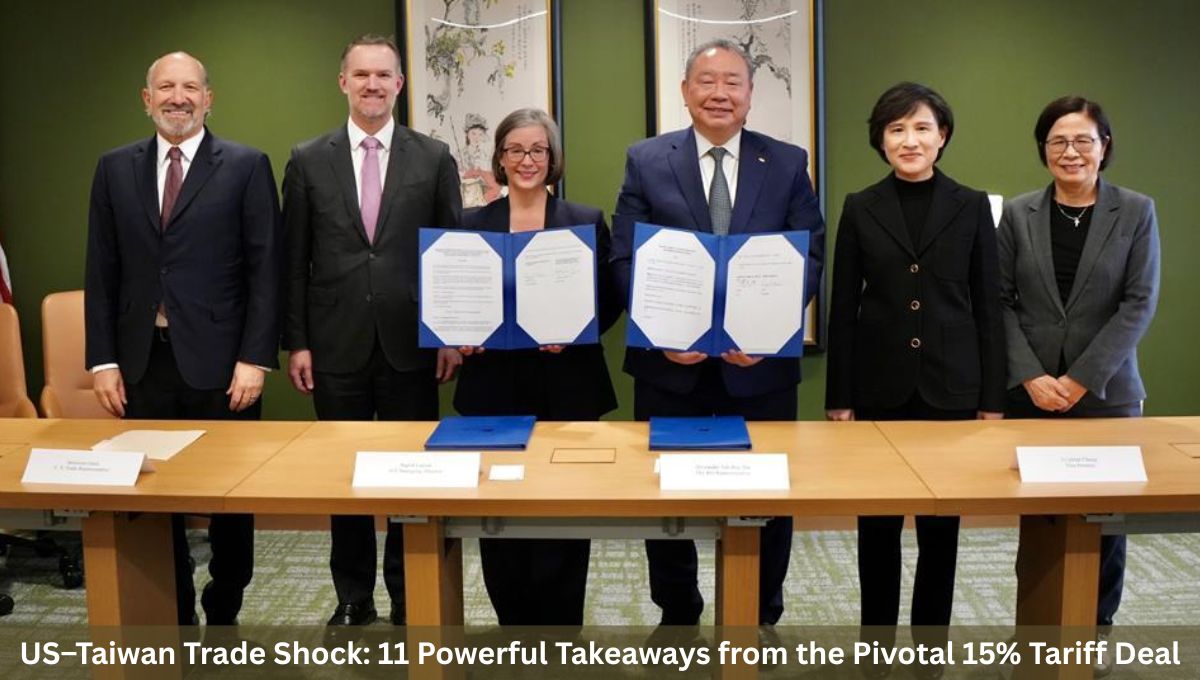
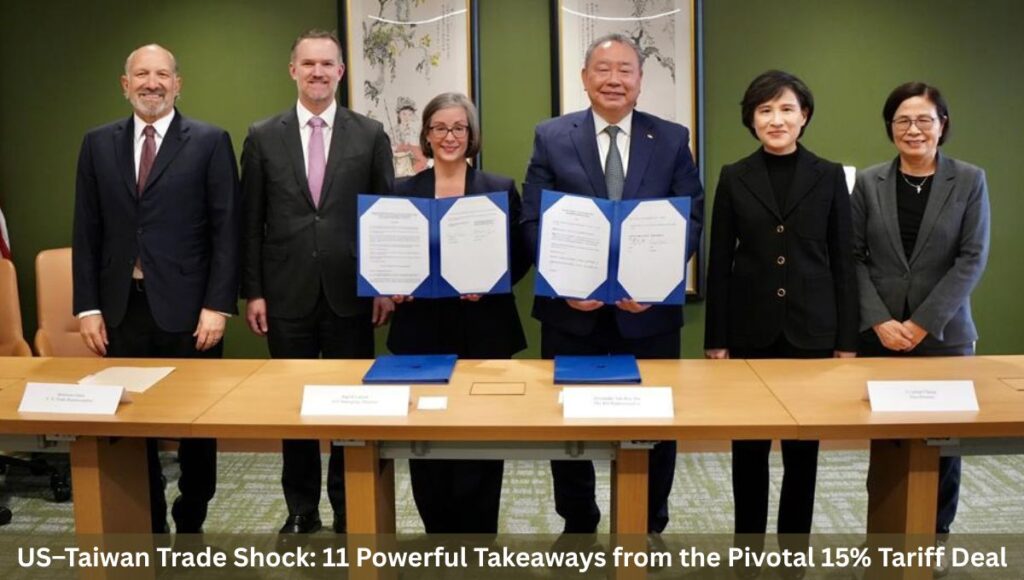
US–Taiwan Trade Shock: 11 Powerful Takeaways from the Pivotal 15% Tariff Deal, a strategic reset. The United States and Taiwan have finalised one of the most consequential trade agreements in Asia-Pacific commerce in recent years, confirming a 15% US tariff on Taiwanese imports while unlocking tens of billions of dollars in guaranteed purchases of American goods and deeper cooperation in advanced technology supply chains.
Signed by officials from the administration of Donald Trump, the deal formalises a framework first reached in January and places Taiwan on equal tariff footing with Japan and South Korea, its closest Asian export competitors.
Beyond tariffs, the agreement reshapes energy flows, aircraft sales, agricultural trade, and semiconductor geopolitics — all while intensifying strategic tensions with China, which views Taiwan as its sovereign territory. For Washington, the pact aims to narrow a ballooning trade deficit and reinforce supply chain security.
For Taipei, it offers global competitiveness, tariff relief, and strategic reassurance — but at the cost of deepening economic entanglement with the US.
US–Taiwan Trade Shock: 11 Powerful Takeaways from the Pivotal 15% Tariff Deal
What the US–Taiwan Trade Agreement Does
At its core, the agreement establishes reciprocal trade concessions designed to rebalance economic ties while strengthening industrial cooperation.
Key headline provisions
- 15% US tariff on Taiwanese imports (down from 20%)
- Taiwan to eliminate or reduce 99% of tariffs on US goods
- Taiwan commits to massive purchases of US products (2025–2029)
- Removal of major non-tariff barriers, especially in autos and pharmaceuticals
- Enhanced cooperation in semiconductors, AI, and advanced manufacturing
The Office of the US Trade Representative said the deal would “significantly enhance the resilience of supply chains,” particularly in high-technology sectors critical to national security.
Tariffs Cut to 15% — Why This Number Matters
The 15% tariff rate is not arbitrary.
It matches the tariff levels Washington applies to Japan and South Korea, two of its closest allies in Asia.
This parity ensures that Taiwanese exports — especially semiconductors, electronics, and machinery — are no longer disadvantaged in the US market.
The deal replaces an earlier Trump-era tariff threat that could have climbed as high as 32%, a level that would have significantly damaged Taiwan’s export-driven economy.
By securing the 15% rate, Taipei effectively neutralised a major competitive risk at a time when nearly one-third of Taiwan’s exports now go to the US, its largest market for the first time since 2000.
Taiwan’s Massive US Purchase Commitments (2025–2029)
One of the most striking aspects of the deal is Taiwan’s binding commitment to dramatically expand purchases of American goods.
Confirmed purchase schedule
- $44.4 billion in liquefied natural gas (LNG) and crude oil
- $15.2 billion in civil aircraft and engines
- $25.2 billion in power grid equipment, generators, marine and steelmaking machinery
Combined, the purchases exceed $85 billion over five years, creating a predictable demand pipeline for US exporters.
For Washington, this directly supports farmers, energy producers, aerospace manufacturers and heavy industry — constituencies central to Trump’s domestic economic strategy.
Agriculture: US Farmers Score Big Gains
The agreement delivers immediate and tangible wins for US agriculture.
Taiwan will:
- Immediately eliminate tariffs of up to 26% on beef, dairy, corn and several other farm products
- Reduce tariffs on additional agricultural goods over a defined schedule
- Grant preferential market access to US food exporters
Some sensitive products remain protected. High tariffs on pork belly (40%) and ham (32%) will fall only to 10%, reflecting domestic political sensitivities in Taiwan.
Still, US Trade Representative Jamieson Greer said the deal would significantly expand opportunities for American farmers, ranchers and fishermen.
Non-Tariff Barriers Finally Addressed
Beyond customs duties, Taiwan agreed to dismantle long-standing regulatory barriers that have frustrated US exporters for years.
Major regulatory shifts
- Acceptance of US Federal Motor Vehicle Safety Standards
- Removal of duplicative testing requirements for autos
- Streamlined approval for US medical devices and pharmaceuticals
These changes lower compliance costs and accelerate market access, particularly for American automakers and healthcare firms.
Semiconductors: The Strategic Core of the Deal
Although the final agreement avoids explicit numerical mandates, semiconductors remain the strategic heart of the US–Taiwan relationship.
Taiwan dominates global chip manufacturing, and US reliance on Taiwanese production — especially advanced AI chips — has surged.
For the first 11 months of 2025, the US trade deficit with Taiwan ballooned to $126.9 billion, driven largely by imports of high-end chips, according to Census Bureau data.
Washington’s objective is clear:
secure chip supply chains on US soil.
The $250 Billion Investment Pledge — What’s Included
The January framework accompanying the tariff deal included a commitment that Taiwanese companies would invest $250 billion in the US across:
- Semiconductors
- Artificial intelligence
- Energy infrastructure
Chip giant Taiwan Semiconductor Manufacturing Company alone committed $100 billion, part of a broader $165 billion expansion that includes fabrication plants and a major R&D center.
Commerce Secretary Howard Lutnick said the Taiwanese government would guarantee an additional $250 billion in credit to facilitate further investment.
The final trade text, however, deliberately keeps the investment language flexible, reflecting Taipei’s resistance to relocating too much of its semiconductor ecosystem.
Taiwan Pushes Back on US Chip Demands
While US officials have spoken publicly about relocating up to 40% of Taiwan’s semiconductor supply chain to the US, Taipei has firmly rejected the idea.
Vice Premier Cheng Li-chiun said Taiwan’s chip ecosystem — built over decades — “cannot simply be relocated.”
Taiwan’s position is that overseas expansion must complement, not hollow out, domestic production — a view shaped by both economic logic and national security concerns.
Taiwan Secures Key Tariff Exemptions
In return for concessions, Taiwan achieved significant carve-outs.
According to President Lai Ching-te, more than 2,000 Taiwanese products won exemptions from reciprocal US tariffs.
When all carve-outs are accounted for, the average tariff on Taiwanese exports drops to about 12.33%, strengthening competitiveness across sectors ranging from agriculture to consumer goods.
Products highlighted by Taipei include tea, pineapples, orchids, bubble tea ingredients, coffee and processed foods — exports with growing global appeal.
‘A Pivotal Moment,’ Says Taiwan’s President
President Lai described the agreement as a “pivotal moment” for Taiwan’s economy.
He said the deal:
- Optimises the Taiwan–US trade framework
- Builds trustworthy industrial supply chains
- Establishes a high-tech strategic partnership
For Taiwan, the agreement is also symbolic — reinforcing international economic engagement at a time when diplomatic space is constrained.
Parliamentary Approval Still Required in Taiwan
Despite celebratory rhetoric, the deal is not yet law.
It must be approved by Taiwan’s parliament, where the opposition holds a majority. While outright rejection is unlikely, legislative scrutiny could delay implementation or demand clarifications.
Domestic debate is expected to focus on:
- Agricultural imports
- Investment exposure
- Semiconductor sovereignty
China Reacts Sharply to the Agreement
Beijing has been openly critical of the US–Taiwan trade framework.
China argues the deal:
- “Drains Taiwan’s economic interests”
- Enables Washington to “hollow out” Taiwan’s key industries
President Xi Jinping has repeatedly described Taiwan’s reunification with the mainland as a “historical inevitability” — a claim rejected by Taipei.
The agreement deepens economic ties without formal diplomatic recognition, a balancing act that continues to irritate Beijing.
Trade Deal Signed Against a Sensitive Geopolitical Backdrop
The pact comes as:
- US–China tensions remain elevated
- Washington boosts arms sales to Taiwan
- Trump prepares for high-stakes diplomacy with Beijing
While the US lacks a formal defence treaty with Taiwan, the 1979 Taiwan Relations Act commits Washington to help the island maintain sufficient self-defence capabilities.
China views expanding US-Taiwan trade as part of a broader containment strategy.
Why This Deal Matters Globally
This is not just a bilateral trade pact.
Global implications
- Reinforces US leadership in Asia-Pacific trade
- Anchors semiconductor supply chains outside China
- Expands LNG demand amid global energy realignment
- Signals tariff parity as a tool of strategic alignment
For multinational firms, the agreement provides predictability in an era of trade fragmentation.
What Happens Next
Key developments to watch:
- Parliamentary ratification in Taiwan
- Implementation of agricultural tariff cuts
- Pace of Taiwanese investment announcements
- China’s diplomatic and economic response
The deal will shape trade flows, technology supply chains and geopolitical alignments well beyond 2029.
A Strategic Trade Reset, Not Just a Tariff Cut
The US–Taiwan trade agreement is best understood as a strategic economic realignment, not merely a tariff adjustment.
It binds Taiwan closer to the US market, shores up American industrial policy, and redraws the commercial map of Asia-Pacific trade — all while intensifying the fault lines of great-power rivalry.
As supply chains, energy markets and technology ecosystems evolve, this deal may be remembered as one of the defining trade pivots of the decade.
Also Read: 10 Explosive Facts Behind China’s Hard-Hitting Sanctions on US Defence Firms Over Taiwan
Also Read: US, Taiwan finalise deal to cut tariffs, boost purchases of US goods