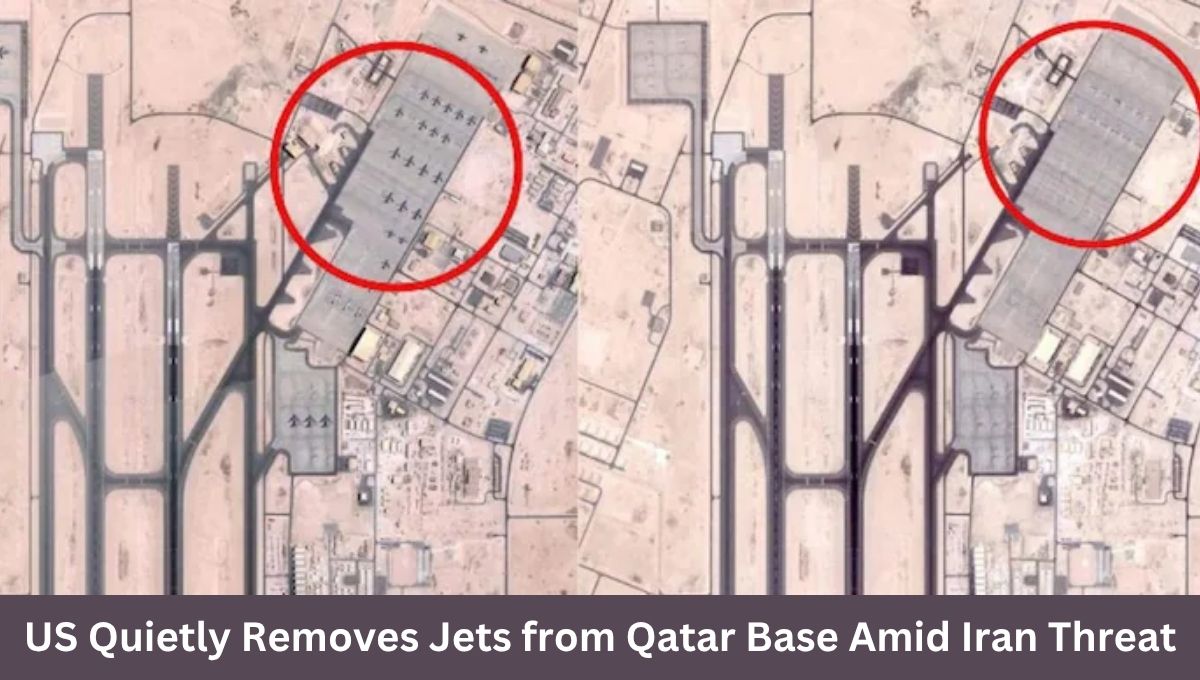
As Iran and Israel conflict intensifies, US Quietly Removes Jets from Qatar Base Amid Iran Threat. The United States has quietly removed nearly 40 military aircraft from Al Udeid Air Base in Qatar, its largest installation in the Middle East, as satellite images show a dramatic decrease in aircraft presence between June 5 and June 19. Analysts suggest the move is a pre-emptive measure to shield US assets from potential Iranian strikes, as regional hostilities between Iran and Israel intensify and the White House deliberates possible military intervention.
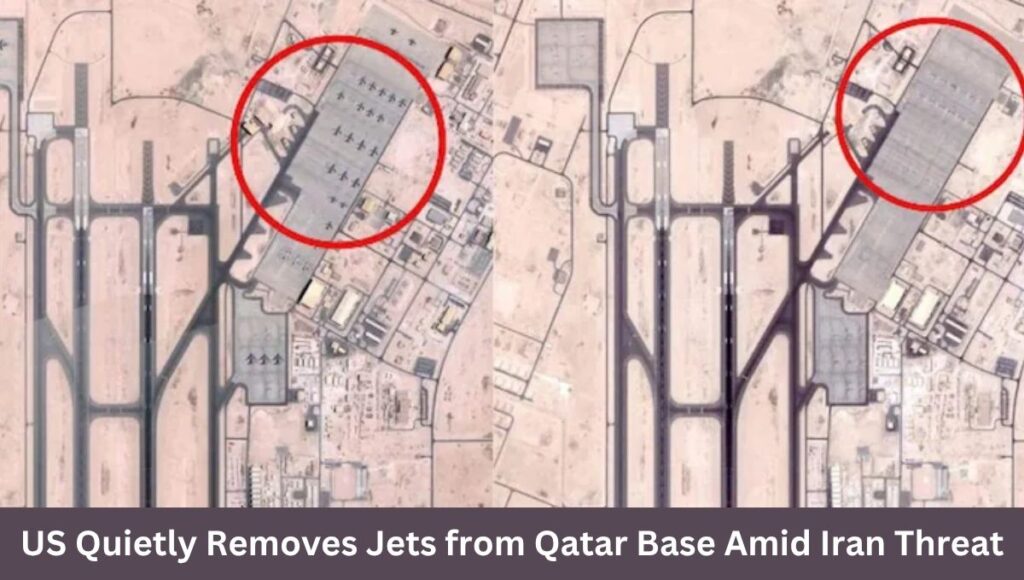
US Quietly Removes Jets from Qatar Base Amid Iran Threat
Satellite Images Reveal Major Drawdown at Al Udeid Air Base
High-resolution satellite images from Planet Labs PBC, analyzed by AFP, show that where roughly 40 US military aircraft including C-130 Hercules transport planes and reconnaissance jets once sat in plain view on June 5, only three aircraft remained by June 19.
The stark contrast has triggered speculation about the strategic motivations behind the sudden withdrawal. This mass relocation, occurring without public fanfare, has raised questions among defense experts and foreign policy watchers.
Given Al Udeid Air Base’s proximity to Iran, the move is widely seen as a calculated effort to minimize risk to US forces and equipment in the event of an Iranian counterattack.
US Embassy Confirms Security Measures and Limited Access
On Thursday, the US Embassy in Qatar confirmed increased security protocols, noting that access to the base is now restricted “out of an abundance of caution and in light of ongoing regional hostilities.” Personnel have also been urged to “exercise increased vigilance.”
Though no official military statement has been made regarding the aircraft’s final destinations, analysts believe they were either moved into hangars or relocated to other bases across Europe and the Middle East.
Flight Data Points to Possible Redeployment Strategy
Public flight tracking data, reviewed by AFP, offers further insight into the relocation. Between June 15 and 18, at least 27 military refueling aircraft, including KC-46A Pegasus and KC-135 Stratotanker planes, flew from the United States to Europe.
As of June 19, 25 of those aircraft remained in Europe, suggesting preparations for potential long-range missions or positioning to support a future US air campaign in the region.
These tankers are crucial for mid-air refueling, enabling extended reach for combat and surveillance aircraft over Middle Eastern airspace.
Strategic Caution as Iran Threatens Retaliation
The move comes as tensions escalate between Iran and Israel, with the US caught in a delicate balancing act. Iran’s government has repeatedly warned of “significant and irreversible repercussions” if US military installations in the Gulf are used in any attack against it.
With 40,000 US troops currently stationed across the region up from the usual 30,000 Pentagon officials remain tight-lipped about further force adjustments but have indicated that forces are on high alert and ready to respond as the situation evolves.
Trump’s Decision on Military Action Expected Soon
Amid this heightened military activity, US President Donald Trump is said to be weighing a decision on whether to support Israel’s military efforts against Iran. According to White House press secretary Karoline Leavitt, Trump plans to decide within two weeks.
“Based on the fact that there’s a substantial chance of negotiations that may or may not take place with Iran in the near future, I will make my decision whether or not to go within the next two weeks,” Leavitt quoted Trump as saying.
This announcement follows increased Israeli pressure, particularly after Israeli Defense Minister Israel Katz publicly stated that Iran’s Supreme Leader Ayatollah Ali Khamenei “cannot continue to exist.” Such rhetoric has only intensified fears that a broader regional war could be on the horizon.
Al Udeid’s Vulnerability in Focus
Mark Schwartz, former US Army lieutenant general and current defense analyst at the RAND Corporation, noted that Al Udeid’s proximity to Iran makes it a high-risk target.
“Even shrapnel from a missile strike could render the aircraft non-mission capable,” Schwartz said, emphasizing that the US military’s first priority must be to protect its assets and personnel.
This vulnerability likely played a key role in the decision to remove aircraft from open tarmacs and potentially reposition them further afield.
Past and Present Force Movements in the Region
The US military presence in the Middle East has surged in recent months. In October, troop numbers spiked to 43,000 amid escalating conflict in Gaza and Houthi attacks on commercial vessels in the Red Sea.
The current deployment of 40,000 suggests Washington is once again preparing for rapid response scenarios should hostilities escalate. An additional US aircraft carrier is reportedly en route to the region, further signaling a possible escalation of US military posture.
Iran’s Warning and Israel’s Persistence
Iranian officials, responding to Trump’s delay in making a final decision, have maintained that any US involvement would result in direct attacks on American bases.
Meanwhile, Israel has made clear that it will continue striking Iranian facilities regardless of whether the US joins in.
Israeli Prime Minister Benjamin Netanyahu stated this week that Israel is “capable of eliminating all of Iran’s nuclear infrastructure” with or without US backing.
This aligns with Israel’s recent wave of strikes targeting Iranian military and nuclear sites, which Tehran claims have already triggered casualties and damage to civilian infrastructure, including a hospital.
A Strategic Pause or Prelude to War?
As of now, the removal of aircraft from Al Udeid Air Base appears to be both a defensive precaution and a signal of preparation.
Whether it serves as a pause before possible diplomacy or a strategic prelude to full-scale military intervention, remains to be seen.
The next two weeks could prove decisive not just for US foreign policy, but for the stability of the entire Middle East.
Conclusion: The Gulf Braces for What Comes Next
The withdrawal of US military aircraft from Qatar is just the latest move in a region gripped by uncertainty. With threats flying from all sides and decisions hanging in the balance, Gulf nations, American allies, and global powers are watching closely.
Whether diplomacy prevails or war ignites, the events unfolding at Al Udeid Air Base mark a clear warning: the stakes in the Iran-Israel conflict are growing, and the US is already preparing for the fallout.
Also Read: Israel Strikes Iranian Airfields, Destroys 15 Jets and Missile Sites Amid Escalating Conflict
Also Read: Where Iran could hit back: US bases and assets now in Tehran’s crosshairs after Trump strike
Related Posts:
- Iran Missile Strike Hits US Air Base in Qatar,…
- Afghanistan–Pakistan War 2025: Inside the 48-Hour Ceasefire

- 7 Powerful Measures: Trump Sanctions Russian Oil…

- 11 Explosive Revelations From Ted Cruz’s Leaked…

- In 8 Moves, EU Targets China-Linked Refineries and…

- Trump’s 20-Point Gaza Peace Plan Gains Urgent Global…
