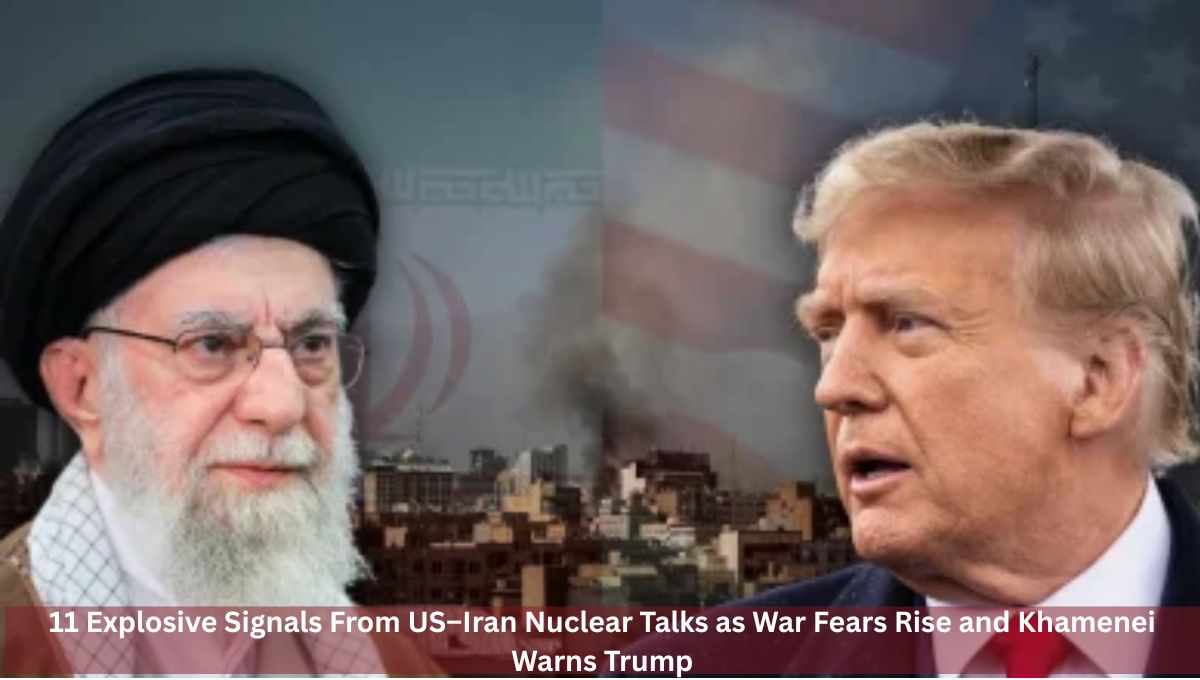
11 Explosive Signals From US–Iran Nuclear Talks as War Fears Rise and Khamenei Warns Trump amid a major US military buildup. The United States and Iran have launched a fresh round of indirect nuclear negotiations in Geneva, reviving long-stalled diplomacy at a moment when the Middle East is facing one of its most dangerous escalations in years.
The talks come under the shadow of recent US and Israeli strikes on Iranian nuclear facilities, an expanding US military footprint in the region, Iranian military drills in the Strait of Hormuz, and a barrage of warnings from Iran’s Supreme Leader Ayatollah Ali Khamenei, who has bluntly told US President Donald Trump that attempts to destroy the Islamic Republic would fail.
For global markets, energy security planners, and regional powers, the Geneva talks represent a last diplomatic off-ramp before the risk of a wider military confrontation increases dramatically.
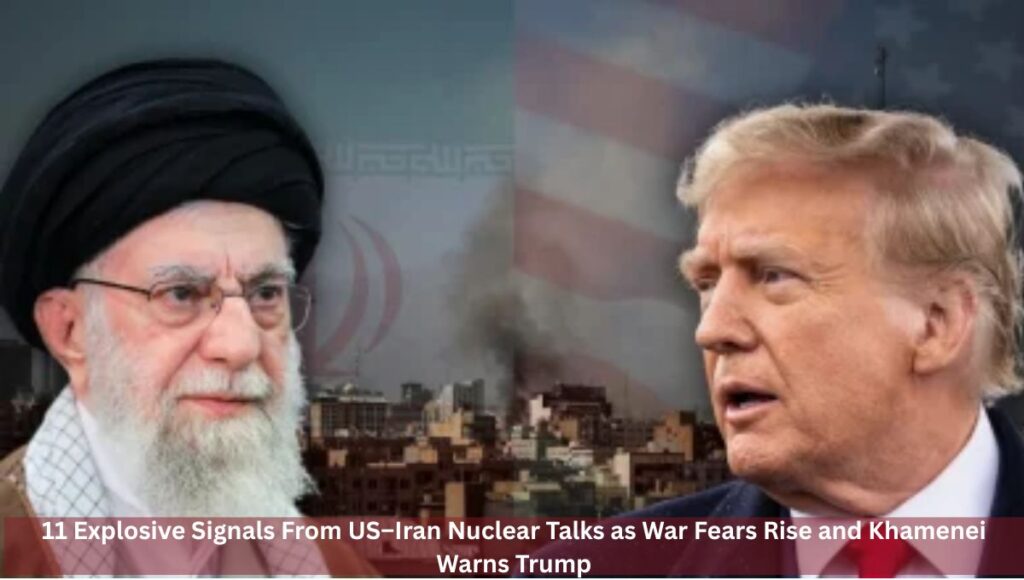
11 Explosive Signals From US–Iran Nuclear Talks as War Fears Rise and Khamenei Warns Trump
Why the Geneva Talks Matter Now
These negotiations are not taking place in a vacuum.
They follow:
- June airstrikes by the US and Israel on Iranian nuclear targets
- Heightened rhetoric around regime change in Tehran
- A surge in US naval and air deployments across the Middle East
- Iranian threats to disrupt global oil shipping routes
Taken together, they underscore how fragile the strategic balance has become.
The talks are being mediated by Oman, a long-time regional interlocutor trusted by both Washington and Tehran, and are being held at the residence of the Omani ambassador in Geneva under heavy security.
Who Is at the Negotiating Table
The US Delegation
Washington is being represented by Middle East envoy Steve Witkoff and Jared Kushner, according to sources briefed on the talks.
President Trump has said he is involved “indirectly,” suggesting the talks carry strong White House backing even as he maintains a public posture of pressure.
The Iranian Side
Iran’s delegation is led by Foreign Minister Abbas Araqchi, who has described the goal as achieving a “fair and equitable deal” while making clear that Iran will not negotiate “under threats.”
Khamenei’s Stark Warning to Trump
Just as talks got underway, Iranian media published a series of statements from Supreme Leader Khamenei that sharply escalated the rhetoric.
“The US President says their army is the world’s strongest,” Khamenei said. “But even the strongest army in the world can sometimes be struck so hard it cannot get up again.”
In further remarks and social media posts, he warned that US warships deployed near Iran could be sunk, signalling Tehran’s readiness to retaliate if diplomacy fails.
The message was unmistakable:
Iran sees the negotiations as taking place under coercion—and rejects that framework outright.
The US Military Buildup in the Middle East
The diplomacy unfolds alongside a visible and expanding US military presence:
- Deployment of B-2 stealth bombers
- Two US aircraft carriers in or en route to the region
- Expanded naval patrols in the Persian Gulf
Satellite imagery has confirmed the presence of the USS Abraham Lincoln, while reports indicate that the USS Gerald R. Ford, the world’s largest warship, is also being dispatched.
US officials have privately acknowledged preparations for weeks of sustained operations should diplomacy collapse.
Iran’s Response: Drills in the Strait of Hormuz
Iran has responded to the military pressure with live-fire naval drills in the Strait of Hormuz, through which roughly one-fifth of the world’s oil supply passes.
The drills are being led by the Islamic Revolutionary Guard Corps, and include scenarios focused on “smart control” of the strategic waterway.
Even temporary disruptions in the Strait can send shockwaves through global energy markets—making the drills a powerful signal to oil-importing nations worldwide.
Oil Markets Watch Closely
Despite the tension, Brent crude prices edged lower in early Asian trading as investors weighed the likelihood of actual supply disruptions against hopes that diplomacy could succeed.
Energy analysts warn, however, that markets are pricing in optimism, not certainty. A breakdown in talks—or a single miscalculation at sea—could reverse sentiment overnight.
The Core Dispute: Nuclear Enrichment
At the heart of the Geneva talks is a familiar but unresolved disagreement:
- The US and Israel believe Iran seeks a nuclear weapon
- Iran insists its program is peaceful and civilian
Iran has enriched uranium far beyond levels required for power generation, approaching weapons-grade thresholds—raising alarm in Washington, Tel Aviv, and European capitals.
Iran, for its part, argues that enrichment is a sovereign right guaranteed under the Non-Proliferation Treaty, to which it is a signatory.
Israel’s Position and Nuclear Ambiguity
Israel, which is not a signatory to the NPT, neither confirms nor denies possessing nuclear weapons—a long-standing policy of strategic ambiguity.
Scholars widely believe Israel acquired nuclear capability decades ago, a reality often referenced indirectly in Israeli media due to military censorship rules.
This asymmetry remains a core grievance for Iran, which argues that regional nuclear rules are applied selectively.
Sanctions: Iran’s Red Line
A senior Iranian official told Reuters that progress in Geneva depends on two conditions:
- No “unrealistic demands” from Washington
- Credible steps toward lifting crippling sanctions
Sanctions have severely constrained Iran’s oil exports, weakened its currency, and fuelled domestic unrest tied to rising living costs.
Tehran insists that any nuclear concessions must be matched by tangible economic relief, not promises.
Washington Wants More Than Nuclear Limits
The US has sought to broaden the talks to include:
- Iran’s ballistic missile program
- Regional military activities
Iran has rejected this outright, calling its missile arsenal “non-negotiable” and essential for deterrence after repeated attacks on its territory.
Foreign Minister Araqchi has been explicit:
missiles are off the table.
Marco Rubio: “It’s Going to Be Hard”
US Secretary of State Marco Rubio acknowledged the difficulty of the negotiations while maintaining cautious optimism.
“I think there’s an opportunity here,” Rubio said. “But I don’t want to overstate it. It’s going to be hard.”
His remarks reflect a broader recognition in Washington that military pressure alone has not resolved the Iran issue.
Lessons From the JCPOA
Past diplomacy offers mixed lessons. The Joint Comprehensive Plan of Action (JCPOA) temporarily curbed Iran’s nuclear activity before the US withdrew and reimposed sanctions.
Supporters say the deal delayed Iran’s nuclear progress; critics argue it failed to address missiles and regional influence.
The Geneva talks are, in many ways, an attempt to salvage diplomacy without repeating past mistakes.
Domestic Pressure Inside Iran
The talks come as Iran’s leadership faces internal strain:
- Street protests over economic hardship
- Heavy security crackdowns
- Rising public frustration
Analysts note that sanctions relief could ease domestic pressure—making diplomacy strategically attractive for Tehran despite its defiant rhetoric.
Why the Risk of War Is Real
The danger lies not only in policy disagreement but in compressed timelines and military proximity:
- Warships operating in narrow waters
- Aircraft carriers within striking range
- Missile forces on high alert
History shows that under such conditions, miscalculation can be as dangerous as intent.
What Success Would Look Like
A viable outcome would likely involve:
- Caps on uranium enrichment
- Expanded inspections by the International Atomic Energy Agency
- Phased sanctions relief
- De-escalation measures in regional waterways
Anything short of that risks prolonging uncertainty.
What Failure Could Trigger
If talks collapse, scenarios include:
- Expanded US-Israeli strikes
- Iranian retaliation through proxies
- Disruption of global oil shipping
- Sharp energy price spikes
For Europe, Asia, and developing economies alike, the consequences would be immediate.
Conclusion: Diplomacy on a Knife’s Edge
The Geneva talks represent a high-risk gamble for both sides. For Washington, they are a chance to avoid another Middle East war.
For Tehran, they are a test of whether pressure can be translated into relief without surrendering sovereignty.
As Ayatollah Khamenei’s warnings echo and US warships loom offshore, one reality is clear:
the margin for error has never been thinner.
Whether Geneva becomes a turning point—or merely a pause before escalation—will shape global security far beyond Iran and the United States.
Also Read: 7 Explosive Moments as US Jet Shoots Down Iran Drone Near Aircraft Carrier
Also Read: ‘World’s strongest Army can be slapped so hard it can’t get up’: Khamenei warns Trump