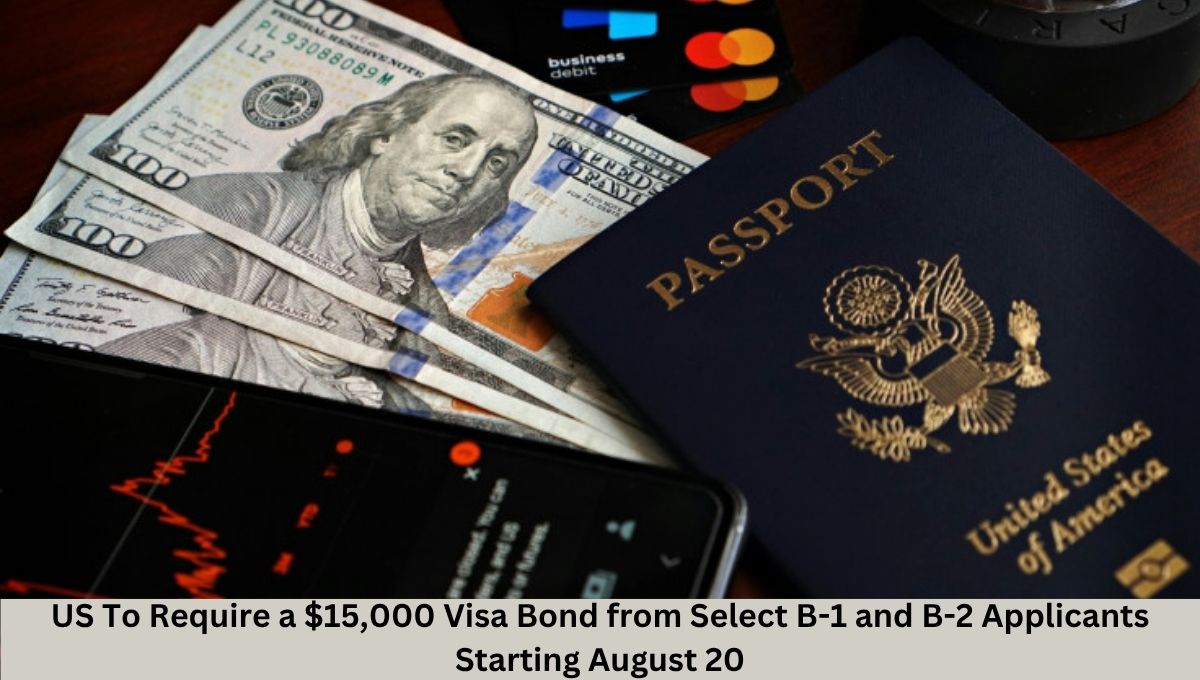
Marking a new era of travel costs, the US to Require a $15,000 Visa Bond from Select B-1 and B-2 Applicants Starting August 20.In a significant move aimed at curbing visa overstays and tightening immigration enforcement, the United States will soon require visa bonds of up to $15,000 from certain applicants of B-1 (business) and B-2 (tourist) visas.
The pilot program is set to begin on August 20, 2025, and will run for 12 months, according to an official notice published in the Federal Register. This new requirement is part of President Donald Trump’s broader immigration agenda in his second term, aiming to crack down on visa overstays and hold foreign visitors accountable under US immigration law.
US To Require a $15,000 Visa Bond from Select B-1 and B-2 Applicants Starting August 20
What Is the US Visa Bond Pilot Program?
The visa bond pilot program gives consular officers the discretion to require bonds of $5,000, $10,000, or $15,000 from visa applicants who are deemed to pose a high risk of overstaying their permitted duration of stay in the United States.
The standard bond amount is expected to be $10,000, unless specific risk factors or country conditions justify a higher bond.
If the visa holder complies with all visa conditions and departs the US on time, the bond will be fully refunded. If not, the bond will be forfeited.
This move adds a financial enforcement mechanism to the nonimmigrant visa system, targeting visitors from countries with high overstay rates, screening deficiencies, or citizenship-by-investment programs with minimal residency requirements.
Who Will Be Affected by the Visa Bond Rule?
While the final list of countries has not been officially released, past data from the Department of Homeland Security (DHS) and Customs and Border Protection (CBP) suggests likely targets.
These are countries with historically high visa overstay rates and poor cooperation with US authorities. They include:
- Chad
- Eritrea
- Haiti
- Myanmar
- Yemen
- Burundi
- Djibouti
- Togo
The US government has cited these countries in previous reports and executive orders for immigration noncompliance or national security risks.
Many were also included in Trump’s earlier travel ban list during his first term.
Background: A Trump-Era Policy Revived
The idea of a visa bond requirement was initially proposed in November 2020, near the end of Trump’s first presidency.
Although officially announced, it was never fully implemented due to the COVID-19 pandemic and plummeting global travel volumes.
With Trump back in the White House and making immigration enforcement a top priority, the visa bond policy has been revived and strengthened.
According to the State Department, the program is intended to test whether such a financial requirement is effective in reducing overstays and promoting compliance with US immigration laws.
The agency will collaborate with the Department of Homeland Security and the Department of the Treasury for enforcement and processing.
Visa Bond Process: How It Will Work
Applicants flagged under this pilot program will be informed during their visa interview that they must post a bond as a condition of visa issuance.
Key aspects of the process include:
- Bond Amounts: $5,000, $10,000, or $15,000 based on risk.
- Discretionary Authority: US consular officers abroad will determine whether to impose the bond.
- Designated Entry/Exit Points: Bonded travelers may be restricted to using only certain US airports or ports of entry.
- Refund Conditions: Full refund if the traveler leaves the US on time and complies with visa terms.
The Visa Integrity Fee: An Additional Cost
Alongside the bond program, a separate Visa Integrity Fee of $250 will go into effect starting October 1, 2025.
This amount is refundable if the traveler complies with visa conditions but adds another financial layer to the already costly process of visiting the US.
With these changes, the US will have one of the highest visa fees in the world, according to the US Travel Association.
Broader Context: Trump’s Renewed Immigration Crackdown
The visa bond initiative is part of a larger immigration enforcement campaign under Trump’s renewed leadership.
Earlier in 2025, the administration reinstated a travel ban on multiple nations and introduced partial visa restrictions on others.
Full Travel Ban Countries:
- Afghanistan
- Iran
- Libya
- Somalia
- Sudan
- Yemen
Partial Restrictions:
- Cuba
- Laos
- Sierra Leone
- Venezuela
These countries face varying levels of immigration restrictions based on security risks, overstay rates, and lack of cooperation with US authorities.
Financial and Diplomatic Implications
The State Department has framed the visa bond rule as a “diplomatic tool” to encourage foreign governments to improve their vetting and identity verification procedures.
It also aims to promote bilateral cooperation on immigration enforcement.
However, human rights organizations and immigration experts are raising alarms over its financial and social impact, especially for citizens of economically disadvantaged countries.
Critics Call the Visa Bond Rule Discriminatory
Human rights advocates argue that the visa bond program discriminates against poorer nations, penalizing travelers who may not have the financial means to post such large bonds even if their travel purpose is entirely legitimate.
Immigration attorneys warn that leaving the decision to impose a bond to the discretion of individual consular officers creates inconsistency, confusion, and possible bias in visa adjudications.
“Requiring thousands of dollars upfront is a deterrent, not just to overstay risks but also to legitimate family visits, business trips, and tourism,” said an immigration lawyer based in Washington, D.C.
US Travel Industry Voices Concern
The US Travel Association, representing airlines, hotels, and tourism companies, has voiced concern about the chilling effect this policy could have on international travel.
The group estimates that while only about 2,000 travelers annually may be directly impacted, the indirect consequences could be much larger.
The policy sends a message that the US is becoming harder and more expensive to visit, at a time when transatlantic airfare has returned to pre-pandemic levels, but travel from Canada and Mexico is down 20% year-over-year.
Pilot Program Could Raise $20 Million
According to internal estimates cited in the program announcement, the 12-month visa bond initiative could generate up to $20 million in revenue if all bonds are posted and not refunded.
However, the government insists the program is not intended as a revenue generator, but as an enforcement tool.
High Stakes for Visa Compliance
This move comes amid a rising concern over nonimmigrant visa overstays, with an estimated 500,000 suspected overstays in fiscal year 2023.
Overstays complicate immigration enforcement and can undermine public trust in the visa system.
In the eyes of the Trump administration, this visa bond rule is a necessary step to protect national security, American jobs, and the rule of law.
Studies Dispute Security Claims
Critics have also challenged the national security justification for the crackdown. Studies by Oxford Economics and a 2024 report to the US House of Representatives show that both documented and undocumented immigrants commit crimes at lower rates than US citizens.
A 2021 study found that undocumented immigrants were 33% less likely to be incarcerated than native-born Americans, raising questions about the real risks posed by overstays.
What Happens Next?
The visa bond pilot program will launch on August 20, 2025, and will be reviewed after 12 months to assess its effectiveness.
The final list of countries will be released with at least 15 days’ notice before implementation.
Based on results, the US government may choose to expand, modify, or terminate the program.
Conclusion: High Price for Entry
The $15,000 visa bond program represents a turning point in US immigration enforcement blending financial pressure, border control, and diplomatic leverage.
While the Trump administration views it as a necessary deterrent, others see it as an economic barrier that disproportionately affects travelers from the Global South.
Whether this pilot program leads to better compliance or global backlash, one thing is certain: visiting the United States is about to get a lot more complicated and expensive.
Also Read: $15,000 visa bond rule for select travelers to enter US
Also Read: Germany Welcomes Indian STEM & Management Talent Amid US H-1B Visa Fee Hike