
In what may become a defining moment, UK and EU Seek Historic Reset in First Bilateral Summit Since Brexit. The United Kingdom and European Union are convening in London on Monday, May 19, 2025, for their first bilateral summit since Brexit. The historic meeting, hosted by UK Prime Minister Keir Starmer, signals an urgent push to reset UK-EU relations, focusing on trade, defence, mobility, and geopolitical cooperation.
This summit marks the most ambitious effort to repair UK-EU ties since Britain formally exited the EU in 2020. Starmer, who once backed Remain, is now leading a pragmatic recalibration aimed at re-engaging with Europe without reopening divisive Brexit wounds.
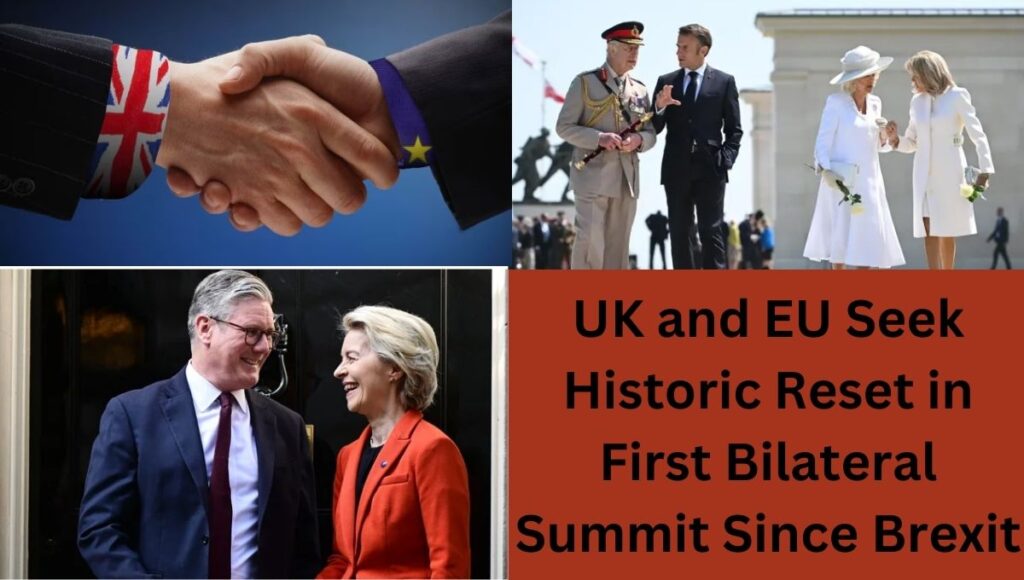
UK and EU Seek Historic Reset in First Bilateral Summit Since Brexit
Starmer’s Political Gamble: Resetting Brexit Without Backtracking
Keir Starmer is making a calculated political gamble by promoting a reset of Brexit-era relations. His strategy hinges on delivering economic and security gains that can outshine criticism from hardline Brexiters, particularly Nigel Farage and Reform UK.
“This new deal with Europe is good for our jobs, good for our bills, and good for our borders,” Starmer declared in an interview with The Times. His message is clear: pragmatism over ideology in an increasingly volatile world.
A Landmark Defence Pact and Access to €150 Billion EU Fund
At the heart of the summit lies a proposed UK-EU defence and security pact, prompted by Russia’s war in Ukraine and rising global instability.
The UK is pushing for access to the EU’s €150 billion defence loan scheme, which would allow British firms to compete for critical European rearmament contracts.
While some EU leaders, notably France’s Emmanuel Macron, have resisted, others like Germany and Poland support UK inclusion, emphasizing the UK’s strength in defence innovation.
“Britain is a serious player both in traditional defence capabilities and cutting-edge innovation,” notes Sophia Gaston, a defence expert at King’s College London.
Trade Reset: SPS Agreement Could Help UK Farmers and Lower Food Prices
The summit is also expected to produce new post-Brexit trade agreements that ease UK-EU commerce. Talks have focused on SPS (Sanitary and Phytosanitary) standards, with Britain seeking to reduce paperwork and border delays for food and agricultural exports.
This sector-by-sector approach could provide immediate relief to UK farmers struggling with post-Brexit trade barriers, and help bring down food prices for British consumers.
In return, the EU may request UK alignment with future EU food safety regulations a politically sensitive issue due to fears of creeping EU oversight.
Faster Travel: E-Gates Access for British Tourists and Business Travelers
On the mobility front, the UK is expected to secure improved access for British travelers at EU airports, including the use of fast-track e-gates. This would be a major win for UK tourists and business travelers, who have faced longer queues and stricter checks since Brexit.
Youth Mobility and Erasmus Programme Still Under Negotiation
One of the more contentious discussions centers on youth mobility. While the EU wants the UK to rejoin the Erasmus exchange programme, UK negotiators have proposed a more limited Youth Mobility Scheme similar to deals with Japan and Canada.
“Youth mobility is not freedom of movement,” Starmer emphasized, seeking to calm domestic fears around immigration while leaving room for a targeted, mutually beneficial agreement.
Germany has led efforts to push the UK toward accepting a youth deal, while migration-sensitive UK politics continue to complicate negotiations.
Fishing Rights: A Stubborn Flashpoint in UK-EU Relations
Fishing remains a symbolic and emotional flashpoint in the UK-EU relationship. France, along with Denmark and the Netherlands, is demanding a long-term extension for EU access to UK waters beyond the 2026 expiration date of the current deal.
Despite its small economic contribution, fishing holds outsized political importance, especially in coastal constituencies. A compromise here is crucial to securing broader trade and defence agreements.
Macron’s State Visit: Diplomacy Meets Royal Pageantry
In a gesture of palace diplomacy, the UK announced that French President Emmanuel Macron and his wife will receive a state visit in July, hosted by King Charles and Queen Camilla at Windsor Castle. The move is seen as an effort to soften France’s hardline stance ahead of the summit.
A Joint Declaration on Geopolitical Priorities
Alongside trade and defence, the UK and EU are expected to release a joint declaration outlining shared geopolitical priorities. These include:
- Continued support for Ukraine
- Sanctions on Russia
- Coordinated humanitarian efforts in Gaza
- Countering Chinese authoritarian influence
Analysts say that geopolitical pressures, particularly fears of a more isolationist United States under Donald Trump, have pushed the UK and EU closer together.
Germany Emerges as a Bridge Builder
Under new Chancellor Friedrich Merz, Germany is playing a key role in encouraging deeper UK-EU ties. Merz has stressed the importance of a unified European front, both economically and militarily, and sees Britain as an essential partner in that vision.
Mutual Recognition of Professional Qualifications
The summit is also expected to address mutual recognition of professional qualifications, making it easier for professionals especially healthcare workers, engineers, and creatives to work across borders. This is a practical step aimed at easing workforce gaps and improving bilateral cooperation.
Reform UK and Domestic Political Pressure
The summit takes place amid growing pressure from Reform UK, which made significant gains in recent local elections.
In response, Downing Street has toughened its migration rhetoric, proposing stricter residency rules and visa restrictions to placate Brexit voters.
Starmer must now balance diplomatic engagement with political optics at home—walking a tightrope between cooperation and sovereignty.
Challenges Ahead: Defence Spending, Sovereignty, and Political Trade-Offs
Despite progress, major challenges remain. Increased defence spending to meet EU security goals may divert funds from public services. Similarly, accepting EU oversight on trade and safety regulations could reignite debates over sovereignty and control.
Achieving a pan-European defence industrial base would also require tough economic compromises. While some businesses stand to benefit, others especially smaller national contractors could lose out.
Conclusion: A Symbolic Reset with Strategic Stakes
Monday’s UK-EU summit in London may not deliver dramatic changes overnight, but it marks a critical symbolic and strategic turning point.
For the first time since Brexit, the UK and EU are talking less about what divided them and more about what still binds them.
Whether through joint defence planning, eased trade barriers, or closer people-to-people ties, this summit underscores one clear message: in a fractured and volatile world, cooperation is back on the table.
As the final agreements are hammered out, the eyes of Europe and the world will be watching to see whether Starmer’s bold Brexit reset delivers on its promise of a new era in UK-EU relations.
Also Read: UK and EU Reset Ties with Historic Post-Brexit Deal Covering Trade, Defence, and Youth Mobility
Also Read: Military and economic deals in pipeline as UK looks to EU reset
Related Posts:
- UK and EU Reset Ties with Historic Post-Brexit Deal…
- 7 Powerful Measures: Trump Sanctions Russian Oil…

- 7 Critical Signals Behind Starmer’s Bold China Reset…
- In 8 Moves, EU Targets China-Linked Refineries and…

- 7 Powerful Truths: UAE Golden Visa vs Saudi Premium…

- Afghanistan–Pakistan War 2025: Inside the 48-Hour Ceasefire
