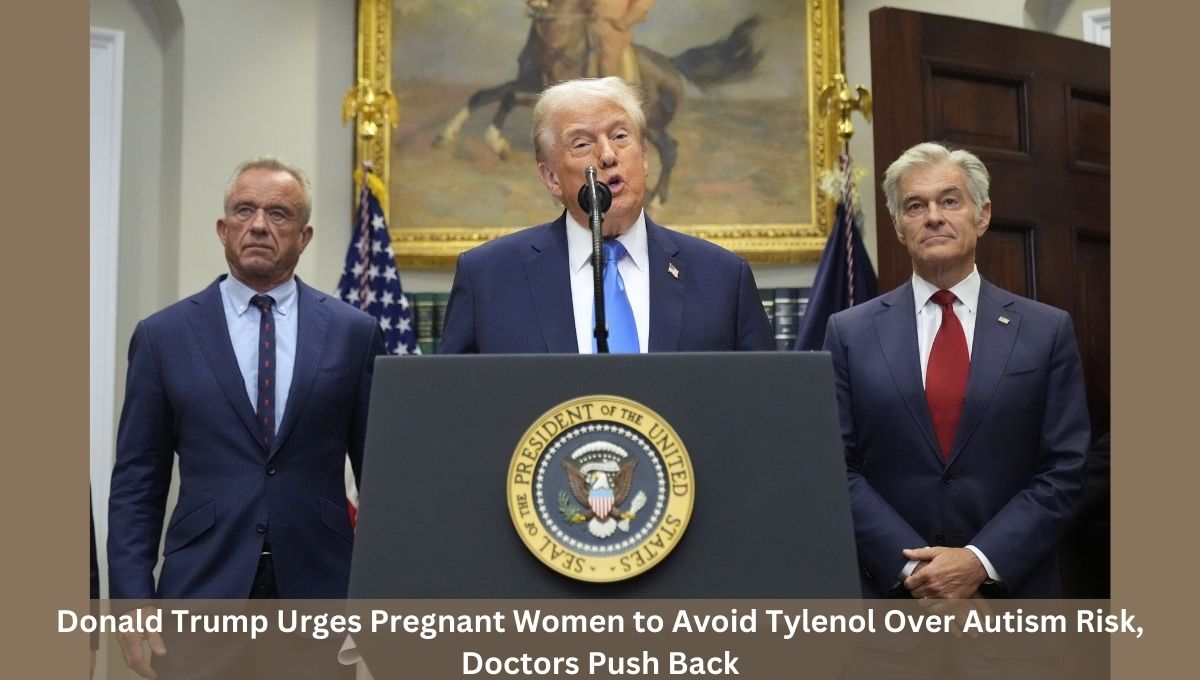
Donald Trump Urges Pregnant Women to Avoid Tylenol Over Autism Risk, Doctors Push Back, saying science does not support his claim. US President Donald Trump on Monday urged pregnant women to avoid Tylenol, saying its active ingredient acetaminophen may be linked to rising autism rates in the country.
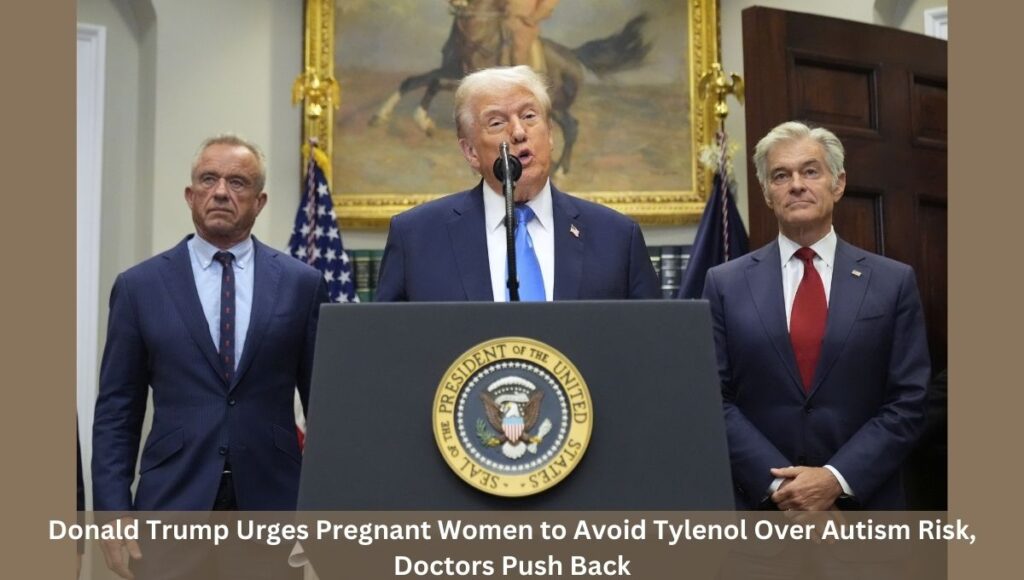
Speaking from the White House alongside Health Secretary Robert F. Kennedy Jr., Trump warned expectant mothers against using the popular over-the-counter painkiller “during the entire pregnancy.” He claimed his administration is “linking Tylenol’s active ingredient to autism” and advised women to seek alternatives.
“You should not take acetaminophen during the entire pregnancy,” Trump said at the briefing. “Don’t take Tylenol. Don’t take it. Fight like hell not to take it.”
The remarks marked the most direct intervention to date by the Trump administration in the debate over autism’s causes, echoing arguments long promoted by Kennedy and his “Make America Healthy Again” movement. Trump also cast doubt on childhood vaccines, suggesting that combined shots such as the MMR vaccine could pose risks.
The announcement drew swift condemnation from medical experts, who said the claims are unsupported and risk spreading confusion among expectant mothers.
Donald Trump Urges Pregnant Women to Avoid Tylenol Over Autism Risk, Doctors Push Back
What Medical Experts Say
Obstetricians Warn Against Fearmongering
Dr. Steven Fleischman, president of the American College of Obstetricians and Gynecologists (ACOG), cautioned that Trump’s claims could unnecessarily alarm pregnant women and parents of children with autism.
“I don’t want you going back and saying to yourself, ‘I shouldn’t have done this, I shouldn’t have done that.’ It’s nothing you did,” Fleischman said. “Not treating a fever probably has more adverse effects than taking the medication.”
ACOG reiterated that acetaminophen is considered safe for use during pregnancy when taken as directed, calling Trump’s comments “not backed by the full body of scientific evidence.”
Pediatricians Reject Link
Dr. Susan Kressly, president of the American Academy of Pediatrics (AAP), rejected suggestions that Tylenol causes autism.
“Studies have repeatedly found no credible link between life-saving childhood vaccines and autism. Any effort to misrepresent sound, strong science poses a threat to the health of children,” she said.
The AAP reaffirmed its guidance that acetaminophen remains an appropriate first-line treatment for fever and pain during pregnancy.
Autism Researchers Cite Lack of Evidence
Dr. Emily Carter, a child development researcher at Johns Hopkins University, said no evidence supports Trump’s claim.
“The evidence simply does not support a link between Tylenol use in pregnancy and autism,” she said. “Autism is influenced by a mix of genetic and environmental factors, but no single cause has been proven.”
David Mandell, associate director of the Center for Autism Research at the Children’s Hospital of Philadelphia, said evidence for leucovorin — a drug promoted by the administration as a potential autism therapy — is also weak. “A large-scale study has yet to be conducted,” he said, while noting his Coalition of Autism Scientists supports such research.
Tylenol Manufacturer Responds
Tylenol, first introduced in 1955 by McNeil Laboratories, is today manufactured by Kenvue, an independent consumer health company formerly part of Johnson & Johnson. Its portfolio also includes Band-Aid, Neutrogena, Aveeno, Benadryl, and Listerine.
In a statement, Kenvue rejected Trump’s assertions.
“We believe independent, sound science clearly shows that taking acetaminophen does not cause autism. We strongly disagree with any suggestion otherwise and are deeply concerned with the health risk this poses for expecting mothers,” the company said.
The firm noted that untreated fever during pregnancy carries its own risks, including miscarriage and preterm birth, and warned that discouraging Tylenol use could push women toward riskier alternatives.
Kenvue added that the US Food and Drug Administration (FDA) has found no clear evidence linking appropriate acetaminophen use in pregnancy with negative outcomes.
FDA and Administration Plans
At the briefing, Kennedy said the FDA will:
- Issue a notice to physicians on potential risks of acetaminophen in pregnancy.
- Begin the process of updating Tylenol’s safety label.
- Launch a public health campaign on the subject.
Trump also announced that the FDA has begun approving leucovorin calcium tablets as a possible autism treatment. Traditionally used to protect cancer patients during chemotherapy, leucovorin is based on a theory that low folate levels in the brain may contribute to autism symptoms.
FDA Commissioner Marty Makary said approval would rely on research suggesting leucovorin could improve verbal communication in some autistic children, though experts stressed more robust studies are needed.
What Is Leucovorin?
Leucovorin, also known as folinic acid, is a metabolite of folic acid, a vitamin B compound routinely recommended before and during pregnancy to prevent birth defects.
Some studies have suggested that mothers who take folic acid around conception may reduce their child’s likelihood of developing autism by 30–70%. However, other studies found no significant effect.
Small clinical trials of leucovorin in autistic children have shown mixed results. A 2016 US study of 48 children found improvements in verbal communication compared to placebo, but researchers caution the findings are preliminary.
The Autism Science Foundation said much more research is required before leucovorin can be considered a treatment.
Autism, Genetics, and Environment
Experts emphasize that autism spectrum disorder (ASD) has no single cause. Research suggests a combination of genetic predispositions and environmental factors, though no definitive link has been found with any one substance.
Autism prevalence in the US has risen sharply, with the Centers for Disease Control and Prevention (CDC) reporting that 2.77% of 8-year-olds had been diagnosed with ASD by 2020. Experts attribute part of the increase to broader diagnostic criteria and greater awareness.
Dr. Monique Botha, a professor of social and developmental psychology at Durham University, said “there is no robust evidence or convincing studies to suggest there is any causal relationship” between acetaminophen and autism.
Trump’s Claim on the Amish
During the briefing, Trump also claimed that “the Amish essentially have no autism.”
The Amish are a conservative Christian community known for rejecting modern technology. While early studies suggested autism may be less prevalent in Amish populations, a 2010 study found autism does exist in Amish children, with an estimated rate of 1 in 271 compared to the then-national average of 1 in 54.
Researchers said cultural norms and reporting differences may affect diagnosis, stressing that autism is not absent in Amish communities.
Contradictory Studies on Tylenol and Autism
Studies Suggesting a Possible Link
A 2023 review led by Harvard University’s Chan School of Public Health argued that children exposed to Tylenol in utero may have higher risks of autism and other neurodevelopmental disorders. The researchers suggested limiting use but acknowledged acetaminophen remains important for treating maternal fever.
Studies Finding No Link
By contrast, a 2024 Swedish population study of 2.4 million children born between 1995 and 2019 found no relationship between prenatal acetaminophen exposure and autism, ADHD, or intellectual disability.
Sibling comparison analysis reinforced the findings, suggesting no increased risk could be definitively linked to the drug.
Also Read: Trump Issues Tylenol Warning: Autism Causes, Cuba Claim, and the Vaccine Debate
Expert Pushback Against Trump
Arthur Caplan, a bioethicist at NYU Grossman School of Medicine, described the Trump administration’s briefing as “hugely negative” for public health.
“The big reveal about autism was a total bust full of misinformation, a lack of evidence, bad advice and a bogus answer about the cause,” Caplan said.
Catherine Lord, a professor of psychiatry at UCLA, said existing studies on acetaminophen and autism suffer from confounding factors. “I think the medical community will be firm that Tylenol in pregnancy does not cause autism,” she said.
Also Read: Trump and RFK Jr. link autism to Tylenol, and doctors push back: Takeaways
What Pregnant People Should Know
Major medical organizations reaffirmed their guidance Monday:
- ACOG: Acetaminophen is safe to use in pregnancy and remains a first-line treatment.
- Society for Maternal-Fetal Medicine: Acetaminophen is appropriate for treating pain and fever.
- AAP: The drug remains among the safest options for expectant mothers.
Experts warn that untreated fevers — especially during the first trimester — can raise risks of miscarriage, congenital heart defects, and neural tube defects. Some research even suggests fever itself may be a stronger risk factor for neurodevelopmental disorders than the medication used to treat it.
Dr. Allison Bryant, an ob/gyn at Massachusetts General Hospital, said providers sometimes use acetaminophen diagnostically. “If someone has a headache in pregnancy, we oftentimes want to know that it’s not associated with high blood pressure,” she explained.
The Bigger Picture
The Trump administration’s remarks come as US autism policy faces growing influence from Kennedy and his allies. The CDC’s immunization panel has seen appointments critical of vaccines, while federal health agencies face pressure to reconsider longstanding guidance.
Experts say the politicization of autism research risks undermining public trust in science.
“The most important thing that was said during that conference today is that autism is complex with a multi-factorial etiology,” said Dr. James McPartland, director of the Yale Developmental Disabilities Clinic. “What that means is that autism is complicated, and there’s not one cause.”
Conclusion
Trump’s call for pregnant women to avoid Tylenol over an alleged autism risk has placed America’s best-selling painkiller at the center of a high-stakes political and medical debate.
While his administration prepares to issue warnings and pursue leucovorin as a potential treatment, medical groups stress that decades of research show no proven link between acetaminophen and autism.
Experts say pregnant women should continue consulting their doctors, weigh risks and benefits, and not be swayed by unproven claims. As Dr. Fleischman of ACOG put it: “Not treating the fever probably has more adverse effects that you need to worry about than taking the medication.”