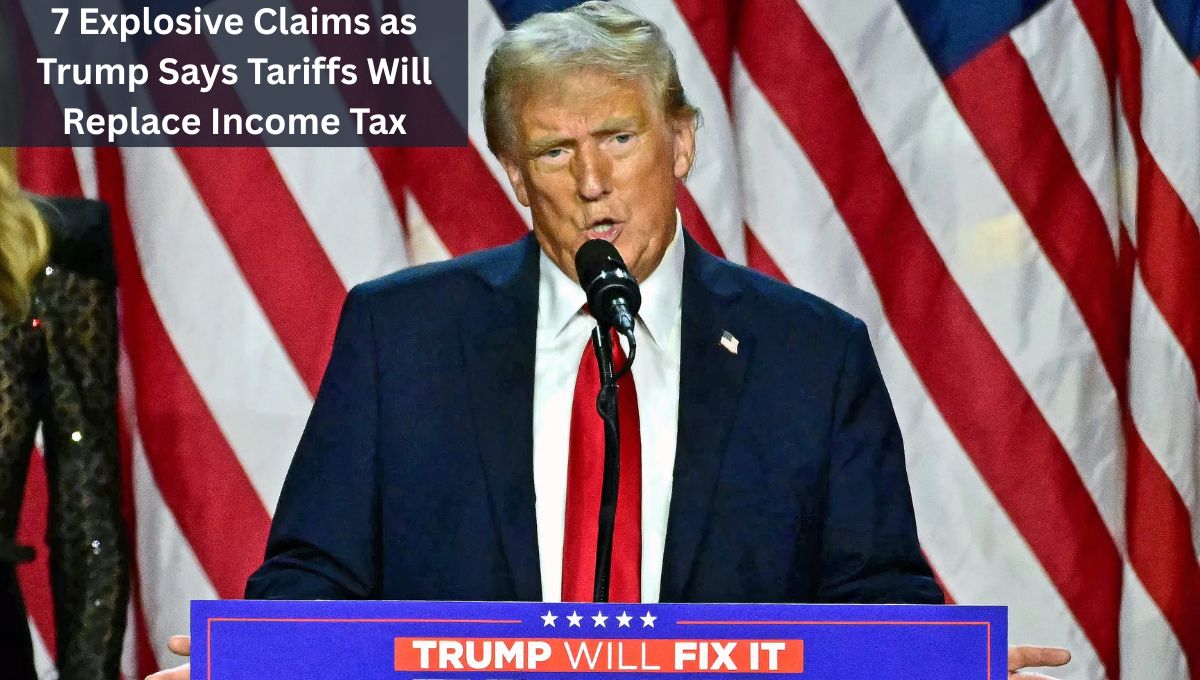
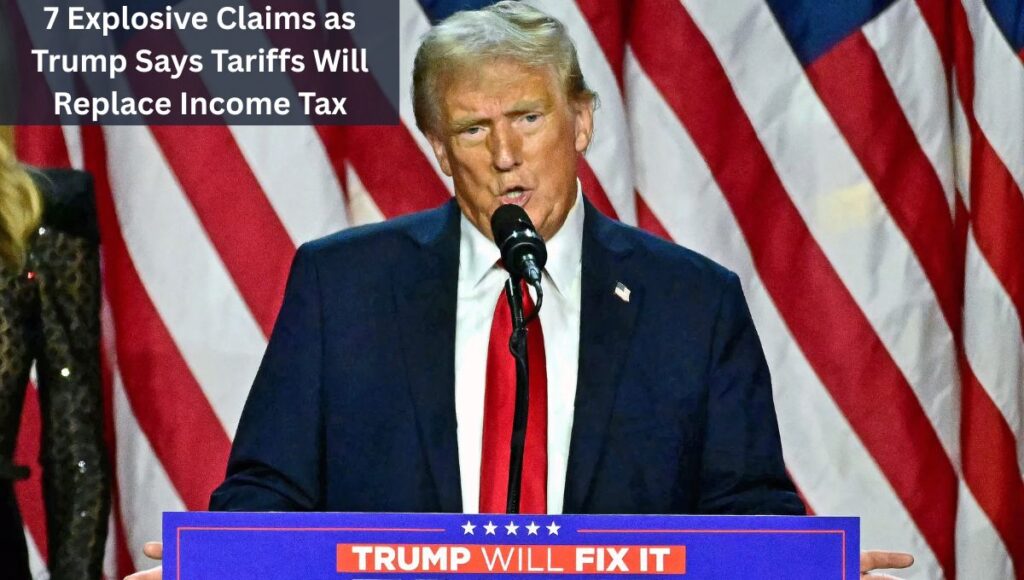
7 Explosive Claims as Trump Says Tariffs Will Replace Income Tax after supreme court setback. US President Donald Trump has once again placed tariffs at the center of his economic worldview—this time making one of the boldest claims of his political career:
that tariffs paid by foreign countries could eventually replace America’s income tax system.
Delivering his first State of the Union address of his second term, Trump defended his sweeping trade actions just days after a stinging setback from the US Supreme Court, which ruled that many of his emergency tariffs were unlawful.
The speech, the legal ruling, and Trump’s immediate counter-move—imposing a new global tariff under alternative laws—have together triggered renewed uncertainty across global markets, rattled trade partners from India to the European Union, and reignited debate over who actually pays tariffs.
This article breaks down Trump’s claims, the legal reality, the economic consequences, and what it all means for the world.
7 Explosive Claims as Trump Says Tariffs Will Replace Income Tax
Trump’s Core Claim: Tariffs Instead of Income Tax
At the heart of Trump’s argument is a simple but controversial assertion:
foreign countries pay tariffs, not Americans.
“As time goes by, I believe that tariffs, paid for by foreign countries, will, like in the past, substantially replace the modern-day system of income tax, taking a great financial burden off the people that I love,” Trump said.
Trump framed tariffs not merely as trade tools but as a revenue engine, suggesting that the US could shift away from taxing its own citizens toward taxing imports.
Why Trump Believes Tariffs Work
According to Trump, tariffs have already:
- Generated hundreds of billions of dollars in revenue
- Forced countries into one-sided trade deals favorable to the US
- Strengthened national security leverage
- Delivered growth without inflation, in his words
Trump pointed to past negotiations where he claimed trading partners “caved” under tariff pressure, agreeing to deals they would not otherwise accept.
Reality Check: Who Actually Pays Tariffs?
While tariffs are legally paid by importers, most economists agree that the cost is largely passed on to:
- Consumers, through higher prices
- Businesses, through squeezed margins
- Supply chains, through reduced efficiency
Studies cited after the Supreme Court ruling estimate that Americans paid over $130–175 billion in higher costs under Trump’s now-invalidated tariffs.
This disconnect—between Trump’s framing and economic consensus—sits at the core of the controversy.
The Supreme Court Blow That Changed Everything
Just days before Trump’s speech, the Supreme Court delivered a 6–3 ruling striking down most of his global tariffs imposed under the International Emergency Economic Powers Act (IEEPA) of 1977.
The Court held that:
- Congress, not the President, holds primary taxing authority
- Declaring a trade deficit a “national emergency” exceeded executive power
Chief Justice John Roberts wrote that the Constitution “very clearly” assigns taxation to Congress.
Trump called the ruling “unfortunate” and accused parts of the Court of undermining American strength.
Trump’s Immediate Counterattack: New Tariffs Anyway
Rather than retreat, Trump pivoted aggressively.
Within hours of the ruling, he:
- Halted the invalidated tariffs
- Announced a new 10% global tariff under Section 122 of the Trade Act of 1974
- Signaled the rate would rise to 15%, the legal maximum
- Set a 150-day limit, unless Congress extends it
Trump insisted congressional approval was unnecessary and hinted that alternative statutes might be “even stronger” than before.
Why Section 122 Matters
Section 122 allows temporary tariffs to address:
- Serious balance-of-payments deficits
- Fundamental international payment problems
Trump’s order cited:
- A $1.2 trillion US goods trade deficit
- A current account deficit near 4% of GDP
However, many trade lawyers argue the US is not facing a balance-of-payments crisis, leaving the new tariffs vulnerable to fresh legal challenges.
Global Confusion: 10% or 15%?
Adding to uncertainty:
- US Customs initially began collecting 10% tariffs
- Trump publicly said the rate would rise to 15%
- No formal order was signed immediately
Markets reacted with volatility, global stocks dipped, and businesses struggled to plan amid shifting signals.
As one analyst put it:
“Pure tariff chaos.”
India in the Crosshairs: A Veiled Threat?
Trump’s post-ruling rhetoric quickly turned toward countries he accused of “ripping off” the US—language he has historically used against India.
Hours after an Indian trade delegation postponed a Washington visit, Trump warned on Truth Social:
“Any country that wants to ‘play games’… will be met with a much higher tariff.”
Though unnamed, timing and language led many to see India as a target.
Trump later said:
“Nothing changes. They’ll be paying tariffs… PM Narendra Modi was ripping us off, so we did a little flip.”
Why the Supreme Court Ruling Helps India
Ironically, the ruling strengthened India’s negotiating position.
Key factors:
- The invalidated 18% reciprocal tariff now lacks legal footing
- Trump’s new 15% cap is lower than India’s negotiated rate
- A clause in the interim deal allows renegotiation if tariffs change
This reopens space for India to:
- Revisit concessions
- Seek more balanced terms
- Avoid a rushed, optics-driven deal
Former officials argue India’s cautious approach has paid off.
Europe, the UK, and Others Also Hit Pause
India is not alone.
- The European Union paused ratification of its US trade deal
- The UK now risks seeing its 10% deal rise to 15%
- Japan, South Korea, and Indonesia face uncertainty over stacked tariffs
Several countries that made concessions now fear they may end up worse off than those that never negotiated.
Refunds: Will Americans Get Their Money Back?
The Court’s ruling raised a massive question:
what happens to the money already collected?
Key points:
- Over $175 billion in tariffs may be refundable
- Lawsuits are underway demanding refunds with interest
- Trump says refunds could take years in court
Democrats have seized on the issue ahead of midterms, calling tariffs an illegal tax on Americans.
Trump’s Political Calculation
Despite polling showing most Americans oppose tariffs, Trump appears undeterred.
Why?
- Tariffs fit his economic nationalism narrative
- They project strength to his political base
- They provide leverage without congressional negotiation
- They shift blame outward—to foreigners and courts
With midterm elections looming, tariffs are again central to Trump’s messaging.
Can Tariffs Really Replace Income Tax?
From a fiscal standpoint, most economists say no.
Consider:
- US income tax raises trillions annually
- Even peak tariffs cover only a fraction of that
- Higher tariffs risk inflation, retaliation, and slower growth
Replacing income tax would require tariff rates so high they could cripple global trade.
What Comes Next
Over the next 150 days, several outcomes are possible:
- New legal challenges to Section 122 tariffs
- Congressional resistance to extensions
- Renegotiated trade deals
- Partial refunds to importers
- Continued global uncertainty
Trump has promised “new and legally permissible tariffs,” signaling the trade fight is far from over.
The Bigger Picture
Trump’s tariff doctrine is no longer just about trade—it is about redefining taxation, executive power, and America’s role in the global economy.
Whether tariffs can truly “replace income tax” remains deeply contested.
But one thing is clear:
the tariff era is reshaping global commerce, alliances, and political debate in ways that will outlast court rulings and election cycles.
Bottom Line
Trump may have lost a legal battle at the Supreme Court, but the tariff war—at home and abroad—is very much alive.
Also Read: 5 Major Shockwaves as US Stops Collecting Trump Tariffs After Supreme Court Ruling