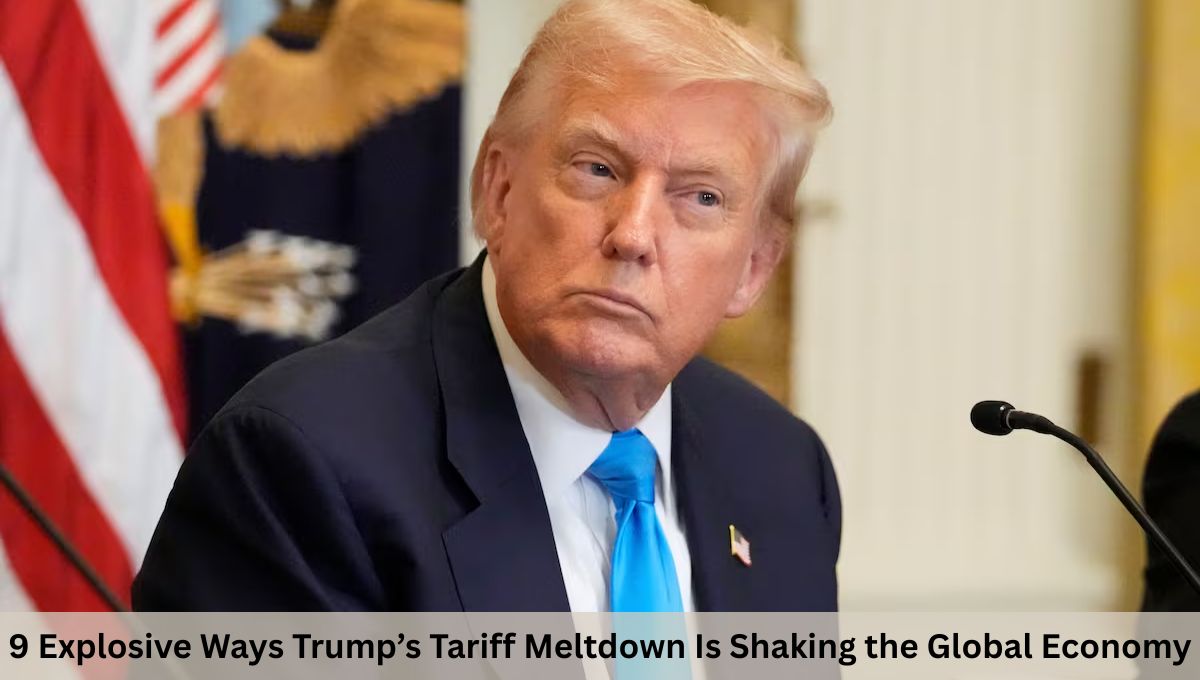
9 Explosive Ways Trump’s Tariff Meltdown Is Shaking the Global Economy while reshaping world trade. When Donald Trump declared that “America is WINNING again,” he was attempting to project strength at a moment of growing fragility in US trade policy. Standing beside the announcement of Japanese-backed investments tied to a mooted $550 billion trade framework, the US president framed tariffs as proof of dominance.
But within days, that narrative collapsed. A landmark ruling by the US Supreme Court struck down much of Trump’s sweeping tariff regime, ruling that he had overstepped his constitutional authority by using emergency powers to impose what amounted to new taxes.
The result is not clarity—but chaos.
From Europe to Asia, governments that scrambled to cut deals with Washington now face a flattened tariff regime, legal uncertainty, and the risk of renewed trade warfare. Markets are rattled. Diplomats are confused. And consumers—especially in the United States—are paying the price.
This is how Trump’s tariff strategy began to unravel—and why its aftershocks are now global.
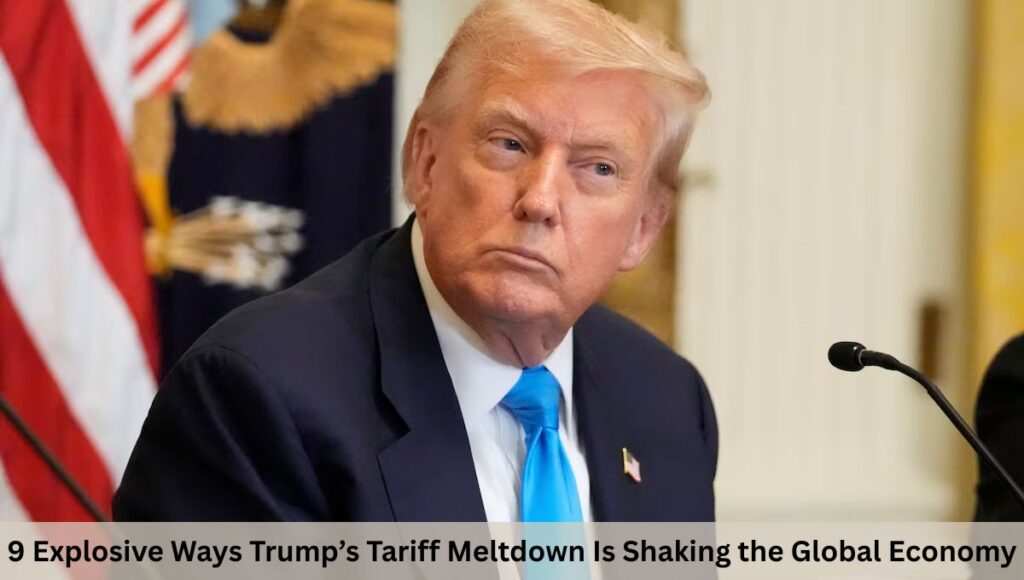
9 Explosive Ways Trump’s Tariff Meltdown Is Shaking the Global Economy
1. The Supreme Court Blow That Shattered Trump’s Trade Strategy
At the heart of the turmoil lies the court’s rejection of Trump’s use of the International Emergency Economic Powers Act (IEEPA) to justify tariffs on nearly every country in the world.
In a 6–3 decision, the court ruled that while IEEPA grants presidents broad authority to regulate commerce during emergencies, it does not authorize tariffs.
The power to tax—including import duties—rests squarely with Congress.
The ruling invalidated the legal foundation of Trump’s so-called “Liberation Day” tariffs, which imposed:
- A baseline 10% tariff on most countries
- “Reciprocal” tariffs of up to 50% on dozens of trading partners
The decision marked a constitutional rebuke—and a political humiliation for a president who has repeatedly styled himself as an unchallengeable economic strongman.
2. From Trade Mastery to Legal Scramble
Rather than recalibrating, Trump pivoted immediately.
Within hours of the ruling, he announced a temporary global tariff under Section 122 of the Trade Act of 1974, first at 10%, then raised to the legal maximum of 15%.
Section 122 allows tariffs only when the US faces a large and serious balance-of-payments deficit, and only for 150 days, unless Congress extends them.
This shift fundamentally weakens Trump’s leverage:
- The tariffs are temporary
- They are nondiscriminatory
- They limit bilateral deal-making
In effect, the administration replaced a blunt—but powerful—weapon with a legally fragile stopgap.
3. Global Trade Deals Thrown Into Disarray
For months, US allies raced to strike agreements with Washington, hoping to avoid punitive tariffs.
Officials from:
- London
- Brussels
- Tokyo
- Seoul
offered concessions—investment pledges, market access, regulatory shifts—under intense pressure.
Now, many of those countries face the same 15% tariff as everyone else.
The European Union has paused ratification of its trade deal, demanding clarity that Washington cannot provide. Japan’s political leadership has openly admitted confusion.
Britain now risks higher tariffs despite concessions, placing it in a worse position than before negotiations began.
As one Japanese lawmaker bluntly put it:
“To be very frank, it’s a real mess.”
4. Winners by Accident: China, India, and Brazil
Ironically, countries that refused to bend may now benefit most.
China, India, and Brazil—once primary targets of Trump’s trade pressure—have seen effective tariff reductions without making meaningful compromises.
- China offset a 19.5% drop in US exports with stronger global sales
- Indian exports to the US rose nearly 6% year-on-year
- Brazil escaped steep emergency tariffs tied to domestic politics
The Supreme Court ruling compressed tariff disparities, eliminating much of the punitive spread Trump had engineered.
5. Markets React: Uncertainty Becomes the New Normal
Financial markets thrive on predictability—and Trump’s tariff pivot delivered the opposite.
In the days following the ruling:
- US stocks slid sharply
- The dollar weakened
- Gold surged to a three-week high
Investors now face an impossible planning environment:
- Tariffs imposed
- Tariffs overturned
- Tariffs reinstated—at different levels—within hours
Economists warn this volatility is itself an economic shock, suppressing hiring, investment, and long-term planning.
6. Americans Pay the Real Price
Despite claims that tariffs “tax the world,” evidence shows otherwise.
Analysis from the Federal Reserve Bank of New York found that 90% of tariff costs fall on US companies and consumers, not foreign exporters.
Recent data reinforces the failure:
- The US goods trade deficit hit a record high
- Consumer prices remain elevated
- Small businesses face higher input costs
Tariffs have not reshored manufacturing at scale. Instead, they have functioned as a hidden domestic tax—precisely what the Constitution reserves for Congress.
7. Trump’s Threats Escalate, Even as Power Shrinks
Undeterred, Trump has lashed out.
On social media, he warned countries not to “play games,” threatening:
- Higher tariffs under other laws
- Possible license fees
- Sector-specific levies
Yet his options are narrowing.
Future tariffs would require:
- Section 232 investigations (national security)
- Section 301 probes (unfair trade practices)
Both require time, evidence, and procedural rigor—none of which support Trump’s preference for sudden, coercive pressure.
8. Congress Reasserts Its Constitutional Role
Beyond trade, the ruling carries deeper significance.
The Supreme Court’s decision reasserted:
- Separation of powers
- Congressional authority over taxation
- Limits on executive unilateralism
In doing so, it sent a signal not only to Trump—but to the world—that US institutions still constrain presidential overreach.
For global markets, that institutional stability may be the ruling’s most important legacy.
9. A Global Economy Left Waiting
For now, the world is stuck in limbo.
Trade partners are:
- Freezing deals
- Delaying talks
- Reassessing exposure to US policy risk
Trump’s tariffs may expire in 150 days, or morph again under new legal justifications. Either way, the damage to trust is already done.
The US president insists America is “winning.”
But as uncertainty spreads, prices rise, and allies hesitate, the question grows louder:
Winning for whom—and at what cost?
Conclusion
Trump’s tariff meltdown is not just a legal defeat—it is a structural shock to the global trading system.
By collapsing the legal foundation of emergency tariffs, the Supreme Court has exposed the fragility of a strategy built on coercion rather than cooperation.
In the short term, confusion reigns. In the long term, the ruling may force a reckoning—one that restores predictability, legality, and balance to global trade. Until then, the world waits.
Also Read: 7 Explosive Ways the Supreme Court’s Tariff Ruling Handed Trump a Political Lifeline
Also Read: Trump Launches Fresh Attack at Supreme Court Over Tariff Ruling