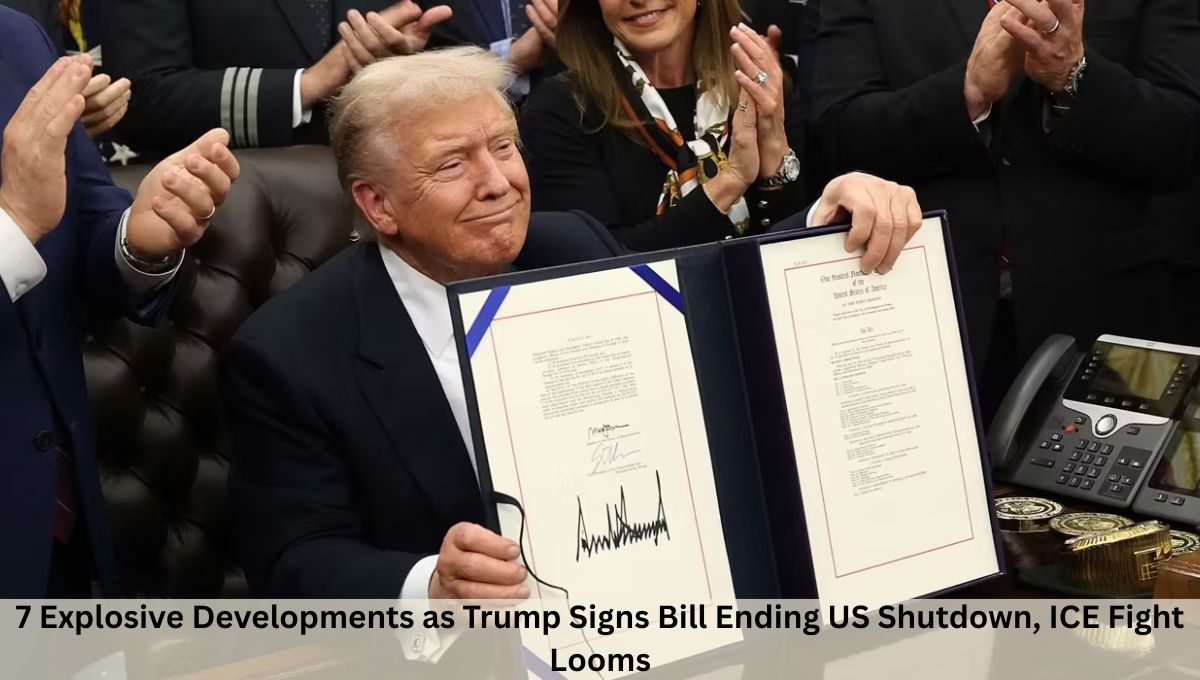
7 Explosive Developments as Trump Signs Bill Ending US Shutdown, ICE Fight Looms and Homeland Security funding remains unresolved. President Donald Trump has signed a sweeping spending bill into law, officially ending a brief but politically charged US government shutdown.
While the move restores funding for most federal agencies through the end of the fiscal year, it sets the stage for another potentially volatile confrontation in Washington — this time over immigration enforcement and the future of the Department of Homeland Security (DHS).
The legislation ends a partial shutdown that lasted only a few days, sparing the US economy from the prolonged disruption seen during last year’s record 43-day closure. However, it leaves DHS — the department overseeing Immigration and Customs Enforcement (ICE), Customs and Border Protection (CBP), FEMA, and TSA — funded for just two weeks, triggering an urgent deadline for lawmakers to reach a broader deal.
What follows is a detailed breakdown of how the shutdown ended, why immigration enforcement has become the central fault line, and what the looming DHS funding cliff means for US politics and governance.
7 Explosive Developments as Trump Signs Bill Ending US Shutdown, ICE Fight Looms
Shutdown Ends, But Only Temporarily
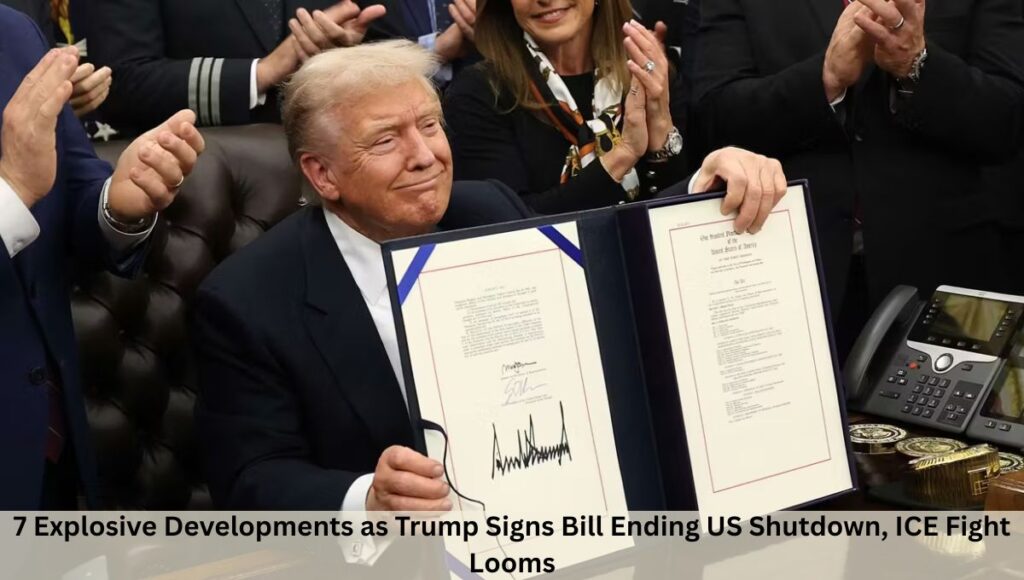
Trump signed the legislation at the White House shortly after it passed the Republican-controlled House of Representatives by a razor-thin 217–214 vote.
The Senate had cleared the measure days earlier, sending it to the president’s desk amid mounting pressure to reopen the government.
The bill restores funding for 11 of the 12 annual appropriations measures, covering roughly three-quarters of federal agencies through September 30, the end of the fiscal year.
“These funds provide certainty and stability for the American people,” Trump said at the signing ceremony, describing the package as fiscally responsible while supporting national security and essential services.
Yet despite the celebratory tone, the legislation is best understood as a temporary ceasefire, not a permanent resolution.
What the Spending Bill Covers
Agencies Fully Funded Through September
The legislation provides full-year funding for major departments, including:
- Department of Defense
- Department of Treasury
- Department of State
- Health and Human Services
- Department of Labor
- Department of Education
- Housing and Urban Development
- Transportation
The bill includes:
- A military pay raise
- New air safety investments
- Continued funding for NIH research, Pell Grants, and election security
- Slight overall reductions in federal spending levels
What Was Cut
The package significantly reduces funding for international aid programs, following the administration’s decision last year to shutter the US Agency for International Development (USAID).
Why DHS Was Left Out
The single biggest unresolved issue is the Department of Homeland Security.
Congress could not agree on full-year funding for DHS following intense national backlash over immigration enforcement operations — particularly after the fatal shootings of two US citizens, Renee Nicole Good and Alex Pretti, in Minneapolis during encounters with federal immigration agents.
Democrats refused to support long-term DHS funding without new limits on ICE and CBP operations, while Republicans resisted what they view as constraints on law enforcement authority.
The compromise:
a two-week stopgap funding extension, keeping DHS operational only until February 13.
House Speaker Mike Johnson summed up the situation bluntly:
“The real fight begins over the Homeland bill.”
ICE at the Center of a Political Firestorm
Democratic Demands
Democrats are pushing for sweeping reforms to federal immigration enforcement, including:
- Mandatory body cameras for ICE and CBP agents
- Limits on the use of masks and unmarked uniforms
- Judicial warrants before entering private homes
- Independent investigations into agent misconduct
- Restrictions on enforcement at schools, hospitals, and places of worship
House Democratic Leader Hakeem Jeffries said these measures must be part of any full-year DHS deal.
Republican Pushback
Republicans argue that ICE agents face serious threats, including doxxing and harassment, and insist that masking and anonymity are necessary for officer safety.
Speaker Johnson warned that unmasking agents could expose them and their families to retaliation, drawing a sharp line between local policing and federal immigration enforcement.
Body Cameras: First Concession Made
One key concession has already emerged.
DHS Secretary Kristi Noem announced that federal agents in Minneapolis would begin wearing body cameras immediately, with plans to expand the requirement nationwide.
The move followed widespread public outrage over the Minneapolis killings and growing bipartisan concern over accountability in immigration operations.
Still, both sides acknowledge that body cameras alone will not resolve the broader dispute.
Trump’s Role in Breaking the Deadlock
Behind the scenes, Trump played a central role in pushing the spending bill across the finish line.
Quashing a Conservative Revolt
A group of conservative House Republicans threatened to derail the bill unless it included stricter voter ID provisions, particularly the SAVE Act.
Leading the rebellion was Rep. Anna Paulina Luna of Florida, joined by other hard-right lawmakers.
Trump personally:
- Spoke with holdouts at the White House
- Made direct phone calls to wavering members
- Sent senior aides to Capitol Hill to lock down votes
In a public message, Trump warned Republicans:
“There can be NO CHANGES at this time.”
Ultimately, the conservative bloc backed down, allowing the bill to pass.
A Narrow House Majority Raises the Stakes
The episode underscored the fragility of House Republican control.
With just a 218–214 majority, Speaker Johnson can afford to lose only one Republican vote on party-line legislation.
That reality forced leadership to keep the House in session for hours as they flipped last-minute defectors and avoided procedural collapse.
The final vote saw:
- 21 Republicans voting against the bill
- 21 Democrats voting in favor
Opposition came from both ideological extremes, highlighting the unstable coalition holding the government open.
Why the Shutdown Mattered — Even Briefly
Although the shutdown lasted only days, its impact was already being felt:
- Delays to the closely watched US jobs report
- Risks to the tax filing season
- Furloughs for non-essential federal workers
- Disruptions across regulatory agencies
Economists warn that even short shutdowns erode confidence and create unnecessary volatility, especially in an already fragile global economic environment.
The memory of last year’s 43-day shutdown, which cost an estimated $11 billion, loomed large over the negotiations.
What Happens Next: A Two-Week Countdown
Lawmakers now face a compressed and politically explosive timeline.
Key Questions to Be Resolved
- Will ICE face new legal restrictions?
- Can Democrats secure enforceable guardrails on immigration operations?
- Will Republicans accept reforms without alienating their base?
- Can Trump broker another compromise — or will DHS shut down?
Failure to reach a deal would trigger a department-specific shutdown, affecting:
- TSA airport screening
- FEMA disaster response
- Border security operations
- Immigration courts and enforcement actions
Global Implications of the DHS Standoff
While the fight is rooted in US domestic politics, the consequences extend globally.
- Airport security disruptions could affect international travel
- Immigration policy shifts influence global migration patterns
- Cuts to international aid reshape US diplomatic reach
- Political instability in Washington impacts global markets
For allies and investors alike, the uncertainty surrounding US governance remains a key concern.
Conclusion: Crisis Averted — For Now
President Trump’s signature ended the immediate government shutdown, restoring stability across most of the federal system. But the relief is temporary.
With DHS funding set to expire in days, Washington is barreling toward another high-stakes showdown over immigration, law enforcement, and executive power.
Whether the next chapter brings compromise or confrontation will shape not only US domestic politics, but America’s global standing in the months ahead. For now, the government is open — but the clock is ticking.
Also Read: 7 Explosive Signals as US Parties Strike Funding Deal to Avert Shutdown
Also Read: US govt’s partial shutdown ends, Trump signs funding bill but DHS headache persists
Related Posts:
- 7 Explosive Signals as US Parties Strike Funding…
- 7 Shocking Facts About Trump’s $1 Million Gold Card…

- “Don’t Want Them To Buy Russian Oil”: Trump Urges…

- 7 Powerful New Developments in the White House Shooting Case

- 7 Explosive Shifts in Trump’s New Immigration…

- Trump’s 2025 Gaza Peace Plan Signing and Historic…
