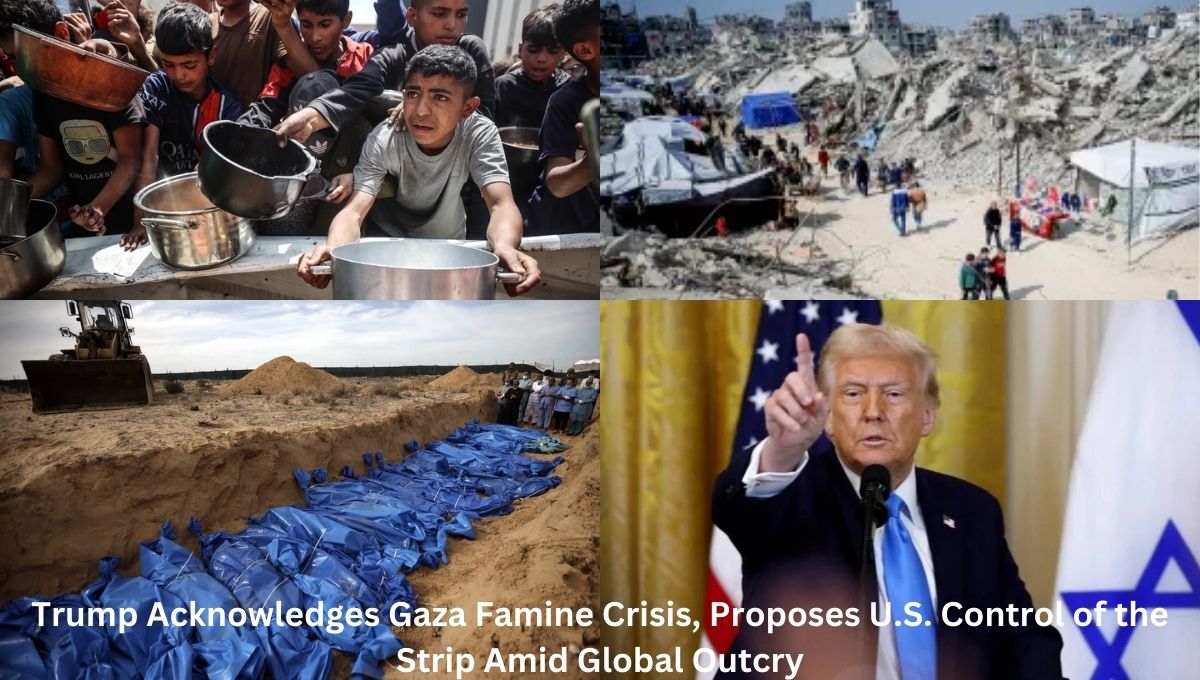
In the escalating Gaza humanitarian crisis Trump Acknowledges Gaza Famine Crisis, Proposes U.S. Control of the Strip Amid Global Outcry. Former President Donald Trump has made a rare and direct statement on the deepening Gaza humanitarian crisis, describing the situation as “painful” and pledging that the United States will “take care of the matter.”
Trump’s comments came during the final stop of his Gulf tour, pointedly excluding Israel, and amid intensified Israeli airstrikes that have killed more than 100 Palestinians in just 48 hours.
Trump Acknowledges Gaza Famine Crisis, Proposes U.S. Control of the Strip Amid Global Outcry
Trump Acknowledges Gaza Humanitarian Catastrophe
Speaking in Abu Dhabi, Trump acknowledged that “a lot of people are starving” in Gaza due to a crippling Israeli blockade now in its third month. “We’re looking at Gaza. And we’re going to get that taken care of,” he told reporters.
“A lot of good things are going to happen over the next month.” The Israeli government has not been swayed by a growing tide of international criticism over the blockade on aid reaching Gaza, now in its third month.
Famine in Gaza Reaches Catastrophic Levels
The humanitarian situation in Gaza has become increasingly dire. According to the World Food Programme, 470,000 people are currently experiencing catastrophic hunger, while nearly the entire population of over two million is facing acute food insecurity.
Aid agencies have issued alarming warnings about rising child malnutrition, with some cautioning that delays in food delivery could be fatal for tens of thousands.
Despite these warnings, Israel continues to restrict humanitarian access to the besieged enclave, citing concerns that Hamas could divert aid.
The Israeli military has instead suggested establishing military-guarded aid hubs, a plan widely condemned by humanitarian organizations as unworkable and illegal.
Tensions Between the U.S. and Israel Escalate
Trump’s decision to bypass Israel during his Gulf tour and his controversial decision to engage in direct negotiations with Hamas for the release of U.S. hostage Edan Alexander have raised eyebrows internationally and signaled growing friction between the U.S. and its key Middle East ally.
While Trump has voiced a desire to end what he called the “brutal war” in Gaza, Israeli Prime Minister Benjamin Netanyahu remains committed to a full military campaign. Netanyahu has vowed that Israel will “conquer” Gaza and continue displacing its population.
According to the Gaza Health Ministry, more than 53,000 Palestinians, the majority civilians, have been killed since Israel began its offensive following the October 2023 Hamas attack.
Trump Floats ‘Freedom Zone’ Idea in Qatar
While in Qatar, Trump made headlines by proposing that the U.S. should take control of Gaza and convert it into a “freedom zone.” He described the region as “practically destroyed” and said, “Let the United States get involved. I’d be proud to have the United States take it.”
The proposal has been met with global condemnation. Palestinian leaders and multiple Arab nations slammed the idea as a form of ethnic cleansing, while the United Nations also voiced serious concerns.
Hamas responded defiantly, declaring that Gaza is “not for sale,” and demanding the resumption of humanitarian aid as the minimum requirement for any negotiations.
Rising Civilian Death Toll in Gaza
On the ground, the Gaza airstrikes continue with devastating results. According to Gaza’s civil defense, 74 people were killed overnight on Thursday in fresh airstrikes that hit civilian areas including Jabaliya and Khan Younis.
Entire families were buried under rubble. A 57-year-old survivor, Umm Mohammed al-Tatari, recounted, “We were asleep when suddenly everything exploded around us.”
The UN Office for the Coordination of Humanitarian Affairs warned on Thursday that famine is not only possible it is becoming inevitable.
“The blockade, displacement orders, and ongoing bombardments including on tents, hospitals, and schools continue to drive mass casualties, displacement and deprivation,” said a UN statement.
Ceasefire Talks Remain Stalled
Efforts to reach a new ceasefire agreement have so far failed. While public support within Israel is reportedly growing for a pause in military operations to secure the release of remaining hostages, the Israeli leadership remains focused on military objectives.
Hamas insists that humanitarian aid access must be restored before any further negotiations take place.
In the meantime, Trump’s administration has rolled out the Gaza Humanitarian Foundation, a U.S.-backed mechanism aimed at delivering aid.
However, its effectiveness is uncertain, with Secretary of State Marco Rubio admitting that the current aid structure is flawed. “We’re open to an alternative if someone has a better one,” he said.
Conclusion: Bold Promises Amid Mounting Suffering
Trump’s comments and proposals mark a significant shift in U.S. Middle East policy. His willingness to criticize Israel and suggest American involvement in the governance of Gaza is unprecedented.
While his pledge to resolve the famine in Gaza may offer hope to some, critics argue that symbolic proposals like a “freedom zone” do little to address the immediate humanitarian needs of over two million Palestinians trapped under siege.
As the Gaza humanitarian crisis worsens by the day, the global community watches closely to see whether Trump’s promises will materialize into real solutions or remain rhetoric in a region desperate for action.
Also Read: Gaza Aid Sites Turn Deadly: Over 70 Killed, UN Warns of Famine and Breakdown of Relief
Also Read: Trump acknowledges starvation in Gaza as Israeli airstrikes kill more than 100
Related Posts:
- Trump’s 2025 Gaza Peace Plan Signing and Historic…

- 5 Powerful Highlights as Trump Lands Second Nobel…

- 9 Explosive Revelations as Trump Declares His Health…

- Trump’s 20-Point Gaza Peace Plan Gains Urgent Global…

- 7 Shocking Reasons FIFA’s Peace Prize for Trump…

- Can the EU and NATO Impose Tariffs on India and…
