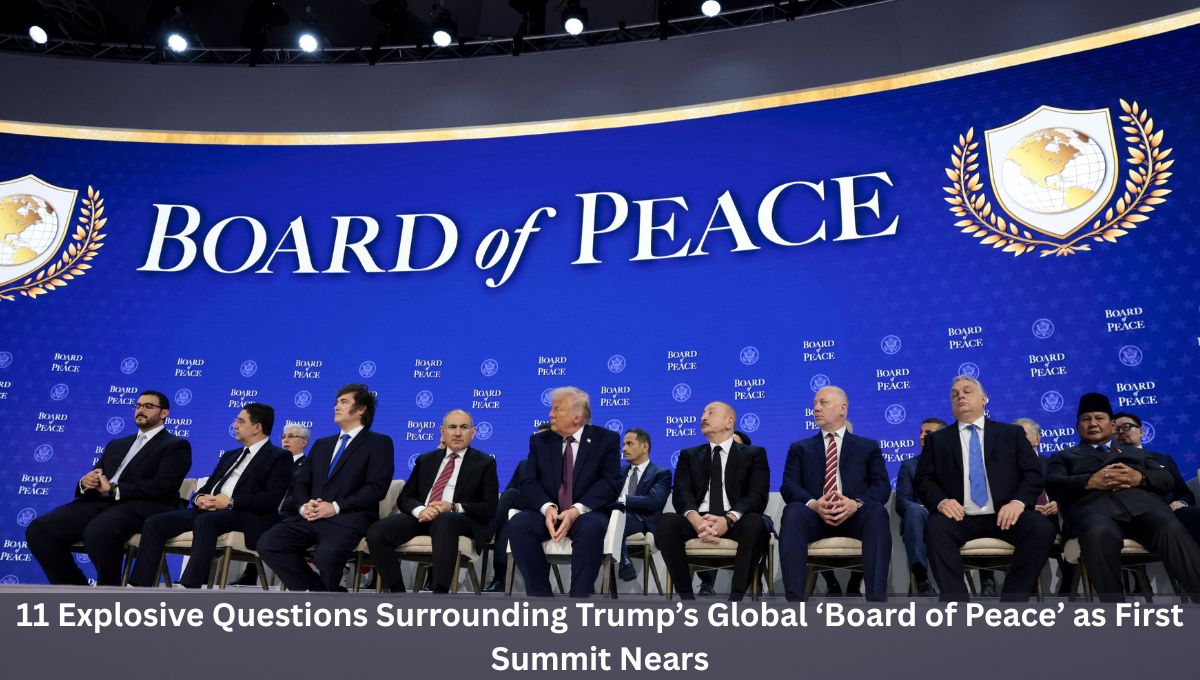
11 Explosive Questions Surrounding Trump’s Global ‘Board of Peace’ as First Summit Nears amid global scrutiny. The Trump administration is preparing to convene the inaugural meeting of its controversial “Board of Peace” on February 19 in Washington, D.C., marking the first formal gathering of a multinational body that President Donald Trump claims will help resolve conflicts worldwide.
Originally pitched as a temporary mechanism to oversee Gaza’s post-war reconstruction following the Israel–Hamas conflict, the board has rapidly evolved into a far more ambitious — and contentious — global initiative.
Its expanding mandate, governance structure, and financing model have raised serious questions among allies, diplomats, and international law experts.
The meeting, confirmed by US officials and first reported by Axios, will be held at the US Institute of Peace, which Trump controversially renamed after himself following a legal dispute with the institute’s former leadership.
11 Explosive Questions Surrounding Trump’s Global ‘Board of Peace’ as First Summit Nears
From Gaza Reconstruction to Global Conflict Resolution
When Trump unveiled the Board of Peace at the World Economic Forum in Davos in January, it was presented as a focused body tasked with managing Gaza’s reconstruction and supporting the fragile ceasefire between Israel and Hamas.
However, a draft charter circulated to invited nations reveals a dramatic shift. The document no longer references Gaza at all, instead positioning the board as a permanent institution aimed at addressing conflicts “across the world.”
Critics argue this evolution reflects Trump’s broader ambition to reshape the post–World War II global order, potentially bypassing or even rivaling established institutions such as the United Nations Security Council.
What Will Happen at the February 19 Meeting?
According to US officials, the February gathering will serve multiple purposes:
- Launch the board’s operational phase
- Discuss implementation of Phase Two of the Gaza ceasefire plan
- Raise funds for Gaza’s reconstruction
- Signal international buy-in for Trump’s peace initiative
Axios and Reuters report that the event will also function as a fundraising conference, with permanent membership reportedly requiring a $1 billion contribution.
While the White House has not officially released an agenda, officials say they expect “robust participation” — though it remains unclear which leaders will attend personally and which will send lower-level representatives.
Who Has Joined the Board of Peace So Far?
Despite skepticism from Western allies, around two dozen countries have signed on, primarily from the Middle East, South Asia, Eastern Europe, Central Asia, and Southeast Asia.
Confirmed or Reported Members Include:
- Middle East & Muslim-majority states:
United Arab Emirates, Saudi Arabia, Egypt, Qatar, Bahrain, Pakistan, Turkey, Morocco - Europe & Balkans:
Hungary, Kosovo, Albania, Bulgaria - Asia:
Kazakhstan, Mongolia, Uzbekistan, Indonesia, Vietnam - Latin America:
Argentina, Paraguay
Pakistan has confirmed it will attend the February 19 meeting after accepting Trump’s invitation in January.
Romania has received an invitation but has not yet decided, citing concerns about the charter.
Hungarian Prime Minister Viktor Orbán has confirmed he will attend.
Why Many US Allies Are Staying Away
Several traditional US allies — including France, Italy, Norway, New Zealand, and Croatia — have declined to join the board or have conditioned participation on major revisions to its charter.
Their concerns include:
- The concentration of power in Trump’s hands
- The lack of clear accountability mechanisms
- The board’s ability to override or duplicate UN functions
- Absence of Palestinian representation
Under the current charter, Trump serves both as chairman and US representative, with “exclusive authority” to create, modify, or dissolve board entities.
He can only be replaced through voluntary resignation or incapacity.
This governance model has led critics to describe the board as personalized diplomacy rather than multilateral governance.
Is the Board of Peace a Rival to the United Nations?
Perhaps the most explosive question surrounding the initiative is whether Trump intends the board to function as an alternative to the UN, particularly the Security Council.
Several diplomats privately told media outlets that the board appears designed to sidestep UN veto politics, allowing Washington and aligned states to act more decisively — but with far fewer checks and balances.
While a UN Security Council resolution adopted in November authorized cooperation with stabilization forces in Gaza, many experts argue that Trump’s board goes far beyond that mandate.
Human rights organizations have warned that overseeing a foreign territory without local representation risks replicating colonial-era governance models.
Gaza: The Board’s First Major Test
Despite its expanded global ambitions, Gaza remains the board’s most immediate and politically sensitive challenge.
The US announced the start of Phase Two of the Gaza ceasefire plan in mid-January, but major hurdles remain unresolved — particularly the demilitarization of Hamas.
Trump’s son-in-law Jared Kushner, who plays a central role in the initiative, unveiled an 11-page slide deck at Davos envisioning a dramatically transformed Gaza, featuring luxury developments and over 150 skyscrapers along the Mediterranean coast.
Kushner admitted the plan has “no Plan B”, stressing that its success depends entirely on Hamas laying down arms — a scenario many analysts view as highly uncertain.
Hamas, Militias, and the Security Vacuum
While Hamas remains armed and influential in much of Gaza, reports indicate the emergence of new militias, particularly around the Rafah crossing.
According to Israeli and Palestinian media:
- Armed groups have allegedly detained and interrogated civilians
- Some returnees report harassment, theft, and intimidation
- Patients seeking medical evacuation face long delays
This has created a troubling dilemma for Gazans: continued Hamas rule versus militia-driven lawlessness.
Historical precedents in Iraq, Yemen, Syria, and Libya suggest that empowering militias without a unified professional force often leads to instability rather than peace.
Rafah Crossing: A Symbol of Ceasefire Fragility
The partial reopening of the Rafah crossing between Gaza and Egypt was supposed to symbolize progress under Phase Two.
Instead, confusion and logistical failures have underscored the fragility of the ceasefire.
Conflicting reports over daily crossing limits, combined with security screenings and militia interference, have left thousands stranded.
For many Gazans, daily life remains largely unchanged — reinforcing skepticism toward ambitious reconstruction promises.
Israel’s Position: Quiet Resistance or Tactical Patience?
Israel has not formally signed the Board of Peace charter, despite Prime Minister Benjamin Netanyahu accepting Trump’s invitation.
Israeli officials have publicly ruled out any role for the Palestinian Authority in Gaza’s future governance, while stopping short of explicitly rejecting Hamas’s continued influence — a position that has fueled speculation about Israel’s long-term strategy.
Netanyahu is scheduled to meet Trump in Washington a day before the board meeting, though Israeli officials say Iran will dominate those talks.
Can the Board Deliver Peace — or Just Optics?
Supporters argue that the Board of Peace represents a bold, pragmatic alternative to stalled international diplomacy.
They point to the ceasefire itself, however fragile, as evidence that unconventional approaches can yield results.
Critics counter that without:
- Palestinian inclusion
- Clear legal authority
- Unified security structures
- Transparent funding mechanisms
the board risks becoming a symbolic project rather than a durable peace framework.
Why February 19 Matters
The upcoming meeting will be more than a diplomatic gathering — it will be a litmus test for Trump’s foreign policy vision.
It will reveal:
- Which countries are willing to publicly align with the initiative
- Whether funding commitments materialize
- How the board plans to confront Hamas and militia violence
- Whether Gaza’s governance vacuum can realistically be filled
For now, the Board of Peace sits at the intersection of hope, skepticism, ambition, and controversy — with Gaza’s future hanging in the balance.
Bottom Line
Trump’s Board of Peace has moved rapidly from a Gaza-specific reconstruction body to an ambitious global peace mechanism.
Whether it becomes a transformative force or a contested diplomatic experiment will depend on what follows the February 19 meeting — and whether promises translate into stability on the ground.
Also Read: 7 Explosive Fault Lines in Trump’s Global “Board of Peace” Gambit
Also Read: Trump’s Board of Peace To Hold Its First Meeting. Here’s What We Know
Related Posts:
- Trump’s 20-Point Gaza Peace Plan Gains Urgent Global…

- Trump’s 2025 Gaza Peace Plan Signing and Historic…

- Dramatic Moments Behind Trump’s Gaza Peace Push and…

- Gaza Peace Deal First Phase Achieved: Trump’s Israel…

- 7 Shocking Reasons FIFA’s Peace Prize for Trump…

- Trump’s Breakthrough Gaza Ceasefire Deal 2025: Key Insights
